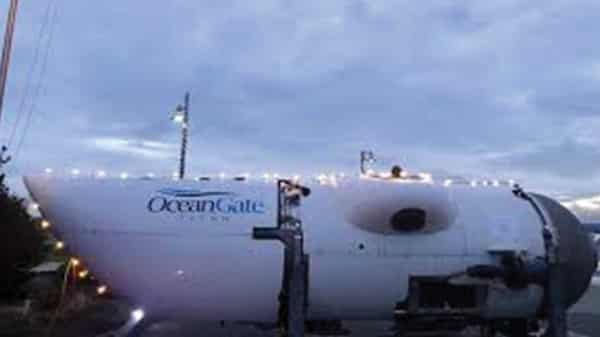
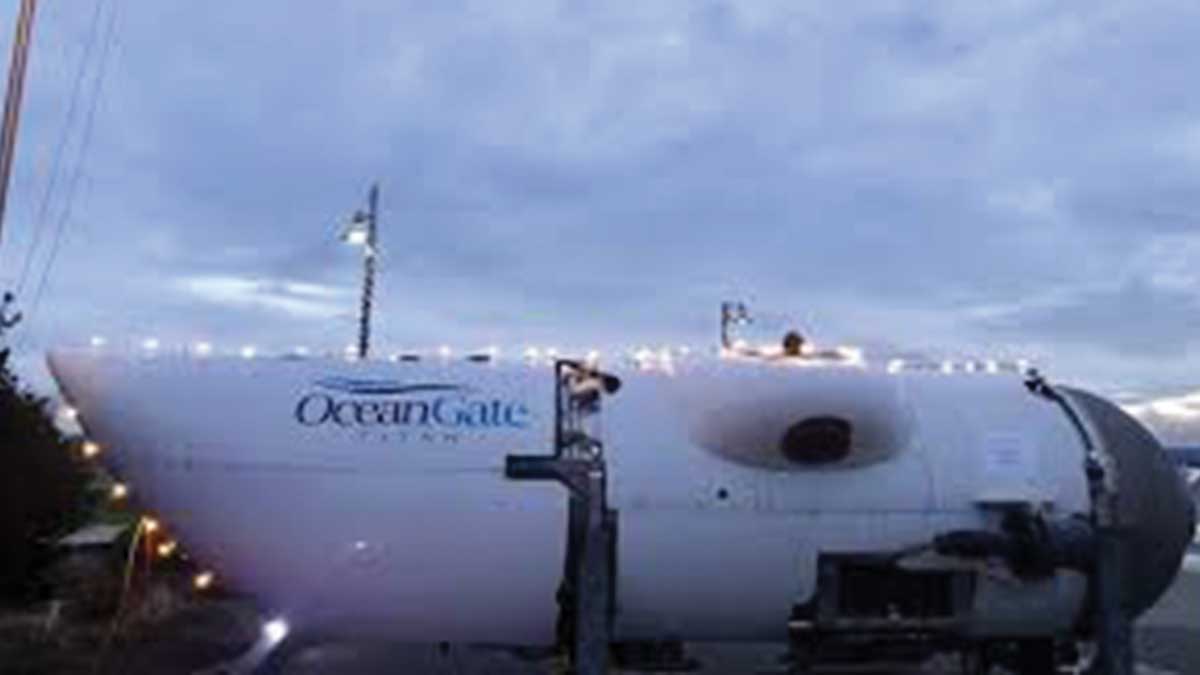
An unexpected disaster hit the world last week. It was hard and it came with speed. It was totally unexpected as the devastating Ukraine-Russian war and shooting conflict in Sudan concentrated the minds. When will mankind come to their senses destroying and polluting the world made out to them as a school for their development? Do they know the enormity of the guilt they are heaping upon themselves which they must atone for until they have washed their dirty “linen clean”? These were the kinds of thoughts that could be presumed racing through the minds in concerned gatherings, communities and nations, indeed, the world at large. And then this: Gbam, a tragic submersible implosion in which the pilot and four passengers died instantly. The renowned news agency, AP, called the incident an “international disaster.”
The destruction of the ocean vessel occurred off the United States coast on Thursday, last week. According to AP, the U.S. Coast Guard led the initial search and rescue operation. And it said on Friday that debris was found about 12,500 feet (3, 810 metres) underwater. Curiously, and if I may add, instructively “near the Titanic wreckage it was on its way to explore.” I say instructively because the vessel that imploded last week in the ocean is called Titan and the famous ship the wreckage of which it was in search of was called Titanic which sank in 1912. Was the similarity in name without signification? The Titanic on its way to New York set sail from England and it sank hit by an iceberg around the area the Titan set sail. The men involved in the catastrophic exploration were drawn from England, Pakistan, France and the United States. I will return to this point later.
The AP digital edition, apnews.com, reports the Transportation Safety Board of Canada as saying it would investigate Titan’s mother ship and support vessel called Polar Prince. During Titan’s sail, Polar Prince had on board 17 crew members and 24 passengers. It is believed that during the investigation the suspicion will come to light that the “world of deep-sea exploration is not well-regulated.” A professor who specialises in maritime history and policy at Campbell University in North Carolina, Salvatore Mercogliano, is said to have remarked that such expeditions are scrutinised less than companies that launch people into space. The Titan, it is said, ‘‘was not registered as a U.S. vessel or with international agencies that regulate safety. And it wasn’t classified by a maritime industry group that sets standards on matters such as hull construction.” Hope of finding the tragic vessel and its occupants dimmed when communication was lost with it. It was also realised that its 96-hour air supply must have run out and the Coast Guards that led the initial rescue operation reported finding debris of the submersible at estimated 1,600 feet (488 metres) from the Titanic.
The Titanic went on its maiden voyage on April 10, 1912 with 2, 240 persons—crew and passengers—on board. On April 15, just some five days after it set sail headed for New York from Southampton, England, it hit an iceberg and it broke into two and sank to the ocean bed. More than 1, 500, passengers and crew, died in the incident. The early 1900s were a flourishing era in shipping travels, the transatlantic in particular. It was competitive and exceedingly rewarding for those who invested in it, hauling profit to the bank. Because of the high demand for seats in oceanliners, two companies decided to expand their facilities. They decided to acquire three large vessels to meet the demands of the market not only in terms of expanded accommodation but in facilities—Olympic, the Titanic, and the Britannic. Britain in particular was renowned for shipping and oceanliners, not only for business but for wars. For Falkland War alone in 1982, Iron Lady, Prime Minister Margaret Thatcher dispatched 100 ships to recover Falkland Islands invaded by Argentina. The violent conflict occurred because British Authorities said the Islands were part of British overseas territories, the same territory to which Argentina was laying claim. The war lasted about two and a half months with 900 deaths, and historians said it was one of the major and devastating conflicts since World War 11.
The Titanic came out in opulence, in glittering decorations. So gigantic was it that it had four elevators. It featured big first-class dining compartments and a swimming pool. It was said of it that its second-class facilities were comparable to first-class features on other categories of ships. Such was the luxury that it was called “Millionaire’s Special,” according to the online publication, britannica.com. Third class was noted for its tastefulness and relative comfort. There was special attention paid to safety, with door facilities to contain water in the event of any issues. Indeed, it was so built that four compartments could be flooded without constituting any dangers. The facilities on offer made the world that heard about the Titanic to conclude that it was invincible, impregnable and unsinkable. It was 882.5 feet (269 metres) long, and 92.5 feet (28.2 metres) wide at the bulging side. It had capacity for 52,000 tonnes.
The ship was test run on in 1911 and before the maiden sail of April 10, 1912. When it got to France, the dock was too small to take the Titanic and passengers had to be ferried to and from the ship. After it made its last stop in Ireland, it had altogether 2,200 on board, 1,300 of whom were passengers. In the course of its journey, reports of iceberg warnings were received several times by radio operators. At a point, warning about an ice field warning sent was not received by Titanic. It soon got surrounded by iceberg and nest’s binoculars were missing. When it was hit by iceberg, five of its foolproof watertight compartments were ruptured. Distressed signals went out but the nearest help was three hours away. The ship that was in the vicinity which could come to its rescue had its wireless turned off for the night. Lifeboats were far short of what was required. Even while waiting for the few lifeboats, Titanic’s musicians were playing in the first-class lounge, before eventually moving to the deck of the ship on realising what was happening. Panic naturally ensued among the passengers; there was desperation among all on board and it became “it’s every man for himself.” In the end, the light went out and Titanic broke into two. The ship sank and many went into icy water and almost all the people died from exposure to icy water. Those in the third class suffered the most, with 710 deaths, according to reports. The last song of the musicians, it was said was: Nearer my God to Thee.
According to BBC online report, it was stated that warnings over safety of the OceanGate’s Titan submersible were repeatedly ignored by the chief executive officer of the company, “email exchanges with a leading deep sea exploration specialist show.” “In messages seen by the BBC, Rob McCallum told OceanGate CEO, Stockton Rush that he was potentially putting his clients at risk and urged him to stop using the sub until it had been certified by an independent agency.”
BBC report quotes Mr. Rush responding that he was “tired of industry players who try to use a safety argument to stop innovation.”He was said to have expressed frustration with the criticism of Titan’s safety measures. Mr. McCallum wrote: “I think you are placing yourself and your clients in a dangerous dynamic. In your race to Titanic you are mirroring that catch cry: ‘She is unsinkable.’
Mr. Rush said in the email: “We have heard the baseless cries of ‘you are going to kill someone’ way too often. I take this as a serious personal insult.’ Mr. McCallum, however, told the BBC that he “repeatedly urged the company to seek certification for the Titan before using it for commercial tours. The vessel was never certified or classed. Until a sub is classed, tested and proven it should not be used for commercial deep dive operations. I implore you to take every care in your testing and sea trials and to be very, very conservative. As much as I appreciate entrepreneurship and innovation, you are potentially putting an entire industry at risk.”
A few days later, Mr. Rush defended his business and his credentials, saying, “OceanGate’s engineering focused, innovative approach …flies in the face of the submersible orthodoxy, but that is the nature of innovation.”
Mr. McCallum was not going to give up. What was he seeing that his warning rang so loudly in the ears? What signals was he picking? He wrote once more: “It will be sea trials that determine whether the vehicle can handle what you intend to do with it so again, take care and keep safe. There is a lot more riding this than Titan and the Titanic.”
According to BBC report, Mr. Rush founded OceanGate in 2009 and “the company offered customers a chance to experience deep sea travel, including to the wreck of the Titanic, on board Titan for a price of $250,000 US Dollars (195, 600 pounds Sterling).”
Predictably, views on the catastrophic expedition will necessarily differ. A great many would see nothing wrong in the men’s spirit of adventure despite feelings of unease and prophetic warnings. Some saw it as the path to discovery. Nothing ventured, nothing gained and no progress made. No pains, no gain—as the sayings go. Mrs. Margaret Thatcher would say, “He who dares, wins.” Those were her words when she dispatched British troops to Falkland Islands in 1982, which many Britons saw as a symbol of British national pride, but which a great many with feelings would dismiss as a crime. The words of admonition have world-wide application, but the thought and act of war that triggered the pronouncement was a crime.
A young public figure friend of mine is among those who see the Titan voyage as an innovation, sad true it was. It is through such daringness the world had developed, he argues in a note to me. He wrote: “They are the men in the Arena. They tried and failed. Sadly they do not have a second chance. I am certain others will learn from their mistake, improve and succeed. That is the story of mankind. Seemingly a senseless and daring mission upon which mankind’s course was altered for good.
“Don’t cry for them. When the University of Bologna, the first and surviving university in the world, started in 1088AD it was not certified by anyone. Certification is for established systems. I went to Jamestown with my family and saw the replica of the Susa Constant, the first ship that came from England in 1607. No ship registry will flag that vessel today for human transport. The imploded Titanic submersible is a forerunner to our effort to conquer the seas, mountains, and space… We try, we fail, succeed, learn, evolve, and improve. That is the story of mankind.”
The note is persuasive, no doubt. But the issue is deeper than that. Was there any possible connection between Mr. Rush and the disaster of Titanic that sank in 1912, for example? It requires deep reflection. What was mankind to gain in a voyage to see the wreckage of Titanic that sank in 1912? And more! I will treat the subject next week.