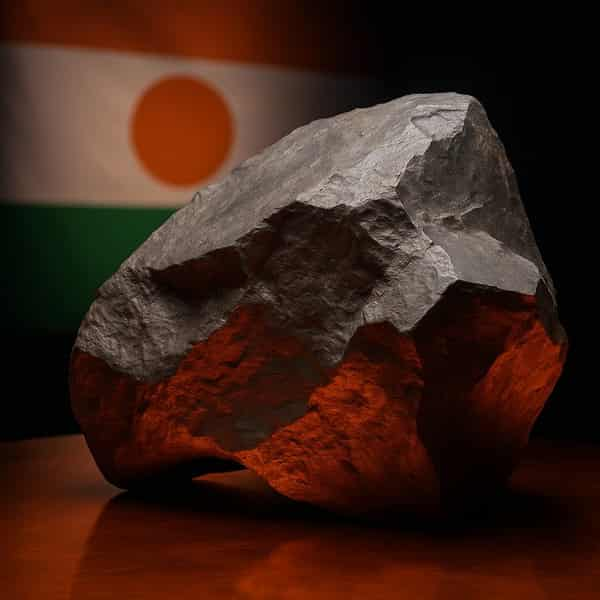
The Nigerien government has launched an investigation into the removal and sale of a Martian meteorite discovered in the country in 2023, questioning whether its export complied with international and national laws.
The rock, identified as NWA 16788, was found in November 2023 in the Agadez region of northern Niger by an unnamed meteorite hunter. Weighing 24.7 kilograms, it is considered the largest Martian fragment ever documented.
In July, the meteorite was sold at Sotheby’s in New York for $4.3 million—about $5.3 million including fees—during the auction house’s “Natural History” sale. Sotheby’s described it as “the largest Martian fragment on Earth.”
Nigerien authorities say they have no record of proceeds from the sale and suspect the export “bears all the hallmarks of illicit international trafficking.” A statement from the government said the Ministries of Mines, Security, Higher Education, and Justice are investigating “the circumstances of its discovery, export, and sale.”
“How did it end up being sold in New York?” asked Alia Baré, daughter of former Nigerien president Ibrahim Maïnassara, in an interview with Forbes Africa. “This is a crucial matter of sovereignty. This is a national treasure that shouldn’t have been sold.”
Palaeontologist Paul Sereno of the University of Chicago, who has worked extensively in Niger, told the BBC that “international law says you cannot simply take something that is important to the heritage of a country—be it cultural, physical, natural, or extraterrestrial—out of the country.” He believes the meteorite should be returned to Niger.
Sotheby’s denies any wrongdoing, stating the meteorite “was exported from Niger and transported in line with all relevant international procedures.”
A spokesperson said all documentation was “in order at each stage of its journey” and confirmed the auction house is “reviewing the information available” in light of Niger’s inquiry.
Before its sale, NWA 16788 was exhibited by a private gallery in Italy and at the Italian Space Agency. An Italian academic study detailed its composition—primarily olivine and pyroxene—and traced its origin to Mars, likely ejected millions of years ago after an asteroid impact.
The case has reignited debate over the trade in meteorites and whether private sales deprive science and the public of access to rare extraterrestrial material. “It belongs in a museum,” said Steve Brusatte, a palaeontologist at the University of Edinburgh. “It would be a shame if it disappeared into the vault of an oligarch.”
Niger currently has no specific legislation governing meteorites, but officials say the case could prompt new legal measures to safeguard the country’s geological and scientific heritage.