 Follow Us on Google News
 Follow Us on Google Discover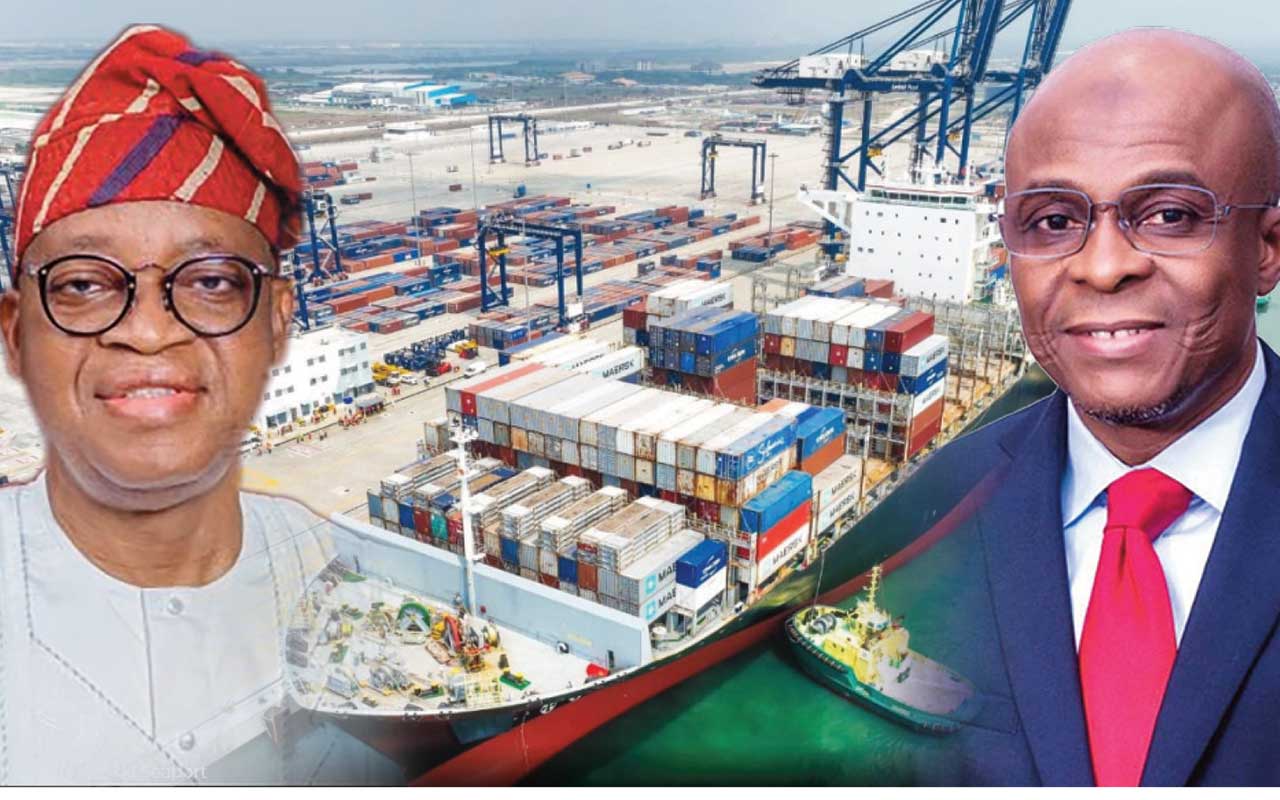
• Lekki Port operates at 20% capacity, battles weak infrastructure
• Experts urge FG to review licenses, tackle corruption
• Propose ‘Prioritisation Matrix’, maritime hubs
Nigeria’s ambition to regain its status as the leading maritime hub for West and Central Africa is faltering, with seven proposed deep-seaports stalled due to a lack of investors and an estimated $14 billion (N19 trillion) in foreign investment needed to complete them.
While the Lekki Deep Seaport is operational, the other seven, including major projects such as Badagry, Ibom, and Bonny, remain uncompleted, primarily due to investors’ concerns about the lack of guaranteed cargo and weak hinterland connectivity. This investment paralysis persisted despite neighbouring ports in Ghana, Togo, and the Benin Republic accommodating mega-ships that Nigeria’s facilities cannot handle.
Findings showed that the development of a single deep seaport costs at least $2 billion, a scale of capital beyond local financing.
According to the Managing Director of the Nigerian Ports Authority (NPA), Dr Abubakar Dantsoho, no investor is attracted to investing in the country’s deep-seaport development, especially when there are no returns on investment following the diversion of cargoes to other countries.
Additionally, their reliance on long-term capital and vulnerability to global investment trends are beyond the reach of local banks and government financing.

The NPA boss stated that it took 14 years and $1.5 billion in Chinese funding to deliver the Lekki Deep Seaport. In contrast, the Badagry Deep Seaport remained stalled after nearly 60 years of planning, with funding needs standing at $3.7 billion.
“No group of people in Nigeria can sit and give you $3.7 billion. It must come from international partnerships and private sector investors,” Dantsoho said.
While the diversion of Nigeria’s 60 per cent maritime trade of West Africa to Tema (Ghana), Lomé (Togo), Cotonou (Benin Republic), Côte d’Ivoire and Abidjan, has been a concern for investors and businesses in the country, the proliferation of abandon proposed deep seaports countrywide has, however, raised both interest and concern among maritime professionals, investors, and policy watchers.
According to industry experts, the viability of any port project extends beyond coastline availability, as it depends critically on six interlinked fundamentals. These include intermodal transport connectivity, cargo generation capacity, port governance and fees, funding and concession models, depth and maintenance dredging, as well as regional competition and transhipment potential.
However, these concerns and the inability of Nigeria to stop its cargo losses to other countries are driving investors away for fear of not getting their ROI.
The National President of the Chartered Institute of Logistics and Transport (CILT) Nigeria, Mfon Usoro, had, in a forum, revealed how the lack of guaranteed cargo had stalled foreign investment in establishing a national shipping fleet.
According to her, Singapore’s Pacific International Lines had pledged 40 per cent equity in the vessel, but demanded proof of assured cargo before committing.
She said the ability of the Federal Government agencies to generate or allocate cargo stalls the foreign investment
She lamented that a large number of Nigerian-bound cargoes are discharged at the Port of Cotonou, where there are business-friendly government policies, while Nigeria has been turned into a transhipment hub, receiving smaller vessels from neighbouring countries.
Meanwhile, Lekki deep port, projected to contribute a cumulative $200 billion to government revenue over its concession period, is operating at only 20 per cent of its projected cargo throughput, out of the 1.2 million TEUs capacity.
This was confirmed by the Minister of Marine and Blue Economy, Adegboyega Oyetola and the Deputy Managing Director of the Port, Daniel Odibe.
Regional competing ports have leverage over Nigeria’s legacy ports, including Apapa, Tincan, Onne, Warri, and Calabar, operational inefficiencies, which continue to suffer age infrastructural decay, shallow depth, and inefficient cargo evacuation corridors, leaving them operationally stressed and less competitive compared to neighbouring ports in Ghana, Togo, and the Benin Republic.
Other inefficiencies include manual terminal operations, port congestion, extra voyage time, and the dwell time of ships. Specifically, these ports have an average vessel turnaround time of seven days compared to the one to two days in developed countries, as contained in the National Policy on Marine and Blue Economy.
Findings by The Guardian revealed that the Badagry deep port project, structured in four phases, showed no significant signs of progress one year after entering its second phase – focusing on implementation and securing financial partners – despite assurances from the Lagos State Government that it would be completed by 2025.
The NPA boss admitted Nigeria lost its comparative advantage, saying: “If Badagry port had been built 16 years ago, Nigeria would have outpaced Tema and Cotonou,” adding that investment delays allowed competitors to dominate trade routes.
Other abandoned projects included the Federal $4.6 billion Ibom deep seaport project, which received the Federal Executive Council’s (FEC) $2.016 billion approval in 2020, $1.3 billion Ondo port, $462 million Bonny deep seaport, $3 billion Agge deep port and Bakassi port.
Although the President of Dangote Group, Aliko Dangote, had commenced the process to develop the Olokola deep seaport, progress remained slow.
Head of Research, Sea Empowerment and Research Centre (SEREC), Dr Eugene Nweke, said while the Lekki Deep Seaport has achieved commendable progress and is now operational, the other approved proposed deep seaport projects remain uncompleted, primarily due to funding challenges, weak hinterland connectivity, overlapping investment focus, and insufficient commercial justification.
He said the viability of deep-seaport projects depends critically on efficient road, rail, and inland waterway links, which are crucial to port success, as well as alignment with regional industrial clusters, agricultural belts, oil and gas zones, and manufacturing corridors for cargo generation capacity.
Nweke also highlighted excessive levies, opaque clearance procedures, and multiplicity of charges, which discourage shippers and investors. Viable PPP structures with transparent risk allocation attract credible investors, as well as consistent depth and minimal siltation risks.
He noted that rather than pursuing the simultaneous development of multiple deep-sea ports, Nigeria requires a Prioritisation Matrix Framework—a structured method that ranks port projects based on commercial readiness, regional demand, connectivity, environmental sustainability, and funding feasibility.
He said that a functional Prioritisation Matrix, anchored on connectivity, cargo volume, funding credibility, and specialisation potential, will enable Nigeria to build commercially viable deep-seaports, reduce redundancy, and transform idle coastal projects into profitable maritime hubs.
Nweke also highlighted the conversion of redundant deep-sea ports into Maritime Service Hubs.
“To optimise national investment and promote sustainability, some of the yet-to-be-developed deep seaport sites should be converted into floating ship repair yards, bunkering facilities, dry docks, and offshore logistics bases,” he said.
He noted that such conversions will reduce capital burden on government, promote private participation through modular PPPs, create skilled employment in shipbuilding, repair, and marine engineering and strengthen Nigeria’s role as a regional maritime service hub within the Gulf of Guinea.
Nweke also recommended adopting a Cluster-Based Port Development Strategy, such as incentivising credible investors through transparent concession frameworks, reassessing all pending deep-seaport licenses, retaining those with feasible demand, and converting the rest to alternative maritime uses.
Chief Executive Officer of the Centre for the Promotion of Private Enterprise (CPPE), Dr Muda Yusuf, cautioned against government-led financing of new ports, insisting that such capital-intensive projects are best driven by private investors.
He advised that the focus should remain on improving the viability of existing ports, such as the Lekki Deep Seaport, before expanding further.
“It doesn’t make sense for the government to keep throwing money into projects whose commercial viability is uncertain. Investors will only come when existing seaports operate efficiently and attract sufficient cargo volumes,” he said.
He urged the government to investigate and resolve issues causing persistent cargo diversion to neighbouring ports in Cotonou, Lomé, and Ghana, arguing that until those inefficiencies are addressed, Nigeria’s maritime investments will continue to underperform.
“Unless we make our ports competitive and ensure consistent cargo traffic, it will be difficult to attract credible investors into new port projects,” he stated.
The National Public Relations Officer of the Association of Registered Freight Forwarders of Nigeria (AREFFN), Taiwo Fatomilola, acknowledged that the deep seaports in Delta, Badagry, and other zones have strong commercial potential, but argued that the country’s culture of cutting corners and inflating budgets continues to hinder progress.
“Corruption is our biggest problem. Before starting any port project, there’s always a budget. However, because everyone wants to take a share, they inflate costs, delay work, and later claim there are no funds available. If Nigeria were disciplined, all those ports would be completed and functioning by now,” he stated.
Fatomilola maintained that the completion of deep seaports across various regions would stimulate trade, attract investments, and reduce the dominance of foreign ports currently handling Nigerian-bound cargo.
He, however, emphasised that achieving this requires transparency, proper policy implementation and the eradication of corruption in project execution.
The Executive Chairman and Chief Consultant of Widescope International Group/Global Transport Policy (GTP), Dr Oluwasegun Musa, emphasised that developing more ports would boost competition, attract investment and create economic opportunities across the maritime value chain.
“One good thing about the maritime business is that when you have ports, it attracts investment. People have options. Currently, congestion and high port charges in Nigeria prompt investors to shift to neighbouring countries’ ports. But with more deep-seaports, importers and exporters will find viable alternatives within Nigeria.”
Musa advised that to make the ports viable, the government must ensure strong policy frameworks backed by adequate road networks, modern infrastructure and automation in clearance processes.
He argued that increased port development would not only encourage shipping lines to designate Nigeria as a hub but also spur job creation, technical skill transfer, and foreign investment inflows, which are critical factors in reclaiming Nigeria’s maritime competitiveness in West Africa.

