 Follow Us on Google News
 Follow Us on Google Discover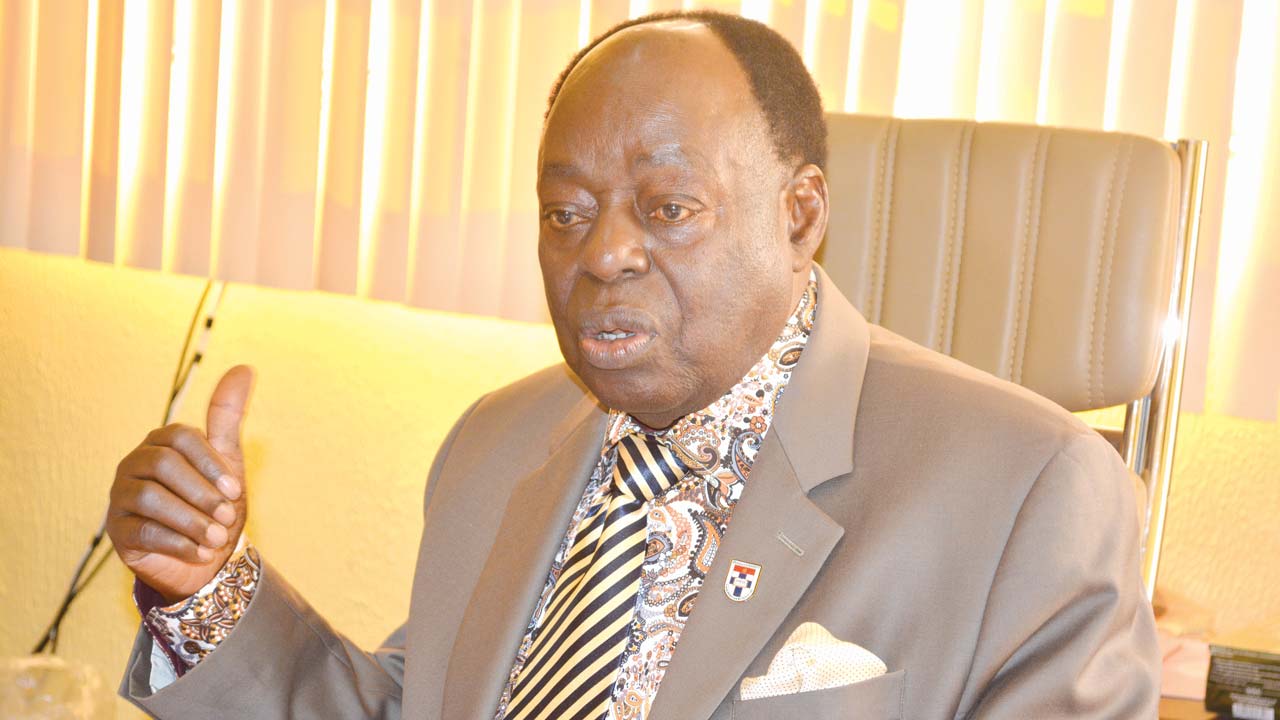
Warren Bennis, the American scholar and author once wrote: “Excellence is a better teacher than mediocrity. The lessons of the ordinary are everywhere. Truly profound and original insights are to be found only in studying the exemplary.” This is indeed the befitting epigraph for my unceasing and irreducible admiration for a truly exemplary icon: Chief Afe Babalola—vintage elder, statesman extraordinary, legal luminary, business mogul, philanthropist, educationist and nationalist. This is not my first tribute or critical engagement with this colossus, nor is it an afterthought. But I seem not to have exhausted the stock of my critical admiration for what his figure or personality means for our cultural, social and political understanding.
In this piece, I attempt to articulate his larger-than-life persona in the mold of a legend; the type of legendary figure that a D. O. Fagunwa would write about—a personality that embodies the very best in the Yoruba understanding of not just an omoluwabi but also a cornerstone of communal progress. Indeed, Papa Afe Babalola has the very image in the Yorubaland that can be likened to those of the Biblical patriarchs, like Abraham, Isaac and Jacob—those who embodied the very essence of cultural and spiritual memories about Israel’s relationship with God and with its people.
I am more than a casual observer of such institutional, cultural and national memories. My personal and professional maturation and experiences have brought me thus far in my attempt to connect with Nigeria’s ongoing project of nation-building. Since my brush with Nigeria’s early and violent attempt at political order and my subsequent grounding in the theoretical frameworks of political theory and analysis, I have ever since been investigating the political and institutional dynamics of the Nigerian state that could make it the centerpiece of democratic governance and infrastructural development for Nigerians. It was Providence that later brought me in contact with national avatars like Chief Obafemi Awolowo, Chief Simeon Adebo, Chief Olusegun Obasanjo, Prof. Ojetunji Aboyade, Chief Afe Babalola, and with President Bola Ahmed Tinubu, among a host of many others who personify the generational strategic capital by which we could begin to understand the way forward for Nigeria.
A while ago, the Nigerian public woke up to the escalation of what had been a simmering hostility between Mr. Dele Farotimi and Chief Afe Babalola. It was a crucial issue that had to do with Nigeria’s dysfunctional justice system and the administration of that justice. I had intervened in that dispute compelled by the imperatives of my ideological standpoint as a public service institutional reformer. A significant plank in my reform philosophy is the interconnected relationship among all institutional frameworks in the public service. It therefore became necessary to use the conflict between the two stakeholders in the justice system to ventilate a larger philosophical point. And Plato’s philosophical contention with the judicial murder of Socrates his teacher by the ancient Athenian society provides a very significant analogy and framework that hold lots of implications for Nigeria’s postcolonial predicaments. Plato used the incidence of Socrates’ death as the opportunity to ventilate an entire reformist philosophy that borders on the political health and order of the Republic—and the nature of justice itself.
The altercation between Mr. Dele Farotimi and Chief Afe Babalola, therefore, has a deeper root that goes beyond the mere maladministration of justice in the Nigeria judicial system. I have often traced it to the importation of a series of colonial structures—Peter Ekeh’s migrated structures—that lack the appropriate institutional wherewithal and value-bases that square with the sociology of Africa’s sociocultural and political processes. Hence the reason why these structures lack the soul to uphold the search for justice, and have rather become the instruments for political opportunism in the hands of unscrupulous elements that constitute the establishment, in the pursuit of anything but elite nationalism. It is within this deep dysfunctional context that we can appropriately situate the conflict between two people who love Nigeria beyond mere words.
Indeed, it is paradoxically within this dysfunctional context that we can situate the larger-than-life essence of Chief Afe Babalola—his stature, accomplishments and legacies. I mean to say that Baba Babablola’s larger-than-life stature cannot be understood except within the dynamics of a crippling and disenabling sociocultural and national circumstances that would ordinarily have dissuade so many who had the means to look elsewhere for habitation. Indeed, there were and are still many who do not have the temerity to dare make Nigeria a part of their existential struggles and the context of their possible achievements. This is exactly what Afe Babalola did. He stayed with Nigeria. He built his life and his career and his achievements within the context of a space that had undermined the aspirations of many. I need to pause a bit and ground this particular point.

Existential anxieties happen to all humans wherever they might find themselves. And it has nothing to do with whether one is rich or poor, an elite or a commoner. Being human is the very source of existential crises. And such crises are mediated or aggravated by the context where a human person finds herself. Nigeria’s postcolonial context is a whirlpool of existential challenges all by itself. I do not need to deploy a range of gloomy statistics to outline the claim about human suffering in Nigeria. And yet, this is the context that a lot of heroic figures have intentionally committed themselves to. This is the very context they have wrestled with, and made their lifelong concern in a feat of patriotic struggles that would not have made any sense to just anyone. This is the very basis of elite nationalism.
Winston Churchill once said this about the British Royal Airforce during the Second World War: “Never in the field of human conflict was so much owed by so many to so few.” This is the grounding for elite nationalism that is rooted in the willingness of such a few open-minded and dogged few to keep pushing the boundaries of national integration, excellence and unity. If these few were to abandon the country, any country, that would be the end of any future possibilities for such a country. It is still saying the same thing if such elites were to be wrong-headed about the decision-making framework that serves as the difference between national prosperity or national poverty.
To be continued tomorrow.
Olaopa is chairman, Federal Civil Service Commission and Professor of Public Administration.

