GDN SIDEBAR
A father’s search for connection through music is evolving into a broader exploration of NeuroArts, sensory wellness and how sound can be experienced beyond entertainment.
When GRAMMY-nominated recording artist Chris Redding began making music with his nonverbal autistic son, Christian, he wasn’t trying to start a movement. He was trying to connect with his child.
That relationship changed the way Redding thought about music.
Instead of focusing only on songs, lyrics and traditional performance, he became increasingly interested in how Christian responded to sound, rhythm, repetition, frequency and musical environments—and how communication could happen without spoken language.
That journey eventually helped inspire The Colors In My Mind, Redding’s Grammy-nominated project featuring Christian and recognised as the first Grammy-nominated album to feature a non-speaking autistic individual.
Now, Redding is continuing the story with Unspoken Psalms, a seven-track instrumental album built around stillness, reflection and communication without words.

The project has appeared on Amazon’s New Age Best Sellers chart and features an international group of musicians including GRAMMY Award-winning Japanese artist Masa Takumi, pianist Vivian Fang Liu, Ukrainian violinist Assia Ahhatt, King Moore, GRAMMY-winning producer Al Walser and Brazilian producer DNNYs Lima.
For Redding, however, the bigger story is what is happening beyond the album.
From Music to NeuroArts and Wellness
Redding is using his experience with Christian to explore the emerging field of NeuroArts—the study and application of how arts experiences can intersect with the brain, body and well-being.
His music incorporates meditative arrangements, atmospheric instrumentation and intentional sonic elements, including compositions tuned around frequencies such as 528 Hz.
Redding’s catalogue has also expanded into wellness and fitness environments, with music appearing on platforms including Peloton and UFC Ultimate Sound.
His collaboration with Unyte Health has taken the work further into sensory and therapeutic listening environments. Redding’s music has been incorporated into Unyte’s listening ecosystem, which includes the Safe and Sound Protocol (SSP), a listening-based intervention that uses specially filtered music.
Redding does not present his music as medical treatment. Instead, he sees the work as part of a broader question: What changes when society begins thinking about music not only as entertainment, but also as a tool for connection, sensory experience and well-being?
“Christian changed my understanding of what music could be,” Redding says. “I started this journey trying to find another way to communicate with my son. It made me realise that listening, expression and connection don’t always require words.”
Creating Sensory Experiences for Children
Redding is now taking those ideas beyond recordings and into live environments.
His sensory-focused programs for children and families combine live music, movement, guided relaxation and interactive musical experiences, giving participants multiple ways to engage rather than expecting every child to experience a performance in the same way.
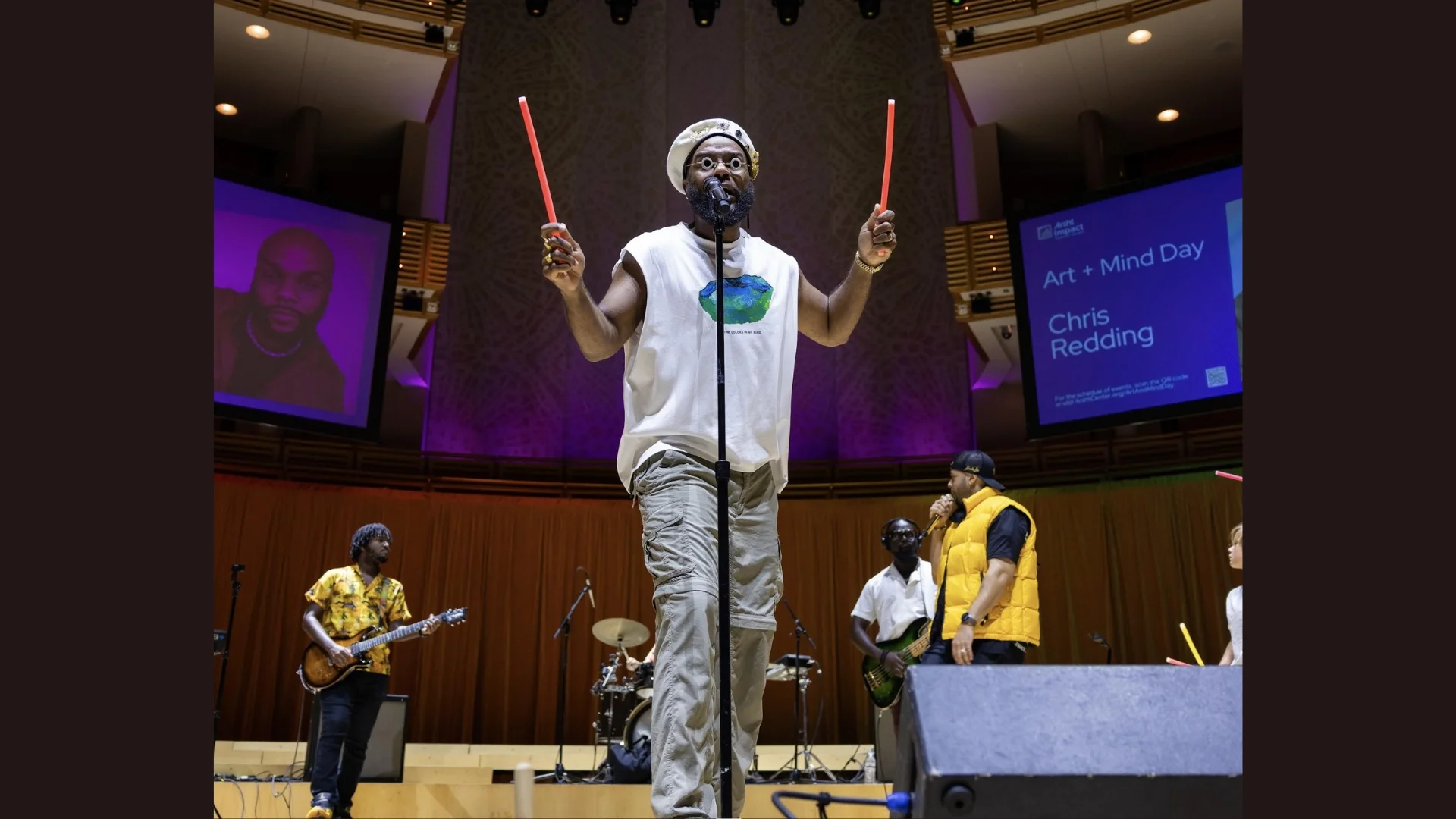
In August, Redding presented that programming at Miami’s Adrienne Arsht Center for the Performing Arts during its Art + Mind Day.
His appearances included Medicinal Music, Sound Healing and Joy Jam, bringing sensory-conscious programming into one of Florida’s major performing arts institutions.
The goal is larger than a concert.
Redding wants to explore how performing arts centres, schools, universities, wellness organisations and other public spaces can incorporate sensory-conscious experiences that recognise the different ways people process sound and their environments.
The Son at the Centre of the Story
Despite the GRAMMY nomination, chart recognition and expansion into wellness platforms, Redding says the work continues to return to Christian.
The experience of raising a non-speaking autistic child challenged his assumptions about what communication should look and sound like. Music became one of the places where father and son could meet without requiring words.

That experience now sits at the centre of Redding’s work in NeuroArts, neurodiversity and sensory wellness.
His career has since received recognition, including inclusion in the U.S. Congressional Record, Billboard chart success, and the UF Health Shands Music Meets Medicine Impact Award.
But Unspoken Psalms brings the story back to where it began.
It is an album without lyrics, inspired by a relationship in which words were never the only language.
For Redding, the question behind the project is simple:
If music helped a father find another way to connect with his son, where else could that idea lead?