

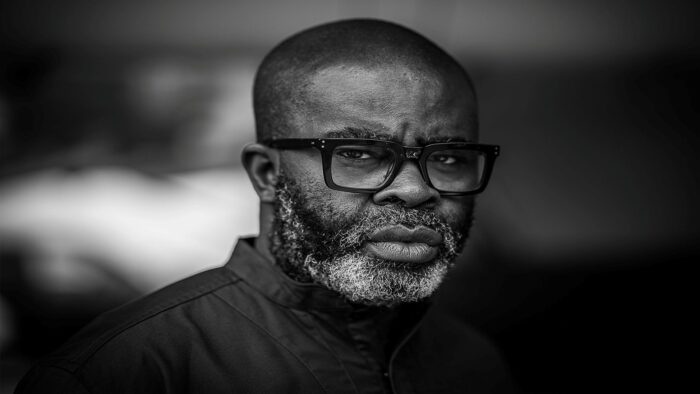
Misan Harriman is a Nigerian-born photographer, filmmaker, entrepreneur and social activist who built a career around using his camera to document humanity, protest and social change. A self-taught photographer, he became the first Black photographer to shoot the cover of British Vogue’s September issue and has documented major social and cultural moments around the world. He is also Chair of the Southbank Centre in London and an ambassador for Save the Children. His work has taken him to communities affected by conflict, hunger and displacement, including Somalia, Somaliland and Egypt, where he has used photography and advocacy to amplify the voices and experiences of children. Currently in Nigeria supporting Save the Children’s efforts to reach children who have received no routine vaccinations, in this interview held at Federal Palace Resort, he discusses why immunisation became a cause he could not ignore, the barriers Nigerian families face, and why he believes Nigerians can mobilise their collective resources to protect vulnerable children.
You have been involved in social activism for several years. What drew you to Save the Children’s work in Nigeria?
For me, as a Nigerian with a platform, it is important to use it for good not just outside Nigeria but in Nigeria. Over the last few years, I have had numerous projects with Save the Children in Nigeria. My team has just returned from Borno State, and my focus is on the work we are doing to make sure there are no zero-dose children in Nigeria. By zero-dose, I mean children who have received no vaccinations. That means their early life can potentially become a death sentence from diseases such as diphtheria, pneumonia and measles. All of these can be fatal, and there is no reason why they should be.
So, I am trying to make sure these children can go to the nearest primary healthcare facility and receive free vaccines. Any mother or father with a child within the appropriate age range should be able to give that child the same chance my children have the chance to live a healthy life and grow well. That is the very least I can do as someone with a platform and as someone who was born in Nigeria. How can I not help the vulnerable?
Why did immunisation become such an important cause for you?
There are many things wrong with all countries, but when you know the medicine exists and that children will die without it, how can you sit there knowing that children can live and that the medicine exists? That is why I chose it. The solution to the problem already exists. It is about distribution and resources. When you see that and ignore it, you have to live with that. I couldn’t live with myself knowing that I had the ability to do something about it.
From your recent interactions with families, what do you see as some of the biggest barriers to accessing healthcare?

There are a lot of cultural and economic issues. Some of the mothers I spoke to in Ikorodu, where I spent time recently, explained that sometimes their husbands do not want to spend money on transportation because the cost of living is so high. That money could become another meal for the whole family. People sometimes prioritise what seems immediately urgent without necessarily understanding that their child could become very sick without vaccination. Education is also important. We need to help mothers know where their nearest primary healthcare facility is. In some places, it is quite far, and even if you have transport, getting there can be difficult. One of the women who came had triplets. She came with her grandmother, and they walked. When you see that level of effort, you realise that these mothers want to protect their children. It is a natural instinct, so how can we not also help facilitate that and make it easier for them?
What can Nigerians do to support the work?
Save the Children Nigeria has channels through which people can donate directly to the projects we are doing. I would encourage people to support the work. You can go through Save the Children’s platforms and donate directly to the Nigerian projects. Every contribution helps because it goes towards supporting these children.
You have described this as an ongoing project. What have you seen on the ground?
This is ongoing. I happen to be here now, but this is not a one-off project. I came to oversee the work and make sure everything had been implemented, and I was really blown away. About 90 per cent of the people I met were home-grown Nigerians. They know the area and understand the cultural nuances. It is amazing to see how effective the work can be when people understand the context. We are not asking for somebody to come and save us. We are doing our own work, saving our own children, and it is really important to understand the context of this work.
What are the biggest limitations?
Resources. There are 2.1 million zero-dose children, so that is a huge challenge. The more resources we have, the more children we can reach and save. It is as simple as that.
Vaccine hesitancy remains an issue in some communities. How do you approach those concerns?
We speak to people respectfully and provide information. We show them historically how medicine has changed lives.
Before penicillin was invented, people were scared of it. Imagine a world without penicillin. Medicine works. It is as simple as that, especially when children are far more vulnerable. As an adult, if you want to make decisions about your own healthcare, that is your choice. But when a child gets measles, can you ignore medicine? You have to ask yourself: are you going to sit and pray and hope your child gets better, or are you going to give that child the medicine that could save his or her life? To me, that is an easy choice.
What has been the most rewarding part of this work for you?
I am just really proud of everyone I have seen working in humanitarian and primary healthcare services in Nigeria. They are dedicated men and women. They care about children. We are dealing with children and, usually, mothers as well, and there are a lot of people dedicating their lives to this. Let’s support them and recruit more people like them in every state in Nigeria. Let’s expand the work. I won’t rest until there are no zero-dose children in this country.
Do you see the government as an important partner in achieving that goal?
If the government wants to participate, that is fine. Save the Children is a global humanitarian organisation, and I am its global ambassador. I look at many projects around the world. I was recently in Somaliland and in Cairo, helping Palestinian children in Egypt. There are many projects I get involved in, but as a Nigerian, I take particular pride in the work we do in Nigeria. So, if the government wants to participate, I am sure we can work with them. But I am focused on fundraising from Nigerians, both in the country and in the diaspora. We can do this ourselves.
Having worked with children in different parts of the world, what has that experience taught you about Nigerians and our responsibility to one another?
I think Nigerians are very aware of how we can make a difference. Before we were colonised, all the tribes and villages knew how to look after their sick and protect their children. It is actually in our bones. Something happened after colonisation, where we became more individualistic capitalism, protecting my own family and that is all I care about. But something is beginning to change. We are going back to a better way of living. Think of all the money we spend on Detty December and what that means in Lagos. Imagine if some of that was spent on children who have a chance of living or dying. Tell me what you would rather be doing. I think people are beginning to grow in what they see as their value system. At the end of the day, we all die. From the people I have met in their final days, they never talk about how much they have. They talk about who they helped and what they did in this life. So, let’s continue to move in that direction.
Your photography is another powerful part of your activism. What role does it play in telling these stories?
I photograph these stories, and I will be releasing some of the images soon. I have released work before, usually with magazines, newspapers or Save the Children. For me, photography is about truth. There is no small talk in black and white. If you look at history books and some of the most important photographs of all time, many of them are black and white for a reason. I love it. I was inspired by photographers I saw when I was a child, images of Martin Luther King Jr., Malcolm X and so many others. Those are the shoulders I stand on. Gordon Parks and his civil rights photography. Peter Magubane’s photography during the apartheid movement in South Africa. Much of that work was in black and white. I guess my eyes see things in monochrome.
Your decision to remain committed to black-and-white photography has become part of your visual identity. What keeps you committed to it?
My work is not about being accepted, it is about truth. If you’re a real artist, you don’t care about acceptance. You care about truth. That is why I do what I do. I have no interest in who accepts me. I have every interest in making people see the truth of the human condition through my lens. That is possibly why so many people around the world have responded to my work. Whether it is the #EndSARS protests I photographed, work in Johannesburg and Minnesota with George Floyd’s family, Black children, children with Down syndrome or my sister, people respond to the images. Sometimes people cry when they see my photographs. As a photographer, you have to search for truth. That is why I don’t use Photoshop. I don’t retouch. I don’t use lighting or flash. I have my camera. That’s it. I’m not a wedding photographer. I document the human condition. I have my camera, my eye and my heart. That’s all I need.
What do you hope people see when they look at your photographs?
I think humans are still humans. We can be good and bad. We can be kind, and people are simply trying to figure out life. The mothers I met just a few days ago are just the same as you and me. They are trying to figure out life. If my images can humanise them and remind everyone that we are all the same that no one is better than anyone else then that is important to me.
