 Follow Us on Google News
 Follow Us on Google Discover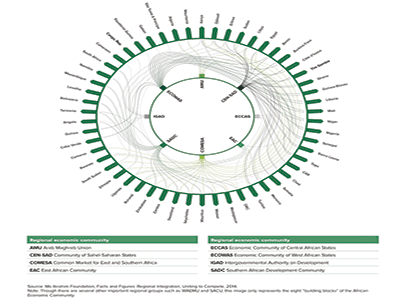
 Less than a year to the 2017 establishment of a Continental Free Trade Area (CFTA) in Africa, transforming the structure of many African economies, through accelerated industrial development and creation of supply and value chain linkages across the continent has become extremely important, if any contribution would be made to global value chains. While three Regional Economic Communities (RECs) have sealed a pact to address red tapes, the ECOWAS corridor remains bland. Can an integrated ECOWAS enjoy the benefit of the CFTA despite lingering challenges? FEMI ADEKOYA writes.
Many African countries rely disproportionately on exports of traditional cash crops and other natural resources. While some are preaching diversification and doing less of it, others are relying on Aids and other developed economies for sustenance.
For the Economic Commission for Africa (ECA), the African Development Bank (AfDB) and the African Union Commission (AUC), transforming the structure of many African economies through accelerated industrial development and by creating supply and value chain linkages across the continent is the way to go.
To experts at Brookings’ African Growth Initiative, one popular approach to remedy reliance on exports of raw goods has been to discourage the exports of raw materials or primary commodities, and to promote domestic processing of those products before exporting them instead.
According to them, such value addition would presumably help create higher productivity jobs, energize local economic activity, and improve trade imbalances by providing more foreign exchange.
More recently, another approach has attracted the attention of policymakers and policy analysts, says a Lecturer, Department of Economics, George Washington University, Soamiely Andriamananjara.
“It is to encourage African firms to integrate into the so-called global value chains—in which each participating producer focuses and specializes in particular tasks or activities. Participation in global value chains is expected to accelerate African economic transformation by encouraging technological transfer, fostering new economic activities, enhancing productivity, and promoting skills development”, Andriamananjara. noted.
hile both approaches entail export diversification and a move into higher-value activities to seize a larger share of value in global markets—a massive effort, to successfully add value to their exports or to effectively participate in a given global value chain, African firms need to deliver higher-quality products at competitive prices and satisfy rigorous norms and standards set out by their trading partners.
For many African firms, these tasks could be too challenging and may not fall within their capacity, at least in the short to medium run.
To overcome the rigorous norms and standards by trading partners, the President of African Organisation for Standardisation (ARSO), Dr. Joseph Odumodu, who is also the Director-General of Standards Organization of Nigeria (SON), noted that by 2017, the African standardisation mechanism should be able to deliver a benchmark that would be acceptable to all in the continent.
Odumodu explained that continental trade deal can only become achievable if standards issue is addressed as well as other bilateral trade agreement concerns, adding that African countries need quality infrastructure to kick-start the CFTA.
“The Continental Free Trade Area means that Africa will become one common market, just like the European Union markets. We will collapse all boundaries, depending on what the African Union Heads of State agree. We may not apply any kind of tariffs because we need to break down the tariffs that are barriers to trade seamlessly with each other. In doing that, we must ensure that we have all attained a comfortable level of development in terms of quality infrastructure.
“These circumstances help to explain why agricultural development is such a powerful tool for reducing poverty in Africa and eliciting economic development,” the ARSO boss explained.
Already, three Regional Economic Communities (RECs)—the Common Market for Eastern and Southern Africa (COMESA), East African Community (EAC) and Southern African Development Community (SADC)—have reached an agreement to expedite the process towards the operationalization of the tripartite Free Trade Area by finalising outstanding issues.
With this development, the three regions have made a bold move to realise the African Union (AU) 2017 target ahead of the Economic Community of West African States (ECOWAS) region, which is still bedevilled by other trade issues.
Indeed, the tripartite agreement would see the establishment of a single market for the 26 African countries in the Eastern and Southern African Region, while outstanding issues like the elimination of import duties, trade remedies and rules of origin, as well as the commencement of Phase II negotiations covering trade in services, cooperation in trade and development, competition policy, intellectual property rights and cross border investments would be addressed under the outstanding issues.
Already, the United States and 11 other countries in October, 2015, announced the largest trade-liberalizing pact called the Trans-Pacific Partnership—an “ambitious” and “challenging” negotiation that will cut red tape globally and “set the rules for the 21st century for trade”.
For the TPP, it is believed that the deal could reshape industries and influence everything from the price of cheese to the cost of cancer treatments, while it is expected to set common standards for 40% of the world’s economy.
“A third approach may be more pragmatic. Integrating into regional (instead of global) value chains can help generate economic gains in short run and facilitate the integration of African production into global value chains in the long run.
“ By providing African firms access to the dynamic but more easily accessible African markets, regional integration offers a space for “learning to compete” and for “self discovery” to many firms and prepares them for the greater rigor and competition in global value chains. With fewer players, the competitive pressures on the regional value chains are likely to be lower than on the global chains. Also, domestic small and medium enterprises are more likely to succeed in regional markets first, where they are more familiar with the buyers’ tastes and the standard requirements.
“Many of the smaller economies with low levels of industrial development will benefit from stronger links with larger regional partners before trying to capture larger global markets”, Andriamananjara, expert at African Growth Initiative explained.
For instance, a United States Department of Agriculture (USDA) review of the agricultural situation in Benin, showed that “Benin serves as a delivery corridor for West Africa, reaching more than 100 million people in the landlocked countries of Niger, Mali, Burkina Faso, Chad and the Northern states of Nigeria.”
Already, a conservative figure estimates that there are over 3,000 entry points into the country from the neighbouring countries such as Benin, Niger, Cameroun, Chad and Gabon, among others.
The USDA observed, “Benin’s relatively efficient port services and liberal trade policies mean it is an important cog in the regional trade flows to nearby countries.”
The report noted that improvements in the country’s port operations as well as some small improvements in the ease of doing business over the past three years aided the flow of imports in the country.
“Informal trade between Nigeria and Benin is substantial.” The main products involved in this informal trade include rice, poultry products, refined sugar and a range of other food and agricultural products”, the report added.
“Accelerating the ongoing negotiations, harmonization, and implementation of various African regional trade agreements (including the Tripartite FTA and the Continental FTA) in 2016 would greatly help African economies reduce their reliance on raw material or primary commodity exports and develop a greater capacity to compete on a global scale. More importantly, it will help them capture larger value from the global market place and efficiently participate in global value chains”, Andriamananjara added.

