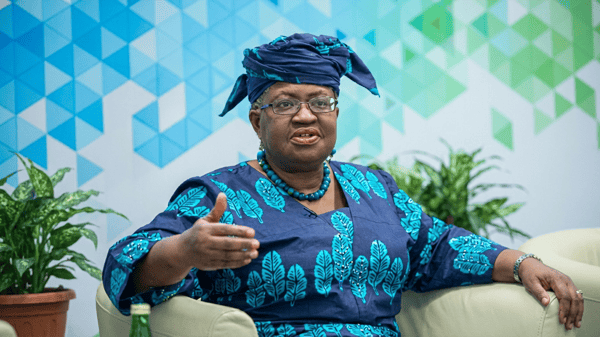
The Director-General of the World Trade Organisation (WTO), Dr Ngozi Okonjo-Iweala, has warned that developing economies can no longer afford to treat services trade as a secondary concern, insisting that any country that sidelines the sector risks undermining its growth trajectory.
Speaking yesterday at the opening of the two-day Trade in Services for Development Conference in Geneva, Okonjo-Iweala underscored the scale of the global shift toward services, noting that the sector now accounts for more than two-thirds of global GDP, over half of all employment and more than half of world trade in value-added terms.
She revealed fresh projections showing that global commercial services trade would expand by 4.6 per cent this year and 4.4 per cent in 2026—far outpacing merchandise trade, which is expected to grow by only 2.4 per cent this year and a modest 0.5 per cent next year.
Digitally delivered services, she added, are set to grow even faster at 6.1 per cent in 2025 and 5.6 per cent in 2026.
“Services are not only the economy of the future; services are the economy of today. Services trade is development in action. It is income, it is dignity, and it is empowerment—particularly for young people and for women,” the WTO DG said.
Nigeria’s Minister of Industry, Trade and Investment, Dr Jumoke Oduwole, who delivered a keynote, painted a stark picture of Africa’s marginal role in global services trade.
Despite services contributing 55 per cent of the continent’s GDP, Africa commands just two per cent of global services trade value, she said.
“May I be so bold as to say that the economic development of any country can be measured by the robustness of its services sector and its levels of trade in services,” Oduwole said.
She recalled how Africa’s services exports, which had doubled from $62 billion in 2005 to $124 billion in 2019, collapsed to $82.7 billion in 2020 as the COVID-19 pandemic ravaged travel and tourism—the pillars of many African economies. Although the sector has rebounded to $150 billion in 2023, she warned that Africa still occupies “the lower rung of the global services value chain.”
Nigeria mirrors this imbalance. While services contribute 58 per cent of national GDP and over 45 per cent of formal employment, they make up less than 10 per cent of the country’s export basket—an imbalance Oduwole described as a critical development challenge.
Both Okonjo-Iweala and Oduwole identified regulatory barriers as a central constraint to the expansion of services trade.
According to the WTO chief, services trade “does not attract the level of policy attention its economic importance warrants,” due partly to the intangible nature of services, their multiple modes of supply and their exposure to heavier regulatory scrutiny.