GDN SIDEBAR
There is a particular posture that has become increasingly familiar in Abuja’s informal fashion economy. A shopper bends down. The hands sift through a pile of trousers, shirts, dresses or leggings. One piece comes out. The fabric, label, stitching, colour and perhaps a small stain around the collar are inspected. It goes back into the pile. Another comes out. The search continues.
“Bend down, select.” “Okirika.” What was once largely associated with roadside second-hand clothing has become a full-fledged retail culture in Abuja, driven by a simple economic reality, people still want to look good, but the money available to achieve it is increasingly limited.
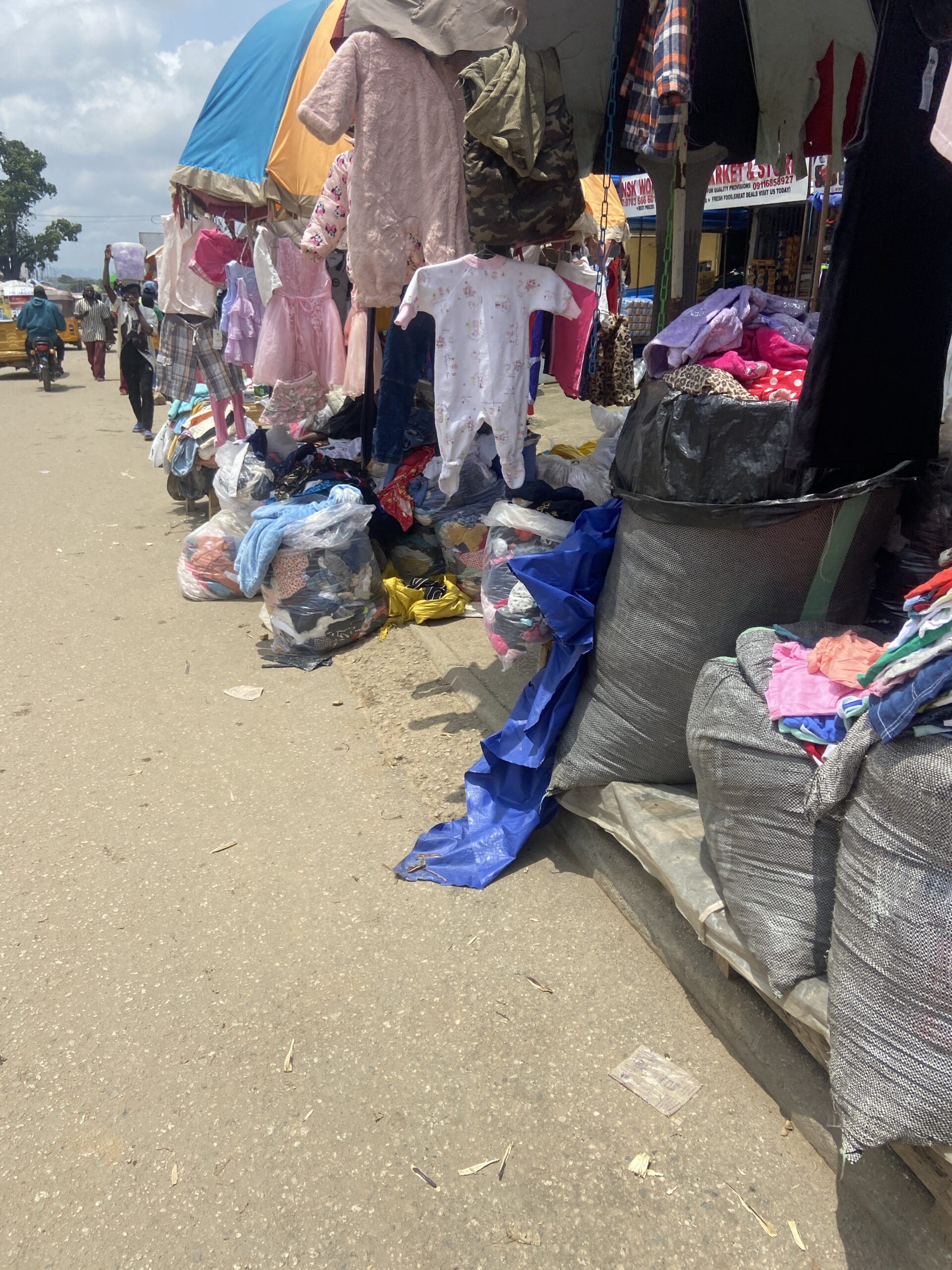
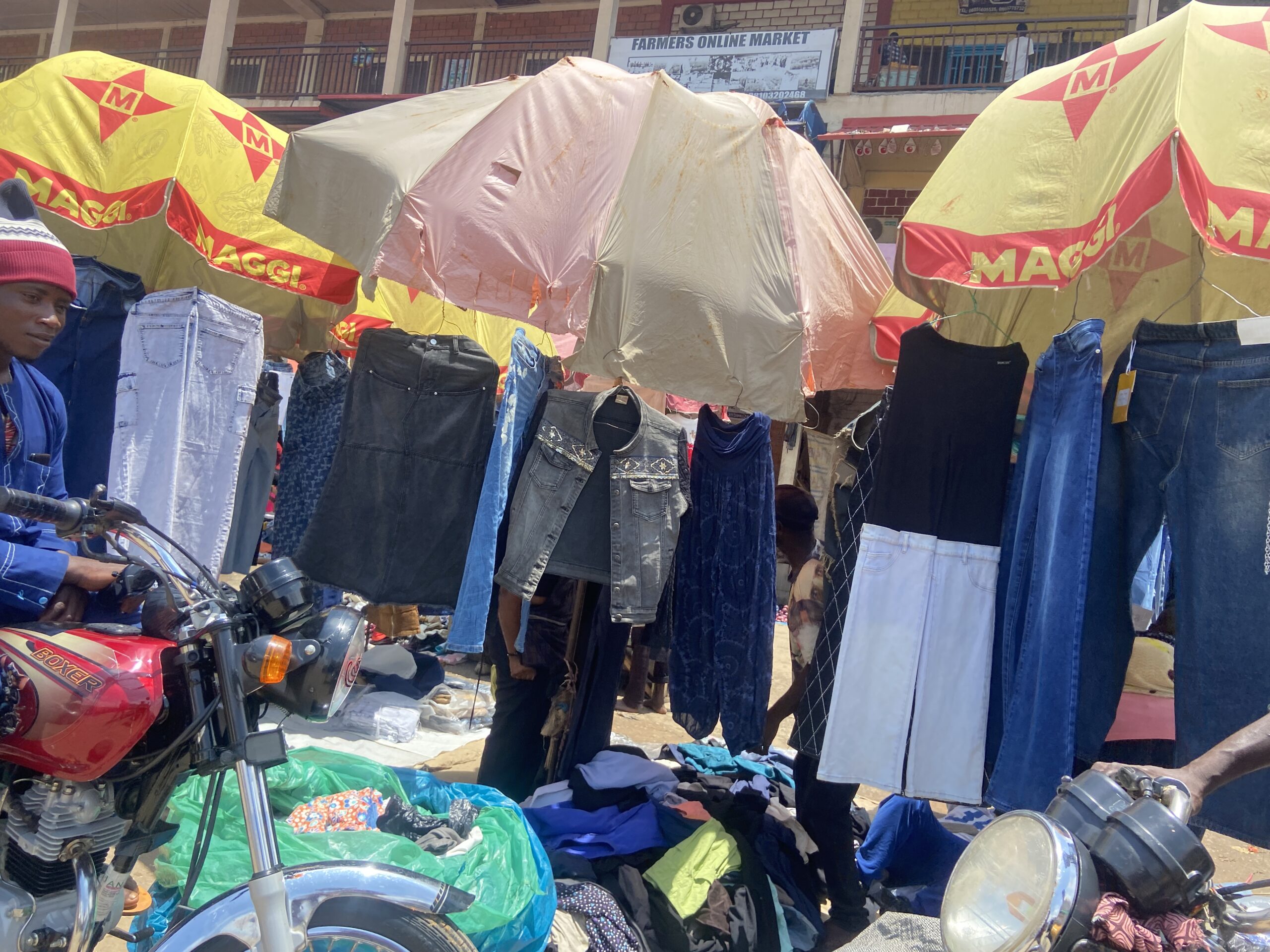
Across Nyanya, Karimo and Kubwa, thrift sellers have built markets around that reality. Their major trading days differ; Karimo is particularly active on Tuesdays and Fridays, Nyanya on Wednesdays, and Kubwa on Sundays, but the rhythm is similar. Clothes hang from umbrellas and improvised structures, while shoes, bags and piles of clothing occupy tables, stands and open spaces.
Shirts, trousers, gowns, leggings, tracksuits, gym wear, vintage pieces, children’s clothes, handbags and school bags are all part of the trade. Prices can start from about N500 and rise to N20,000 or more, depending on quality, brand, condition and grade.
But behind every N3,000 shirt or N5,000 pair of trousers is a business involving bales that can cost hundreds of thousands of naira, sometimes more than N1 million, with no guarantee that their contents will deliver the expected returns.
The economy of the bale
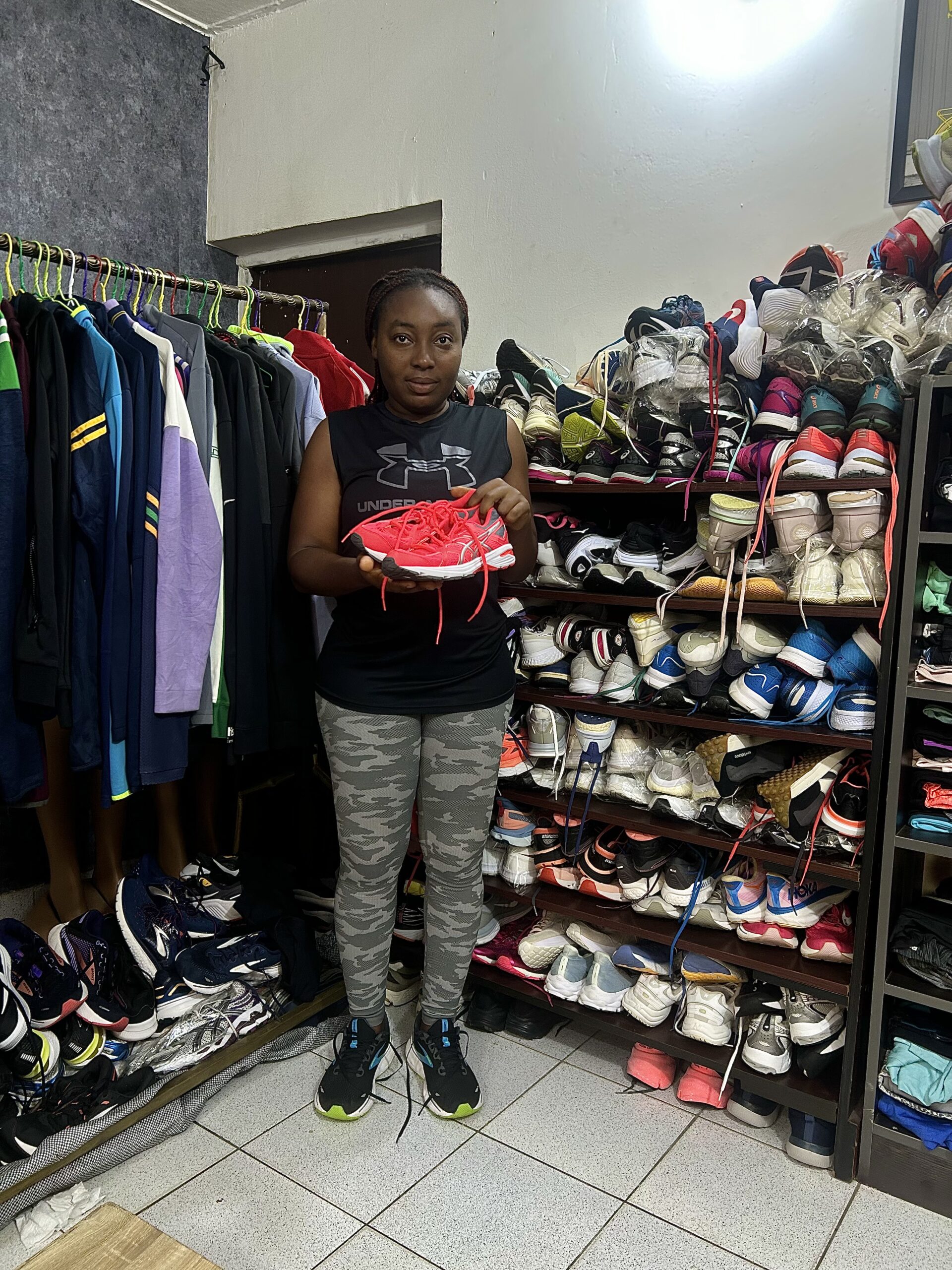
Aniekan Ben Emmanuel, CEO of Swiftwears and a thrift vendor with five years’ experience, understands the gamble.

For traders, a “bale” does not describe one standard product. There are UK, China and Canada bale names commonly used in the trade to describe categories of imported second-hand clothing.
Aniekan explained that the labels do not necessarily mean every bale physically originates from the country attached to its name. They have become descriptions used within the trade, alongside categories covering almost anything that can be worn or carried: children’s clothing, socks, gym wear, tracksuits, bags, swimwear, gowns, vintage shirts and more.
“The bales are for basically everything that you can think of,” Emmanuel said.
Prices vary according to type, size, expected quality, and grade. Some bales cost about N200,000, while high-value ones can reach N1.5 million. Their weight can range from around 55kg to more than 180kg.
For traders, buying a bale is therefore not simply buying clothes. It is buying an expectation. The country labels have acquired particular meanings among traders. Some believe China-associated bales tend to contain smaller sizes, while Canada-associated bales are perceived as having a wider range of larger sizes. Such perceptions are not guarantees, but they influence purchasing decisions.
A seller specialising in plus-size fashion will seek stock believed to contain larger sizes, while a gym-wear seller will look for another category. Beneath the apparently simple business of buying used clothes is therefore a specialised market shaped by experience and risk.
Then comes the grade
Beyond country labels is another language familiar to traders: grading. There are Grade A, AB, B and other classifications, with AA commonly regarded by traders as the highest or among the highest grades. The grade can significantly affect the price of a bale and can also become a source of disappointment.
Aniekan recalled that bales that once sold for about N90,000 have increased substantially, citing exchange rates and clearing costs among the factors. Traders also complain about misrepresentation in the supply chain. A supplier may describe a bale as Grade A, only for an importer to discover after opening it that the contents appear closer to Grade B or C.
Chisom Agbo, a trouser seller with 10 years’ experience, knows that risk. She recently bought a first-grade corporate trouser bale for about N700,000 containing roughly 300 pieces. At an estimated cost of N2,333 per piece, she could sell individual trousers for N4,000 to N7,000.
But she also recalled buying a N650,000 bale containing about 60 cut or faded pieces, while many others were very small sizes. Yet the opposite can happen. Chisom recalled an earlier N700,000 bale in which most of the contents were Grade A and sold within weeks, producing what she described as nearly N600,000 in profit. That is the gamble: one bale can disappoint; another can rescue a business.
Why traders ‘sign’
The uncertainty explains another practice common in the market: “signing” a bale. There is no fixed industry price for signing. The amount depends on the vendor, category, quality, and agreement between buyer and seller.
Instead of purchasing everything inside a bale, a trader arranges to open it and select pieces relevant to their business. A gym-wear seller does not want a bale dominated by office shirts, while a trouser seller does not want dozens of gowns. Signing allows traders to narrow the risk.
Ibrahim Dada, a Nyanya shirt seller specialising in vintage shirts, described it as part of his normal strategy. His supplier knows what he wants and contacts him when suitable stock arrives. But even that offers no guarantee.
He recalled opening an N500,000 bale and discovering that many shirts had stains around the collars and armpits. He estimated his loss at almost N200,000.
“Bales can be very tricky,” he said.
When unwanted items emerge, traders also exchange stock among themselves.
Sani Abubakar, a gym-wear and shorts seller in Area 1, recalled opening an N1 million gym-wear bale and finding about 30 women’s leggings that did not suit his predominantly male clientele. He exchanged them with another sportswear seller for men’s shorts.
What is dead stock to one trader can therefore become useful inventory for another.
Consumers are doing the mathematics too.
On the other side are consumers who have learned to calculate the value of thrift against conventional retail. Daniel, 27, a ride-hailing driver in Gwarinpa, specialises in buying trousers. A pair of chinos that might cost N25,000 to N30,000 in a conventional boutique can sometimes be found for N3,000 to N5,000 in the thrift market.
He recalled buying a new H&M pair for N2,000.
“I need durable trousers for work. The money I save goes to my children’s school fees,” he said.
Joy Akinyemi, 24, an NYSC member and student living in Kubwa, has reached a similar calculation. With an allowance of N77,000, she said paying N20,000 for one shirt from a boutique is difficult.
In thrift markets, she finds shirts for between N1,000 and N2,000 and office gowns for about N3,500. She recently bought six shirts for N9,000.
For her, thrift provides a way to maintain a corporate appearance without exhausting a limited income. From fashion to business
The market has also created a new generation of entrepreneurs.
Favour, 28, an all-round seller at a Sunday market in Katampe, deals in gowns, tops, trousers and skirts. Her last bale cost about N1.4 million and contained approximately 500 pieces, putting the estimated cost at N2,800 per item.
She sells gowns for N6,000 to N15,000 and tops for N3,000 to N5,000. But a N1.4 million investment also means that a bad bale can become a serious financial problem.
She recalled buying a bale containing torn clothes and children’s items that did not suit her market. Some had to be sold for as little as N500.
Yet she also remembers an earlier N1.2 million bale containing recognisable brands and some pieces still carrying tags. She said it generated more than N1 million in profit.
Zainab Dawa, 22, a fashion student from Bwari, buys thrift clothing both to wear and to study fashion. She has found a Zara dress with its tag still attached for N6,000 and a Mango blazer for N4,000.
With N20,000, she said, she can assemble several quality thrift pieces.
That calculation is helping to change the stigma historically attached to second-hand clothing. For a growing number of consumers, “used” does not necessarily mean inferior. It can mean affordable, durable or simply better value.
More than a fashion market
Business strategist and Chief Executive Officer Toyin Joseph Larayetan believes the thrift trade should also be viewed through the wider lens of the urban informal economy.
“The street seller thrift vendors are the hope of low-income earners,” Larayetan said, arguing that roadside commerce provides an entry point for people who cannot afford conventional shops.
The cost of formal retail space, he noted, can run into millions of naira, pushing some traders towards temporary roadside arrangements. For consumers, there is also convenience.
“You just look at the roadside, you get what you want,” he said.
Larayetan pointed to Sunday trading in places such as Kubwa, where traders can take advantage of periods when residents are returning from church. Some also use the frontages of closed shops to create temporary markets without maintaining permanent premises. But he acknowledged the problems that come with street trading, particularly waste disposal and sanitation.
He suggested waste-disposal arrangements and monitoring of temporary trading spaces so that areas can be cleaned before the start of the working week. The larger question is what happens when economic activity is removed without an affordable alternative.