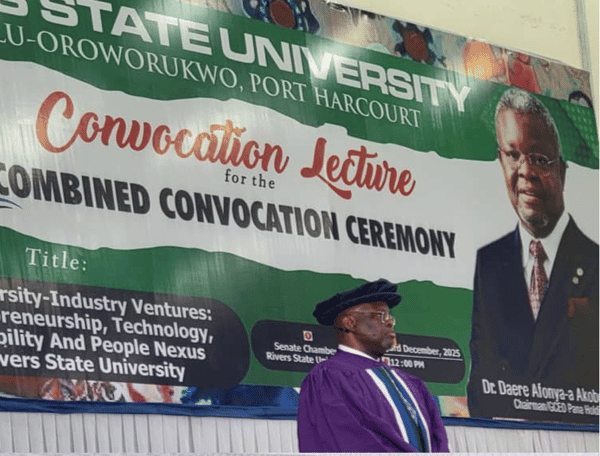
The Group Chief Executive Officer of PANA Holdings, Dr. Daere Akobo, has called for a fundamental shift in how Nigerian universities engage with industry, urging institutions to prioritise innovation, commercialisation, and partnerships that can drive economic growth.
He made the call on Wednesday while delivering the lecture at the combined 37th and 38th convocation ceremony of Rivers State University (RSU), Nkpolu-Oroworukwo, Port Harcourt.
Speaking on the topic “Joint University-Industry Ventures: The Entrepreneurship, Technology, Sustainability and People Nexus for Rivers State University,” Akobo said Nigeria’s innovation output remains low, citing the country’s average of two patents per one million people annually.
He urged universities to move beyond traditional teaching and examination structures and begin graduating students with intellectual property that has commercial value.
“This country is oversized… Innovation starts with critical thinking,” he told the graduating class of 13,242 students.
Akobo, an RSU alumnus and Group Chief Executive Officer of PANA Holdings, used his career journey—from General Electric Nigeria to building a multi-sector conglomerate—to illustrate the opportunities available when innovation is properly supported.
He noted that institutions such as the Indian Institute of Technology Madras (IIT) and the Massachusetts Institute of Technology (MIT) have developed strong economic ecosystems through research, patents, and commercialisation.
He challenged Nigerian universities to adopt similar models.
“How can we move from using tests to graduate students to using patents to graduate students?” he asked. “When you have patents, people pay for patents.”
Akobo said universities must work closely with industry and government under what he described as the “triple helix” model of innovation. He noted that modern universities embed industry realities into academic programmes, co-create technology, and contribute to policymaking.
He urged RSU to evolve into a globally competitive knowledge institution, stressing the need for proprietary software and locally developed technology. Using the oil and gas industry as an example, he said over 750 software used in the sector are developed abroad, representing lost revenue for Nigeria.
Akobo also called on the Rivers State Government to strengthen its directive capacity—its ability to channel resources toward agreed priorities. He questioned whether the state currently possesses the governance strength required to drive innovation-led development.
Sharing lessons from a visit to IIT Madras, he urged RSU to establish a technology hub capable of attracting corporate research funding and partnerships. He said the university already shows strength in renewable energy research but must convert academic output into practical commercial ventures.
Akobo also addressed what he described as a “mental box” limiting ambition in the region, urging graduates and professionals to build enterprises in Rivers State rather than relocate opportunities elsewhere.
On business leadership, he outlined his “Five P’s” framework—purpose, philosophy, process, product, and people—and warned graduates against relying on the “three F’s”: family, friends, and fools, which he said often hinder entrepreneurial progress.
He encouraged the graduates to pursue their goals with urgency, saying, “A dream without a deadline is a nightmare.”
Akobo holds postgraduate qualifications from the Federal University of Technology, Owerri, and has attended executive programmes at Harvard Business School, INSEAD, and Manchester Business School. He was recently awarded an honorary Doctor of Business Management by Obafemi Awolowo University.