 • Job losses loom as terminals grapple with low volume
• Worries in Customs, NIMASA
AS if the harsh reality of dwindling revenue due to the drop in price of crude oil is not bad enough for the country, the Federal Government may soon be grappling with yet another economic crisis, this time in the maritime sector.
Ironically, that is one of the sectors the government may have been hoping on in order to bridge the revenue gap created by the slump in crude oil price in the international market.
Already, some terminal operators have begun disengaging some of their workers pending when the situation either improves or the Federal Government unveils what they called ‘favourable’ economic policies.
Mostly affected by the economic challenges are RoRo Terminals and Oil and Gas-designated ports and terminals.
According to maritime stakeholders who spoke with The Guardian yesterday, the situation has further been compounded by the Central Bank of Nigeria’s (CBN) policy, which restricts access to foreign exchange (FOREX) for about 41 items.
They explained that the development has compelled some importers to route their consignments to ports of neighbouring countries such as Cotonou in Benin Republic from where the goods are subsequently smuggled into Nigeria, thereby depriving the Federal Government of much needed revenue.
They also blamed the Federal Government of inconsistency in policy formulation, which, according to them has led to the unfolding challenges in the sector.
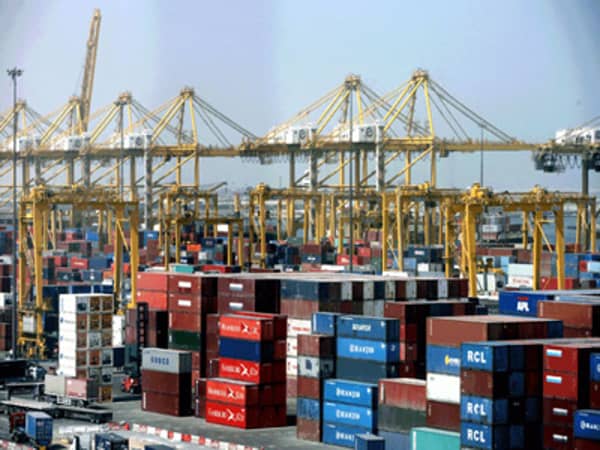
For example, volume at APM Terminals, operator of the Apapa Container Terminal Port, has dropped by 29 per cent this year compared to 2014.
The company experienced the lowest dip in April “maybe as a result of reluctance to import around the elections.”
However, importers blamed the reluctance to import on rising inflation as a result of devaluation of the naira, lower oil prices and CBN policy on import.
But, a former Managing Director of Nigerian Ports Authority (NPA), Chief Adebayo Sarumi has advised Nigerians to take advantage of the CBN policy.
Speaking on Monday at the maiden edition of International Sea Trade Convention, Sarumi decried the design of Nigerian ports, adding that they should be designed and positioned to support export.
Sarumi said: “Our ports have been designed for imports only, without consideration for export, which is what the economy needs for growth.”
He added: “Our ports are designed to receive other peoples’ cargoes and not designed to take out Nigerian cargo. The time has come for Nigeria to be outward-looking.
Speaking in a similar vein, the Executive Secretary of Nigerian Shippers’ Council (NSC), Hassan Bello, said: “For every container that comes, it leaves here empty. We have laden containers coming into Nigeria, but transported back empty and this affects almost everything, including the cost of shipping”.
Lamenting the drop in container volume at the port, a source said: “The current expectation is that this trend of lower volume compared to last year will continue for the rest of the year. Traditionally, the second half of the year has higher volumes than the first. It remains to be seen if this trend will be repeated this year.”
A further analysis of operations indicates that import volume measured in TEUs (Twenty-foot Equivalent Unit) has been on the decline.
In July 2014, the terminal recorded 31,280 TEUs while it handled 25,658 this year.
Also, in June 2014, it recorded 29,764, which is higher than the 24,027 of 2015. It recorded 30,548 for May 2014 and 20,303 for 2015; April 2014 was 30,548 while same month of 2015 was 18,695; March 2014 was 27,224 while this year it had 23,768.
Despite the drop in volume, the Apapa Area 1 Command of Nigeria Customs Service (NCS) has maintained that it generated N30.1billion revenue in the month of August, surpassing its monthly average of N23billion.
Many importers and their agents are lamenting their inability to open Form ‘M‘ to process imports with complaints of low business activities.
In a chat with The Guardian yesterday, an economist, Matthew R. Otiode, appealed to the Federal Government to urgently map out strategists to reposition the maritime sector.
He said: “The maritime sector has huge potentials but the nation can only reap benefits of such potentials if adequate policies are in place and well implemented,” adding that “with necessary policies, the maritime sector could bridge the gap created by the drop in crude oil price in the international market.”
Stakeholders are also saying that the non-appointment of a substantive Director-General for the Nigerian Maritime Administration and Safety Agency (NIMASA) and alleged lack of policy direction for the Nigeria Customs Service (NCS) in the new administration are compounding woes in the maritime sector.
They accused the Comptroller General of Customs, Col. Hameed Ibrahim Ali (rtd) of not unfolding his agenda more than three weeks after he assumed office.
Alli had upon assumption of office charged customs management to work with him to deliver on the mandate given to him by President Muhammadu Buhari.
He was quoted as saying: “The mandate he (Buhari) has given me are three basic things: go to customs, reform customs, restructure customs and increase the revenue generation, simple. I don’t think that is ambiguous, I don’t think that is cumbersome. It is precise and I believe that is what all of you are here to do.”
But a Customs source told The Guardian yesterday: “There is anxiety in the system. We don’t know what will happen next. It’s affecting morale”.
The Chairman, Shipping Association of Nigeria (SAN), Val Usifoh blamed policy summersault as being partly to blame for the decline in the volume of imports into the country.
He explained that the Federal Government policy on rice, automotive policy and the CBN policy on FOREX restriction on certain product make it difficult for stakeholders to plan ahead.
He said: “People need to plan ahead. Business should be predictable so that when you are making investment, medium or long term, you are sure of where you are going. Importation is on the low ebb, business is down for everybody and if it is down for the importer it is down for the ship owner. It is a global trend but we are feeling it more because we are import dependent in the economy. When people cannot predict where to move their investment, it will be difficult to plan”.
He added: “Before the auto policy came into effect, 80 percent of the ‘Tokunbo’ (used) cars were coming to Nigeria and 20 percent go to Cotonu (Benin Republic) and all the second hand trucks were coming through Nigeria .
“But after this policy, over half of the second hand vehicle business now go to Cotonou. The implication is that Nigeria ports have lost 50 percent of its second hand vehicle trade.”
He also used the opportunity to advise the Federal Government to develop local industries as part of measures to boost enough supply before placing restrictions on certain imports.
Meanwhile, the management of NPA has insisted that the numbers of ships calling at the nation’s seaport are on the increase.
For the first quarter of 2015, NPA said about 5,139 ocean-going vessels with a total Gross Tonnage (GT) of 61,990,999 called at Nigerian Ports compared with GT of 57,034,338 in 2014.
Within the period under review, Lagos Port Complex (LPC), handled 372 vessels with a gross registered tonnage of 9,298,761, indicating an increase of 10.6 per cent over 8,407,233 gross tonnage achieved in 2014.
In a related development, Tin Can Island Port handled 435 vessels with a gross tonnage of 12,232,575, indicating an increase of 8.15 per cent over 11,310,751 gross tonnage recorded in the corresponding period of 2014.
NPA’s General Manager in charge of Public Affairs, Capt Iheanacho Ebubeogu, explained that Calabar Port complex recorded a total GT of 958,288, an increase of 11.67 per cent over 858,174 gross tons of 2014, “leaving the port with 100 Ocean going vessels in the period under review”.
Explaining further, Ebubeogu said: “Rivers Port complex recorded a total gross tonnage of 1,475,864, indicating 14.45 per cent increase over 1,288,524 gross tons achieved in the corresponding period of 2014. A total of 132-ocean going vessels were handled within the period under review.
“Onne Port complex recorded a GT of 12,768,834, reflecting an increase of 12.99 per cent over 11,300,433 gross tons recorded in the corresponding period of 2014 with 1,025 vessels handled within the period. Delta Port Complex recorded 1,643,346 gross tons, with 2,816 vessels handled. The gross tonnage of crude oil tankers recorded within the period showed a 12.21 per cent increase over first quarter of 2014.”
Meanwhile, a report put together by UHY has blamed duties and ‘protectionist policies’ as some of the factors responsible for the high cost of goods in Nigeria.
According to the report, consumers in Nigeria are paying comparatively high prices for goods “relative to their counterparts in developed countries thanks to a far higher tax take from import duties in proportion to the size of its economy.”
The report explained that protectionist policies also undermine domestic competitiveness, adding, “Nigeria levies import duties of 0.96 per cent, while burden in European Union (EU) countries averages 0.13 per cent.”
The report discovered that Nigeria charges import taxes equating to 0.96 per cent of its Gross Domestic Product (GDP), compared to a global average of 0.47 per cent.”
It explained that by contrast, the major European “proportionally the least in customs duties, at just 0.13 per cent of their GDP on average – less than a seventh as much as Nigeria.”
Identifying North American Free Trade Agreement (NAFTA) countries such as the United States of America (USA), Canada and Mexico, the group said levies on average a sum equivalent to 0.2 per cent of their GDP in customs revenues.
Client Relations at UHY Maaji & Co, a member of UHY, Lawrence Etokakpan, said: “Consumers in Nigeria may still be getting a raw deal, as the government continues to strike a highly protectionist stance in an attempt to boost the domestic agricultural and manufacturing sectors. Critics say that high tariffs, quotas, frequent policy changes and unclear interpretations by the Nigerian Customs Services (NCS) all make importing difficult and expensive.’’