West African leaders under the umbrella of the Economic Community of West African States (ECOWAS) have pledged to deepen democracy and constitutional order. This commitment, coming from a region steeped in worsening political instability, is welcome. However, the problem with the bloc is not a fresh round of familiar communiqués. It is implementation. Until ECOWAS leaders demonstrate the political will to concretise lofty words, pledges will mean nothing, while skepticism and disenchantment continue to spread across the sub-region.
A convergence of crises confronts West Africa today, blurring the horizons of democratic destinations. Military coups, once believed to be part of the region’s ignoble past, have returned. One after the other, states seem to be discovering that boots provide fairer dividends to socio-economic challenges as fragile civilian governments struggle with legitimacy. Simultaneously, terrorism, banditry and transnational crime have deepened public despair while economic hardship, inflation and youth unemployment have further chipped away at the remnants of faith in statehood.
Under the circumstances, democracy cannot be reduced to periodic elections or communiqués issued after summits in plush conference halls. It must be judged by outcomes: whether on the streets of West African towns and villages, governments are able to deliver security, justice, accountability and inclusive development.
Here is where the soul of the matter lies. Democracy is of little value without good governance, which is patently lacking in many ECOWAS member states. In the words of the late Afrobeats maestro, Fela Anikulapo Kuti, such a misnomer is no better than a “demonstration of craze”. Often, elections are held. However, they are frequently flawed, badly managed or violently contested. Legislative and other institutions that should curb executive excesses are weak or compromised. Corruption holds sway, as citizens, particularly the youth increasingly interpret democracy as an elite contraption that entrenches poverty and exclusion.
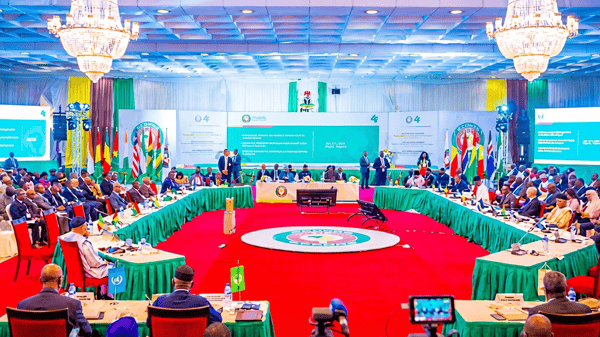
As the de facto leader of ECOWAS, Nigeria ought to set the standard for democratic practice and good governance. Unfortunately, it still struggles with governance deficits, electoral controversies, insecurity, shrinking civic space and public distrust in institutions: the familiar woes plaguing its neighbours. At the 68th Ordinary Session of the Authority of Heads of State and Government, President Bola Tinubu rallied his counterparts on democracy, security and other concerns. However, when Nigeria speaks at the regional level, its credibility is inevitably measured against the conditions that obtain at home, where charity — they say — begins.
“All have sinned,” the Holy Writ declares, and “there is none that doeth good.” The gulf between the implicit democratic ideals of ECOWAS and the explicit conduct of many of its leaders has become too wide to ignore. Very often, supposed proponents of democracy behave unlike democrats. Power is excessively centralised in the executive. The opposition is either harassed or marginalised. In Nigeria’s amazing case, they simply decide, collectively, to “move to the centre.” Civil society and the media across the region still face intimidation. Courts appear pressured or manipulated. In some cases, like Ivory Coast’s Alassane Quattara, constitutional changes have been exploited to elongate tenures, undermining term limits.
As long as these trends persist, citizens will continue to lose confidence in constitutional order, propelled by public cynicism. In turn, fertile grounds are prepared for anti-democratic actors, including coupists, who present themselves, however falsely, as alternatives to failed civilian leadership. ECOWAS leaders have no justification to condemn coups while perpetrating civilian autocracy. Double or inconsistent standards weaken the bloc’s moral authority and cripple its capacity for decisive actions.
The absence of rigorous peer review has not helped the ECOWAS cause. This is a glaring weakness that must be addressed urgently. Often, leaders affirm their shared values and commitments. Outrageous violations of democratic norms such as the indefinite postponement of Senegal’s 2024 polls, weeks before commencement, are often treated with silence or diplomatic euphemisms until they escalate into full-blown crises. By then, the cost of intervention, whether political, economic or military, is far higher.
It is time ECOWAS leaders moved beyond high-sounding pledges and prioritise veritable peer reviews. It is time they began speaking truth to power, regardless of whose ox is gored. Democratic backslidings must be called by their true names such as ‘insidious manipulations to perpetuate unpopular rule and rape of constitutional orders.’ Let the region, at once, jettison the excuse of power greed as “internal matters”. This means strengthening existing mechanisms for election observation, constitutional compliance and human rights monitoring, and ensuring that culpability meets punitive consequences.
The Chairman of the ECOWAS Authority and President of Sierra Leone, Julius Maada Bio, rightly noted during the session that the region faces some of the gravest security challenges in its post-independence history. This assertion must, however, be approached with extreme caution. While security threats are real, they should not be allowed to become grounds for authoritarianism. Democratic governance requires balancing security imperatives with respect for rights and the rule of law. Analysts have pointed out that indiscriminate hoarding of power to tackle insecurity could shrink civic space, fuel agitations, and make long-term tranquility more elusive.
Also, the threats posed by economic exclusion must be resolved. With each passing year, the sub-region’s youth population increases amidst more bleak prospects, migration, crime and political disillusionment. ECOWAS leaders must come to terms with the fact that democratic stability and inclusive economic policies are inseparable. Regional integration, trade liberalisation and free movement protocols mean little if they do not translate into jobs and opportunities for ordinary people.
Beyond the fine talks in Abuja, ECOWAS leaders should understand that democracy is meaningless if it fails to deliver, in which case, it risks being discarded, either gradually through apathy or worse: abruptly through instability.
Hope is not lost, however. ECOWAS leaders still have an opportunity to change course. By embracing genuine peer accountability, respecting term limits, tolerating opposition, strengthening institutions and prioritising good governance, they can begin to re-awaken the region’s long-lost trust in democratic rule. Anything less will amount to democracy in name only.