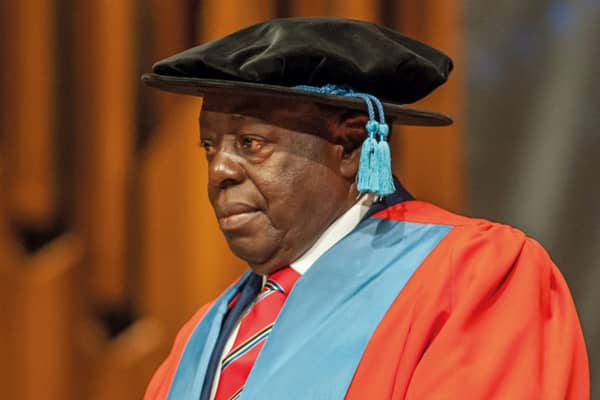
Chief Afe Babalola did not abandon Nigeria. On the contrary, he has left his imprimatur on several dimensions of the Nigerian space. He has blazed a trail through many Nigerian landscapes; and these are trails that are too definitive and enduring to be glossed over as mere achievements. Afe Babalola’s stature as a statesman and an institutional figure is established by his institutional commitment to the Nigerian society. This institutional commitment—three of which I will examine—are defined intentionally around Nigeria’s developmental imperatives.
First, Afe Babalola is a philanthropist. And he is not a frivolous one that throws money at people in a way that assuage the conscience of the philanthropist. On the contrary, his philanthropy is anchored on his character essence as an Omoluwabi—an individual whose value orientation is conditioned by a cultural and developmental commitment to the communal good. Philanthropy, done well, is an ethical commitment to one’s context and to a dimension of what could assist in making it work.
That philanthropic commitment is connected with Afe Babablola’s love for educational advancement. It should be immediately clear to the perceptive reader why that would be a thrilling effort for me. My reform philosophy, as further dimensioned in my little book The Joy of Learning (2010), demands that education, and the educational sector, must play fundamental roles in nation-building and national development.
Education is not just the means by which we articulate the dynamics of human capital development; it is the framework for understanding how we live together and live together for progress. And Afe Babablola understands this, hence his institutional commitment to educational pursuits. And this is not just about scholarships. It is about using scholarships to enable many hapless Nigerian youths connect with their aspiration within a daunting context where Babalola also had to rise from grass to grace. The Afe Babalola University (ABUAD) is a signature commitment to educational excellence in Africa. And the Afe Babalola Centre for Transnational Education at King’s Collee, London—established with a ₤10 million endowment—is a diasporic reach that connect him to the African continent and its youth and education dynamics.
When Martin Luther King, Jr. once said, “Philanthropy is commendable, but it must not cause the philanthropist to overlook the circumstances of economic injustice which make philanthropy necessary,” he was speaking to a connection that Afe Babalola already made. Philanthropy and educational empowerment are just the launchpads for encountering the Nigerian society at a much deeper institutional and policy levels.
Afe Babalola’s stature is tightly connected with Nigeria’s legal and judicial system. And I am not just concerned with the many landmarks cultural, regional and national cases that constitute the elements in the feather of Afe Babalola as a Senior Advocate of Nigeria. Rather, I am concerned with an autobiographical reflection: what was in the mind of the young Afe Babalola when he first enrolled for a law degree in Nigeria? This will be a reflection for another day. I am also concerned with how his legal activities in the judicial landscape, and his reflections on his many legal and judicial activities—set down in many books—have matured, shifted and concretized how we see that system today in relation to the future of the Nigerian state.
Similar activities by many of Afe Babalola’s peers, including Chief F.O. Williams, Prof. Taslim Elias, H.O. Davies, Prof. Ben Nwabueze, Chief Bola Ajibola, Chief Folake Solanke, Gani Fawehinmi, and even the younger ones, the likes of Femi Falana, OlisaAgbakoba, Hauwa Ibrahim, and many others, have the singular benefit of configuring the legal and judicial system to the context that determines how justice is dispensed in Nigeria. To understand the practice of law in Nigeria, for example, one must have to go through some of Babalola’s publications: Injunctions and Enforcement of Orders (2000), Law and Practice of Evidence in Nigeria (2001), Election Law and Practice (2003), Thoughts of a Legal Icon (2013), etc.
Justice is the first condition of humanity, says Wole Soyinka. It is the first condition by which the health of a nation is measured, says Plato. And thus, this provides us with a prism by which to gauge the everlasting patriotism of an avatar who dares to operate within the judicial sphere, and to mentor those who would hold in their hands the dynamics by which Nigeria would become better. If justice were to fail in a place like Nigeria, it would be the death of the commitment of so many who have made it their lifelong responsibility to stand with the Nigerian polity in unflinching commitment.
Afe Babalola has come a long way, chronologically and in all spheres. He has become an exemplary institutional reference that articulates a significant pathway that elite nationalism in Nigeria need to take. Nigeria requires heroic commitment even if it does not often reciprocate such patriotism. And yet, those who will stand with Nigeria—like Afe Babalola has been doing—must be relentless in giving it their best as a collective endeavour. Patriotism demands courage, and Afe Babalola is one courageous and exemplary Nigerian—a singular illumination in a field of heroic efforts!
Concluded.
Olaopa is chairman, Federal Civil Service Commission and Professor of Public Administration.