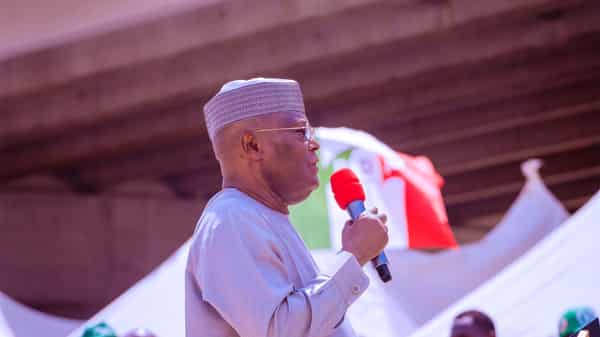
The Peoples Democratic Party (PDP) has remained conspicuously silent following the confirmed resignation of its 2023 presidential candidate, former Vice President Atiku Abubakar.
Atiku, who has been a central figure in the party since its founding, formally announced his departure in a letter dated July 14, 2025, addressed to the Chairman of the PDP in Jada Ward, Jada Local Government Area, Adamawa State.
In the letter titled “Letter of Resignation,” Atiku cited “irreconcilable differences” as his reason for quitting the party. His exit marks the third time he has left the PDP.
“I am writing to formally resign my membership from the People’s Democratic Party (PDP) with immediate effect,” the letter read in part. “As a founding father of this esteemed party, it is indeed heartbreaking for me to make this decision… However, I find it necessary to part ways due to the current trajectory the party has taken, which I believe diverges from the foundational principles we stood for.”
Atiku also expressed gratitude for the opportunities the PDP provided him, including his service as Nigeria’s Vice President from 1999 to 2007, as well as his two presidential candidacies in 2019 and 2023.
When contacted, Atiku’s media adviser, Paul Ibe, confirmed the authenticity of the resignation, but declined further comment. Meanwhile, efforts to get a reaction from national officers of the PDP were unsuccessful, as none were willing to speak on the matter as of press time.
A History of Political Realignments
Atiku Abubakar’s resignation adds to a pattern of political realignments that has defined his career. This latest departure marks his third exit from the PDP since 2006.
His first departure came in 2006 during a heated political fallout with then-President Olusegun Obasanjo. Atiku, then serving as Vice President, defected to the Action Congress (AC) and contested the 2007 presidential election, which he lost to the PDP’s Umaru Musa Yar’Adua.
He rejoined the PDP in 2011 and contested the party’s presidential primary, losing to then-President Goodluck Jonathan. Three years later, in February 2014, Atiku exited the PDP once again to become a founding member of the All Progressives Congress (APC), to contest the 2015 presidential election. He was defeated at the APC primary by Muhammadu Buhari.
In November 2017, Atiku returned to the PDP and went on to secure the party’s presidential ticket in 2019 and 2023, losing both times to candidates of the APC—Buhari in 2019 and Bola Ahmed Tinubu in 2023.
His latest resignation raises questions about his political future, particularly as Nigeria inches toward another electoral cycle. Political analysts are already speculating on whether the former Vice President might once again align with another political platform.