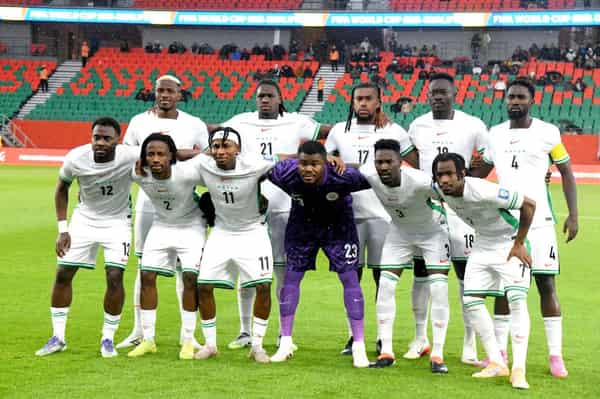
Nigeria’s failure to qualify for the 2026 World Cup next year, for the second consecutive time, is a rude awakening that the country must face and find ways to reset the nation’s football, if it is to avoid a repeat in another four years.
While much of the blame for the latest failure have been heaped on the players, who embarked on a strike two days before the African playoff hosted by Morocco, the Super Eagles’ performance in the decisive game against Democratic Republic of Congo showed a house in disarray, bogged down by administrative incompetence for which the Nigerian Football Federation (NFF) should take full responsibility, failing which it is bound to repeat its mistakes at a possible higher cost.
The players complained of non-payment of their allowances dating back to 2019, as well as other unfulfilled promises. These are issues that should have been resolved long before the team assembled in Morocco.
No doubt, Nigerians are highly disappointed and emotionally distressed that their country will be missing from the world’s biggest football competition. It is the World Cup, where all the best teams from across the world gather every four years to vie for bragging rights and the chance to become the greatest football-playing nation for the next four years.
The 2026 World Cup, to be co-hosted by the United States, Canada and Mexico, will be the first 40-team edition of the championship, with Africa presenting nine teams, which could rise to 10 if DR Congo wins their inter-continental playoff against either New Caledonia or Jamaica next year. Sadly, Nigeria, which was once the fifth-best footballing nation in the world, will not be there.
When the draws for the African qualifying series for the 2026 World Cup were made, and Nigeria was placed in Group C alongside Rwanda, Lesotho, Zimbabwe, South Africa and the Benin Republic, many followers of the global game believed that the Super Eagles had been given an easy passage to the championship because of the pedigree of the team and the quality of players.
Nigeria, being the fifth-ranked team in Africa before the qualifiers began, and with some of the best African players in top European clubs, could not have asked for a better route to the World Cup. However, to the surprise of many pundits, the Super Eagles could only muster three points in their first four games out of a possible 12, with home draws against Rwanda, Zimbabwe, and South Africa, as well as a second-ever defeat by the Benin Republic in 18 meetings.
The team eventually rallied to finish second in Group C qualifiers, behind South Africa, and secured a chance to feature in the African playoff, which would have given Nigeria a second opportunity to qualify for the World Cup. But the team fluffed their lines, condemning Nigeria to a second consecutive absence from the World Cup. The Super Eagles had failed to make the 2022 edition hosted by Qatar.
The result of their strike in Morocco was that the Super Eagles had only one day to train before the first game against Gabon, which they won after 120 minutes of gruelling football.
That poor preparation came to hunt them in the final game as they were visibly tired after another 120 minutes against the more composed DR Congo.
Perhaps the Super Eagles would not have been subjected to the playoff route to the World Cup if the NFF had been decisive in choosing a coach for the team when they sacked Portuguese coach Jose Peseiro, who had started the qualifiers. The long delay and intrigues that followed the appointment of Peseiro’s former assistant, Finidi George, as the substantive coach did not help matters, as the team seemed divided going into the games against South Africa and the Benin Republic.
Learning nothing from the exit of Peseiro, the NFF also dilly-dallied in choosing Finidi’s replacement when the former Super Eagles midfielder left the job after Nigeria’s defeat by the Benin Republic in Abidjan, their adopted home.
Coach Eric Chelle, who eventually replaced Finidi, stabilised the team, but it was obvious from then on that the Super Eagles were in a race against time as South Africa had a tight grip on the group ticket. One decisive factor in the country’s inability to make a second consecutive World Cup was the home draws against teams which should not have posed any threat to the Super Eagles.
Indiscipline among players also contributed to the failure. The players strolled into camp at any time they liked, knowing that they would face no penalties from a federation that lacked the discipline to set the rules and enforce them. This was evident in every match week, as Nigeria opened with a home game, as the team tended to perform better away due to the longer time they had to prepare for the second game.
Missing a second consecutive World Cup would have a negative impact on the country’s game. Aside from the toll it would have on this generation of players, some of whom may never be at the World Cup in their career, it would also set the country back economically, as the individuals and businesses, who usually benefit from the various commercial opportunities provided by the championship, would be left to count their losses.
It is also a big dent on Nigeria’s reputation as a big footballing country that could not qualify for the World Cup when faced with such minnows as Rwanda, Lesotho, Benin Republic and Zimbabwe, even when FIFA deducted three points and three goals from South Africa’s tally for fielding an ineligible player in one of their games against Lesotho.
The events at the playoff in Morocco, where the Super Eagles refused to train on the eve of the championship, showed that the NFF had learnt nothing from Ghana’s failure in the race to the 2022 World Cup in Qatar. It is also curious that the NFF and the National Sports Commission (NSC) failed to settle the players’ allowances, despite billions of naira reportedly being budgeted for the qualifying series.
This is the time for a total overhaul of the NFF to weed out incompetent and corrupt officials, whose greed has held the country’s football down for so long. Also, those staff members whose actions and failures have continually brought misfortune to the country’s football must also be shown the way out to bring sanity to the game. Blaming juju or supernatural things for the Super Eagles’ failure is ridiculous and only reduces the country to a laughing stock when officials had clearly neglected to do their homework.