 Follow Us on Google News
 Follow Us on Google Discover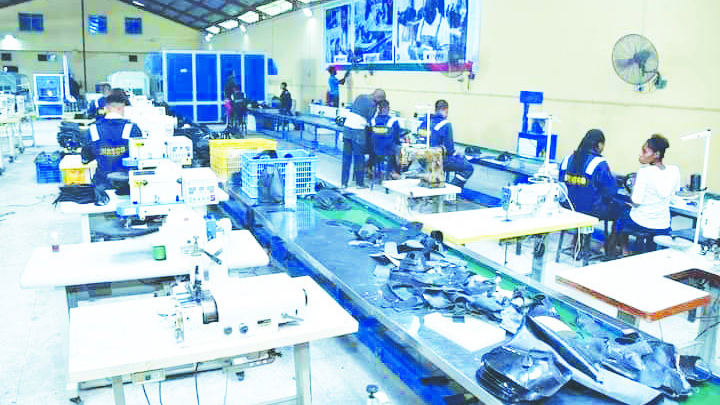
Its commissioning in 2021, amid pomp and pageantry, was an opportunity to create jobs, improve revenues, and give shoe-making another meaning. But after just four years, the multi-million naira facility went comatose. No thanks to wide-scale mismanagement and governance-related issues, LAWRENCE NJOKU reports.
When former governor Okezie Ikpeazu mooted the idea of a shoe company in Aba, Abia State, he did so with a view to harnessing the abundant skills in the leather sub-sector of the state. Ikpeazu boasted of his desire to turn the popular “Made in Aba shoes” into an international brand that would compete with others manufactured globally using local raw materials.
In fact, he saw the venture as a good revenue source away from oil, creating jobs and putting the state among the world’s major shoe manufacturing hubs.
He even emphasised that the ingenuity existing in Aba would make it possible for the shoe makers to break new ground, especially when exposed to modern technologies in shoe production.
Set up in 2020, the Enyimba Automated Shoe Company (ENASCO) was formally commissioned in 2021, and the former Senate President, Ahmad Lawan, while commissioning the multi-million naira facility, commended the governor’s efforts in embarking on “import substitution” and “creating jobs for the youths using the shoe project.”
Lawan, who stated that exploring local resources for productive ventures was the way to go, stressed that the stability of any country rests on providing the youth with the opportunity to put their energy into productive ventures.
On his part, an elated Ikpeazu stated that the state decided to invest in the area because no fewer than one million youths were engaged in the leather and garment sub-sector. He noted that his government had addressed issues of power, machine automation and marketing of products, which had remained a challenge to shoe makers in Aba.

Ikpeazu further disclosed that the essence of setting up the company was to have a greater share in the growing shoe enterprise, stressing that ENASCO would produce five thousand pairs of shoes daily. This, when translated, would amount to about two million pairs of shoes annually, with facilities for expansion.
Mark Atasie, a business consultant and Chief Executive Officer, NEXTZON, became the outfit’s maiden board Chairman. But four years after its commissioning, the firm is deserted, and its future is uncertain. Currently under lock and key, the machines are also malfunctioning, while most staff members have resigned and migrated elsewhere in search of daily bread. All of them are owed several months of unpaid salaries.
A visit to the company located on ENASCO Close, off Obikabia Road, in Aba, Abia State, confirmed that no form of activity was going on in the facility, as only a security man stood guard to prevent the machines from being vandalised.
Sources, however, informed The Guardian that factors that ran the operations of the company underground include poor planning, lack of a transparent administration, and the absence of a road map that takes sustainability into account.
Indeed, even though the then state government claimed that the place would produce five thousand pairs of shoes daily, the maximum the facility ever produced daily when it was operational was 250 pairs of shoes daily. The poor quality of the refurbished machines, which were also in use, contributed to its woes.
It was further learnt that about 30 shoemakers, whom the former administration took to China in 2018 to update their knowledge of shoe making and imbibe modern trends with a view to deploying them in the company (as initial technical staff), did not help matters as they returned to Aba after six months of training, allegedly without sufficient knowledge of the operations of the automated machines.
Some of them returned to their original jobs following months of waiting for the company to fully take off, while others who joined ENASCO at its inception were incapable of operating the machines in the facility.
A former employee of the company, who simply identified himself as Emeka, told The Guardian: “I left there last year because I am being owed a lot of money. I was bringing jobs, but they were not paying me. There is no trained shoemaker there at the moment. Everybody has left. So many things were happening at the same time. The state government that started the place did not do proper planning, and that seriously affected the overall objectives of the outfit.
The ex-staff stated that he worked at the facility for four years, explaining that the company was not planned to succeed.
“What we inherited were refurbished machines that were difficult to operate. We were sourcing our raw materials locally and contracting some of our jobs due to a lack of capacity. The management was only interested in the money, and not in meeting the daily demands or putting down plans on how to expand the company.
“We were told that the state government provided the majority of the funds for the machines and other property in the company, but for four years, no money was paid to the state government,” he alleged.
A board member of the outfit, who spoke to The Guardian on the condition of anonymity, said that he relinquished his shares in the company to the government when he could not “bear what was going on at the firm, adding, “We need a total overhaul of the facility to make it effective.
“I may say we did not understand the direction of the state government. We came in with a lot of promises, but the jobs were not coming as expected, and what we have on the ground could not undertake large-scale production due to frequent breakdowns in production. That is the most I can say for now.
However, I believe the place is currently closed. I don’t know what the present government is thinking,” he stated
In April this year, Governor Alex Otti intervened in the company, dissolved the board, and revoked the right over the parcel of land title granted to the company, as well as reclaimed all assets contributed to the company, including land, buildings, and equipment. It also set legal actions to recover any additional funds or assets misappropriated by the management of the company.
The Chief Press Secretary to the governor, Ukoha Njoku Ukoha, who explained the decision for the action, said it followed a comprehensive regulatory, financial and operational review undertaken by reputable Big Four professional service firms, which unravelled significant discrepancies and corporate governance-related issues within ENASCO. He said that the state government noted the establishment and initial contributions in ENASCO, with equipment imported from Turkey and a projected annual production capacity of two million pairs of shoes, which was established in 2020 under Ikpeazu.
“The goal was to elevate the state’s leather industry by producing high-quality footwear for the local and international markets. The Abia State Government contributed significantly to the company’s assets, including land, buildings, and equipment, with a total asset contribution estimated at N158,315, 809, and cash contributions of N41,850,000. “These contributions from public resources represented over 70 per cent of the cash and assets contributed to the business to date,” he said.
He added that the shareholding structure recorded at the Corporate Affairs Commission (CAC), as at November 2024, “did not reflect ABSG as a shareholder or beneficial owner despite its significant contributions.”
Ukoha hinted that subsequent changes were made to the shareholding structure in July 2023, shortly after Otti took office, alleging that the state government was not mentioned as a shareholder in the document.
“The shareholders on the CAC record as of 3rd April 2025 are Nwakile John Chidi with 445,900 shares; Udeagbala John Chinyelu with 219,600 shares, Nwaogu Chinenye with 111,500 shares, Sam Hart with 111,500 shares and Macauley Atasie with 111,500 shares. This demonstrated a clear intention to covet and misappropriate government investment and assets,” he said.
He also noted that from the findings, ENASCO’s financial performance showed a consistent decline in revenue and significant retained losses amounting to N115.7 million as of October 2024.
He had added that the state government was committed to ensuring transparency, accountability, good and corporate governance in the management of public assets held under its custody in trust, explaining that, “the irregularities observed and shareholders unwillingness to remediate ABSG’s concerns had resulted in government taking the necessary steps to revoke the land title to reclaim the state’s assets and resources”.
Otti recently appointed Nnenna Kalu Ogba, a fashion and design specialist, as the new general manager of the shoe company, a move geared towards resuscitating and realising the vision of making Aba shoes a global brand.
Speaking with The Guardian, Ogba stated that the company was shut down to pave the way for renovation and proper planning, stressing that there was no way the facility could have succeeded in its original state.
“We are renovating the place. We have ordered new machines because what we have there are refurbished machines. We expect that these machines will start arriving from January next year.
“There are no offices and furniture. Many of the machines are not working, and the electrical fittings were done in a hurry. Rainwater drops here and there anytime there is rain. So, we have completed the re-roofing. We are creating other offices.
“So, the whole idea is to get it right at the moment. I am certain we will resume production as soon as we are able to fix all that needs to be fixed. The whole idea is to promote Made in Aba and provide jobs and improve revenues. We will surely meet with these desires,” she assured.

