 Follow Us on Google News
 Follow Us on Google Discover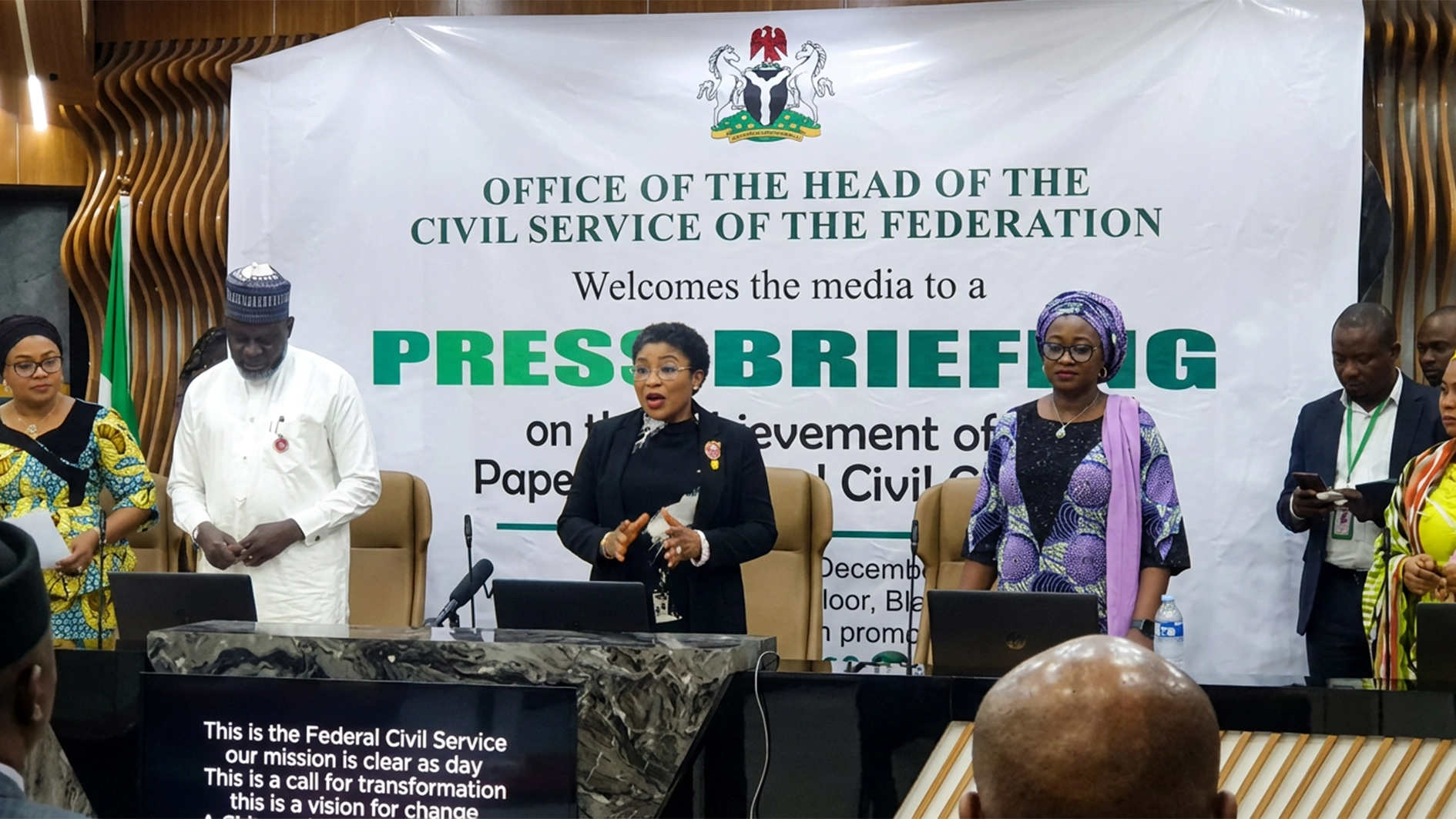
Nigeria has reached a major governance milestone as the Federal Civil Service officially transitioned to a fully paperless system, marking the completion of a nationwide digitalisation drive across ministries and extra-ministerial departments.
The Head of the Civil Service of the Federation (HCSF), Mrs Didi Esther Walson-Jack, announced the development in Abuja at a press briefing on Wednesday, describing it as a decisive break from decades of paper-based bureaucracy.
According to her, as of the close of business on Tuesday, December 30, 2025, all federal ministries and extra-ministerial departments had complied with presidential and administrative directives to operate entirely through digital workflows.
“This milestone marks a bold transition from a paper-based legacy bureaucracy to a modern, accountable, and digitally enabled public service,” Walson-Jack said. “Simply put, all ministries in the Federal Civil Service are now paperless.”
She said the achievement represents a significant step in public sector reform, strengthening accountability, transparency, institutional memory and service delivery, while aligning Nigeria’s governance framework with global best practices.
Reform Built on Successive Leadership
Walson-Jack stressed that the paperless milestone was the outcome of years of deliberate and incremental reforms, driven by successive Heads of the Civil Service of the Federation.
She recalled that the digital transformation journey formally began in 2017, under the leadership of Mrs Winifred Oyo-Ita, with the launch of the Federal Civil Service Strategy and Implementation Plan (2017–2020), which for the first time identified digitalisation as a core reform priority and introduced the Enterprise Content Management (ECM) concept.
The reform momentum, she added, was consolidated under Dr Folashade Yemi-Esan, CFR, through the Federal Civil Service Strategy 2021–2025, which expanded ECM into a broader digital content services agenda.
“The focus moved beyond digitising documents to transforming how information flows, how decisions are made, how work is tracked, and how services are delivered across the public service,” she explained.

Acceleration Since August 2024
Upon assuming office in August 2024, Walson-Jack said digital adoption across the Federal Civil Service stood at about 30 per cent, with only a few ministries operating partially paperless systems.
She noted that implementation has since accelerated significantly, culminating in the inclusion of 38 ministries and extra-ministerial departments, comprising 33 ministries and five extra-ministerial institutions — the State House, Office of the Secretary to the Government of the Federation, Office of the Head of the Civil Service of the Federation, Federal Civil Service Commission, and the Office of the Attorney-General of the Federation.
GovMail Expansion and Cost Efficiency
A major pillar of the paperless reform, according to the HCSF, is the expansion of GovMail, the official government email platform.
She disclosed that fewer than 20,000 official email accounts existed across the Federal Civil Service in August 2024. As of December 31, 2025, however, over 100,000 official government email accounts have been created for civil servants.
“All civil servants now operate with secure, professional, and auditable government email identities,” she said, noting that the move has strengthened data sovereignty, improved inter-ministerial responsiveness and reduced dependence on unofficial communication channels.
She added that the initiative is also generating substantial savings for government by eliminating fragmented agency-specific subscriptions to external email services.
Sustainability, Training and Cybersecurity
With the paperless deadline achieved, Walson-Jack said the next phase would focus on sustainability, optimisation and compliance.
She announced that the Office of the Head of the Civil Service of the Federation would intensify post-implementation optimisation, compliance monitoring, cybersecurity enhancement, and further digitisation of workflows across departments and agencies.
A major capacity-building initiative, to be implemented in collaboration with the United Nations Development Programme (UNDP), will commence in January 2026.
Under the programme, 500 trainers will be trained in a service-wide Training-of-Trainers scheme, who will in turn train officers across ministries and extra-ministerial departments to ensure practical and sustainable adoption of digital systems.
The training will cover the use of key platforms such as Service-Wide GPT, the online compendium of Federal Circulars, GovMail, and other digital tools developed for civil servants and citizens.
End of Physical Paper Submissions
The HCSF also announced a fundamental shift in how the public interacts with government.
She said federal ministries and extra-ministerial departments will no longer accept paper-based correspondence through physical registries.
Instead, all official correspondence must now be submitted electronically to designated registry email addresses, which are published on the website of the Office of the Head of the Civil Service of the Federation. Citizens can also track submissions through the Federal Civil Service Paperless Portal.
“Citizens and the international community no longer need to send traditional paper letters with envelopes. A scanned letter sent to an official registry email address is sufficient,” she said.
She added that the new system would improve audit trails, reduce response times, and eliminate the long-standing problem of missing or misplaced files.
Infrastructure, Connectivity and Partnerships
Walson-Jack said the Federal Government is engaging development partners, public institutions and private sector organisations to support the reform with digital devices to accelerate adoption.
She noted that the ECM platform’s mobile-friendly design supports a mobile-first approach, allowing civil servants to work securely from any location, while engagements with telecommunication providers are ongoing to improve internet affordability and connectivity reliability.
A sustainable pricing model, she said, is also being developed to ensure digital platforms remain affordable, scalable and maintainable over the long term.
Acknowledgement of Leadership and Partners
The HCSF expressed appreciation to President Bola Ahmed Tinubu, GCFR, describing his leadership and commitment as critical to the success of the digitalisation drive.
She also thanked members of the Federal Executive Council for their support, singling out the Minister of Budget and Economic Planning, Senator Abubakar Atiku Bagudu, and the Minister of Solid Minerals Development, Dr Dele Alake, for their advocacy and leadership.
She further acknowledged the support of the Secretary to the Government of the Federation, Senator George Akume, CON, as well as institutional partners such as the National Information Technology Development Agency (NITDA) and Galaxy Backbone Limited, whose infrastructure and technical support enabled the nationwide rollout of the OneGov ECM platform.
Tribute to the Media
Walson-Jack commended the media for their role in informing the public and strengthening accountability throughout the reform process.
“You have served as a vital bridge between the service and citizens, helping to rebuild trust in the Federal Civil Service and increase public awareness of ongoing reforms,” she said.
She added that the digitalisation reform aligns with Nigeria’s national development priorities and international best practices, reinforcing the Federal Civil Service’s commitment to a modern, performance-driven and citizen-focused public service.

