 Follow Us on Google News
 Follow Us on Google Discover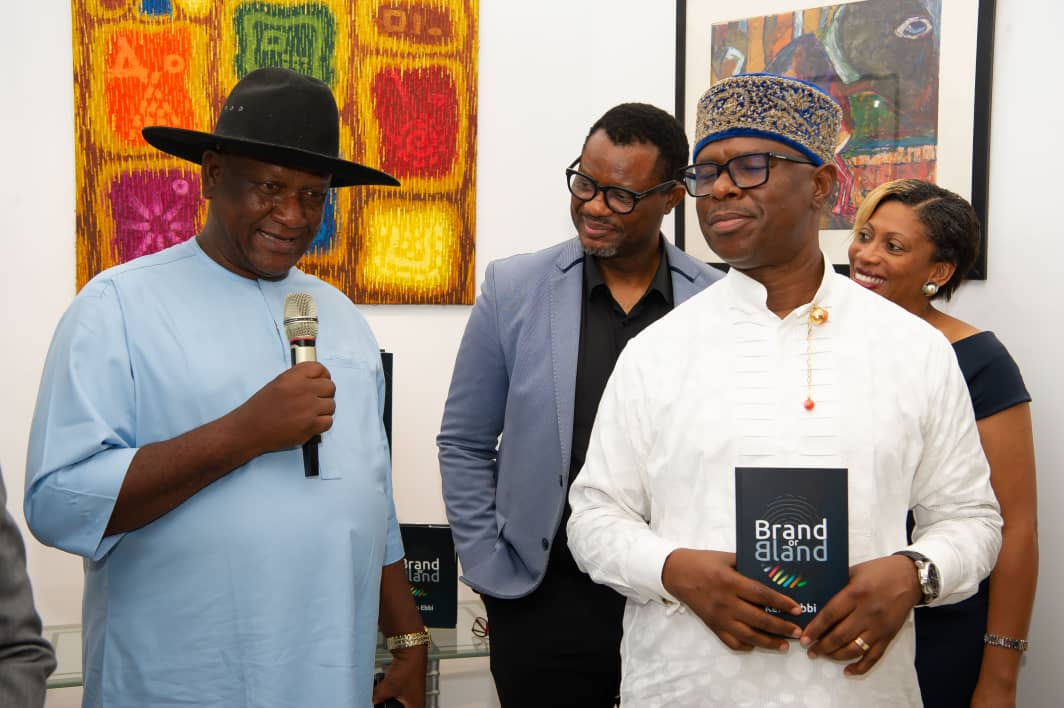
The presentation of a new book by brand strategist Kenn Ebbi titled, Brand or Bland, was held in Lagos last Tuesday, December 16, 2025 turned out to be more than a literary event, as it evolved into a layered conversation on history, identity, creativity and the uneasy relationship between Nigeria’s cultural strengths and its national image.
The book launch and exhibition, held at The Art Hotel, Victoria Island, drew a diverse audience of brand professionals, researchers, policymakers, creatives and business leaders. Alongside the unveiling of the book was a destination branding exhibition featuring monuments and cultural references, reinforcing the event’s central concern with how societies remember, define and project themselves.

Chairman of the occasion, Pastor Onyekwere Ogba, set the tone with a candid reflection on his first encounter with Mr. Ebbi’s Brand or Bland. Reading it, however, proved unexpectedly demanding, conceded, adding, “When I started reading it, the only thing that came to my mind was that I was reading an engineering course without studying MTH101 or PHY101,” he said, drawing laughter from the audience. The difficulty, he noted, was also a testament to the intellectual labour behind the work. He added that the book had a practical effect on him even before the event, recounting how he deliberated over his appearance on the day.
“For about two years, I have not worn a suit,” he said, “but today I told myself, this is your chance for rebranding.”
For Ogba, the experience reinforced a simple but powerful lesson: “If you read books, they change your perception, and that is exactly what Brand or Bland did for me today.”
That theme of perception and the consequences of unexamined narratives was taken further by the founder of the Centre for Research, Information Management and Media Development (CRIMMD), Dr. James Raphael, who spoke extensively on history, memory and the cost of accepting stories at face value without verification. Dr. James explained that his work began as a personal effort to tell Nigerian stories to his children, but in a way that departed from what he described as inherited inaccuracies.
“Most of the time, we don’t try to verify those stories,” he said. “We just swallow them.”
Using the example of Mungo Park, Dr. Raphael challenged one of the most enduring lessons taught in Nigerian schools. He stated that Park never claimed to have discovered the River Niger, noting that historical records show he only set out to discover its source. “He said, ‘And I set forth to discover the source of River Niger,’” James explained. “But today, all of us grew up being told that Mungo Park discovered River Niger, and we believed it, and now we are telling our children the same wrong story.”
Raphael went on to describe what he considered a deeper institutional failure in Nigeria’s treatment of creativity and national symbols. He recounted his research into the origin of Nigeria’s coat of arms, pointing out that for 60 years after independence, there was no publicly known record of who designed it.
“Nigeria used the coat of arms as a symbol of authority,” he said, “but for 60 years, there was no record of who designed it,” with his search leading him from Nigerian archives to the College of Arms in London, which eventually produced a file on the Nigerian coat of arms. For Dr. Raphael, the discovery raised troubling questions.
“Why is it that the Nigerian government never made any effort to find out who designed our symbol of authority?” he asked, stressing that symbols are not decorative but foundational to state legitimacy. He also noted that research had shown the name “Nigeria” existed decades before Flora Shaw popularised it, challenging another widely accepted narrative.
Former Rivers State Commissioner for Information and Communication, Mr. Austin Tam-George, broadened the discussion by situating Nigeria’s branding challenge within a global context. Drawing from international examples, he argued that strong national brands are the result of deliberate, long-term choices rather than natural endowments. He cited Taiwan as a case study, describing its difficult geography, frequent natural disasters and lack of natural resources, adding, “They even have to import sand and gravel.”
Despite these limitations, Taiwan invested strategically in education and technology, becoming a global leader in microchip production. “You cannot invent or even use computers without microchips,” Tam-George said, noting that the United States depends heavily on Taiwan’s output. According to him, that strategic value explains Taiwan’s global relevance and the geopolitical tensions surrounding it.
Tam-George also referenced Italy’s reputation for precision craftsmanship and Barcelona’s meticulous documentation of its past and future as examples of branding rooted in continuity and foresight. Recalling a visit to Barcelona, he described being shown records not only of what the city looked like a century ago but also projections of what it was expected to become decades into the future. When he expressed surprise that such planning was being done by people who might not live to see it realised, he recalled being told that the work was precisely about ensuring continuity beyond individual lifetimes.
Turning to Nigeria, Tam-George cautioned against confusing branding with propaganda. He argued that branding must be grounded in integrity and an honest acknowledgment of problems. “What we want is not an accurate definition of the killings,” he said. “What we want is no killings at all,” and also highlighted Nollywood as one of Nigeria’s most powerful cultural assets, urging Nigerians to engage with it seriously. “If you are a person who has intellectual curiosity, you should watch Nollywood,” he said, describing it as a treasure trove of imagination that could anchor a stronger national brand if properly supported.
In his address, Mr. Ebbi returned the focus to the core thesis of his book, Brand or Bland, arguing that nations, like individuals and organisations, cannot build meaningful brands without authenticity. He said global brands are immediately associated with their countries of origin, noting that names like Ford or Mercedes instantly evoke specific national identities. Nigeria, he argued, has failed to establish its own brand icons at a similar level.
“A brand cannot work outside of its people,” he said. “The people are the ones that make the brand work.”
Mr. Ebbi rejected the idea that natural resources could serve as the foundation of national branding, insisting that authenticity lies in people, not commodities, noting, “It can never be about oil. Everybody has some sort of resource, but a Nigerian will remain a Nigerian. That is authentic.”
He also criticised attempts to fabricate branding narratives disconnected from lived realities, citing discussions around business tourism and infrastructure as examples of misplaced priorities in a country where the ease of doing business remains abysmally low.
A significant portion of Mr. Ebbi’s presentation focused on what he described as Nigeria’s defining cultural traits. He identified the “I-better-pass-my-neighbour” syndrome as both a weakness and a strength, manifesting in everyday competition but also driving excellence. He cited examples ranging from driving habits to private security arrangements, arguing that while the trait can be chaotic, it has also produced highly educated and successful Nigerians globally. The author also challenged the tendency to dismiss Nigeria’s party culture, describing it as an authentic economic and cultural strength. Referencing spending on celebrations, he argued that an economy built around cultural realities could outperform imported development models.”
“An Owambe City will do better than Eko Atlantic City as a Nigerian brand,” he strongly argued, envisioning a cultural hub designed around Nigeria’s social energy.
Former Director-General of Nigerian Maritime Administration and Safety Agency, Dr. Dakuku Peterside, reinforced the conversation by drawing a clear distinction between reputation and branding, arguing that many individuals and institutions mistake visibility for substance. He said reputation is largely about perception — how people see you — while a brand is rooted in the value you consistently bring to the table.
“Perception can be a subset of a brand, but perception itself is not a brand,” he said, stressing that constant public presence without impact amounts to emptiness. According to him, eloquence, exposure and social visibility mean little if they are not supported by tangible contribution. “If you speak the best grammar and you are not adding value, you have no brand,” he said.
Dr. Peterside noted that strong global brands are immediately associated with value and national identity because they have been built on consistent delivery rather than symbolism. Referring to Ford, Mercedes and Toyota (Land Cruiser), he said each name evokes not just a country of origin but a clear competence — American industrial strength, German engineering precision and rugged reliability. These associations, he argued, are not accidental but the result of long-term value creation. In contrast, he criticised Nigeria’s dependence on exporting crude petroleum, describing it as a weak branding proposition because it reflects little innovation or value addition.
“If you talk about exporting petroleum products, you are not bringing any value to the table,” he said.
At the heart of Dr. Peterside’s intervention was authenticity, which he described as the foundation of any sustainable brand. He warned that branding cannot survive manipulation, dishonesty or inconsistency, noting that no one can project strength where none exists.
“You can’t have an advantage where you don’t have strength,” he said, urging individuals, organisations and nations to evaluate their true competencies and project only what they genuinely possess. According to him, brand propositions that are disconnected from reality inevitably collapse over time, and also linked branding to narrative and credibility. He argued that stories told repeatedly by others eventually define character, and observed that persistent negative narratives do not emerge without cause, but are often symptoms of unresolved behavioural or structural failures.
“Negative stories are not built on a foundation of nothing,” he said. “There must be something you are not doing right for those stories to persist.”
For him, branding therefore requires introspection rather than denial, as image cannot be sustainably repaired without addressing underlying weaknesses. The politician from Rivers State concluded by emphasising innovation as the bridge between authenticity and value creation, noting that most strong brands emerge from the ability to solve real problems creatively.
“If you have no value, you don’t have a brand,” he said, adding that authenticity gives credibility, and credibility, over time, becomes the most powerful brand currency.
Representing Codix Pharma Limited’s Chief Executive Officer, Samuel Ogunjimi, was Tolu Ettu, who described Ebbi’s Brand or Bland as a timely intervention in a crowded global landscape where standing out has become essential. He said the book reinforces the idea that brands are shaped by culture, heritage and national identity, and that organisations which invest in clarity and substance contribute to economic growth and national pride.

