GDN SIDEBAR
Air of nostalgia filled the venue. There were smiles on familiar faces, warm embraces across generations and stories that seemed to transport guests back through the decades.
But for the celebrant, Pa Lade Bonuola, former Editor and Managing Director of The Guardian, the clock of life struck 80 and the milestone came alive not in the quietness of old age, but in the exuberance of music, laughter, embraces and a gathering of people drawn from different chapters of his remarkable journey.
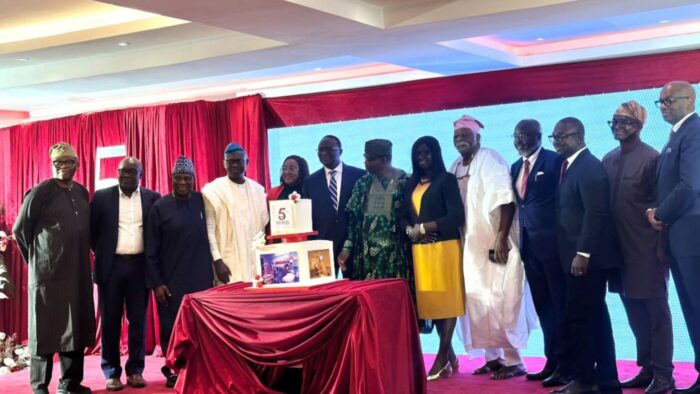
As family, friends, associates, mentees and dignitaries converged to celebrate the octogenarian, the venue became a theatre of memories, with tributes and anecdotes bringing decades of experiences vividly to life. It was a celebration of not just a birthday, but of a life that has gathered stories, friendships and footprints along the way. And the icing for the celebrant was the unveiling of the book, ‘Ladbone: A life in Print,’ which is a collection of essays honouring him, published by the Centre for Journalism Innovation and Development and edited by Mr. Dapo Olorunyomi.
Bonuola, popularly called Ladbone, was overwhelmed by the honour done him on the day. In his speech, he said he got to know about the event and the book about two weeks before the day, when Olorunyomi came to personally invite him for the event. He said they had informed him about the idea of the book many months before but he had dismissed such as he was not willing to toe that line. He, however, said he would have regretted not attending the event and hearing about all the tributes and encomium poured on him later.
Bonuola recounted how Alhaji Babatunde Jose spotted him and gave him all the necessary training at home and abroad. He also talked about how Chief Olusegun Osoba had a lot of confidence in him while Kusa was unwavering in his guidance.
According to him, the late publisher of The Guardian, Mr. Alex Ibru, never interfered in his work for once.
“I was sending news schedule to him, but be never opened it. He would say you are the expert while he is a business man,” he recalled.

Bonuola urged the attendees to thank Jose, Osoba, Michael and Alex Ibru for helping to shape his journalism destiny. He urged the participants to offer prayers for the four anytime they have the time to do so.
The Chief Organiser of the event, Mr. Dapo Olorunyomi, who is also the Publisher, Premium Times and CEO, CJID, in his welcome address, described the ceremony as a mini journalism festival of sorts.
“We are here to recognise, once again, the life, times and work of perhaps the most consequential editor in the late 2oth century history of the Nigerian print press. It is, therefore, a moment of gratitude for the life in print of Mr.
Lade Bonuola, a life that began in 1976 at the Daily Times and ran through The Guardian, The Comet and Compass.
“That half-century, 50 years of a profoundly demanding and momentous professional life, is being marked today, in part, by family, friends and mentees with a biographical anthology of essays. In about 750 pages, it explores six dimensions of Ladbone’s life: his moments of excellence, his life as a legend, the architecture of his editorial genius, his extraordinary record of mentorship, the power and meaning of his courage, and the reality that behind that granite posture lies, as one contributor, Ben Tomoloju, aptly puts it, a greatness of spirit as a father, grandfather, husband, friend and neighbour. The book is titled ‘LADBONE: A Life in Print.’
“We leave it to thoughtful scholars of Nigerian media history to decide whether there was a greater editor in that era. But as more than 60 contributors have asserted, Ladbone had few equals, if any. We are deeply grateful for his labour of love to the country, to the profession, and to the unfinished task of building a resilient democracy in our land.”
Olorunyomi said the idea for the book grew out of the organisers’ continuing effort to help remake Nigerian journalism, which has travelled in many directions since the birth of the newspaper press in this country in 1859.
“In 2011, Mr. Musikilu Mojeed, who is unavoidably absent today, and I co-founded Premium Times as an intervention to strengthen fact-based reporting. By 2014, it had become clear that only an ecosystem-wide intervention could deliver the ambition we had in mind: to build a spirit of innovation into the very innards of our media system, in how we cover news, how we distribute content, and how, more broadly, we finance journalism in the digital age.
“In 2020, we renamed the organisation to keep pace with the spirit of the age, recognising the centrality of technology to the future of our media. That vision has since found substance in an expansion that today places the Centre for Journalism Innovation and Development (CJID) in 15 programme offices across Africa,” he stated.
Olorunyomi said that last year, the CJID launched the Living Archives Initiative. Among its broader goals, he said, include digitising and preserving the works, times and personalities that have given meaning to a part of the world, Africa.
“Fittingly, we began with our own constituency, the media, and with someone who remains a veteran on active duty. The choice was inescapable: Lade Bonuola, the great Ladbone!
“Those who know him will know he is a man of very few words, so this project was, frankly, an act of insurgency. He first heard about it from the people we had asked to write essays. He was initially shocked and probably considered shutting the whole thing down. But, wise man that he is, he quickly realised that resistance was futile. Then came the task of gathering photographs and documents, for which we relied on the kind collaboration of co-conspirators within the family. We even arranged for his wife to visit their children and grandchildren in Abuja, purely, of course, so she could help us fill a few gaps in the family history.
“Today, we thank his six daughters and eleven grandchildren for their help and support in making this book possible. We thank the contributors, some of whom helped shape the project through early interviews before writing their own essays.
We thank our board members, who approved this work. And we must not forget the tireless and remarkable management and staff of CJID and Premium Times, the backbone of our growth and continued success,” he added.
Former Ogun State Governor, Osoba, who chaired the event, recalled that Bonuola came in as a sub-editor to Daily Times when he was Editor of Sunday Times.
According to Osoba, both of them often had a tough time during production as Bonuola often wanted to ensure that all the stories were edited, painstakingly going through the copies which often slowed the pace of production.
He noted that Bonuola often paid too much attention to details while he was always conscious of meeting deadlines and getting the paper early to the news stand the next day. Osoba felt that it was one of the reasons that Bonuola started a
column called, ‘Caught Out,’ where he spotted errors in all the newspapers.
“When The Guardian was established, the late publisher Alex Ibru wanted a serious minded newspaper patterned along London Times and I told him that the best editor is Bonuola. He created a standard that others started following, with his good friend, Kusa,” Osoba said.
Osoba also called for one minute silence to honour Prof. Idowu Sobowale and Ambassador Patrick Dele Cole.
On his part, Kusa noted that Bonuola would usually rewrite almost every sentence in a copy a reporter sent to him, aside from asking for more information to make the story more readable and better appreciated by readers.
He also recalled how both of them made it a standard that all news stories must be background, which also means they would breathe into all news copies.
“When The Guardian started, we maintained quality writing. Nduka Irabor joined us later. We found him a wonderful newsroom person. Mr. Emeka Izeze also helped sanitise the quality of news writing,” he stated.
Just before the book was unveiled, there was a panel discussion around the future of Nigerian journalism. On the panel, moderated by Azu Ishiekwene, were Kadaria Ahmed, Ifeanyi Mbanefo and Chiamaka Ozurumba.
The discussion highlighted the changing phase of journalism and how journalism was practiced in the era of Bonuola cannot be wholly replicated though issues around integrity and ethics remain the same.
On his part, Consul General of the Kingdom of the Netherlands in Lagos, Frank Keurhorst, said: “Today is not only about celebrating Bonuola but also an opportunity to reflect on the role journalism plays. Nigeria has rich media landscape and it has helped reform the country. Bonuola’s contribution reminds us of his professional integrity and editorial independence. An independent press is essential to strengthening democracy and it is important we preserve the stories of those who defend it. This is why the CJID Living Archives Initiative is important by documenting experiences of journalists and helps ensure that this important history is not lost. We are proud of our long-standing relationship with CJID.”
Reviewing the book, Mr. Kunle Ajibade, noted that Bonuola is a man of institutional building. He added that many of the contributors talked about their own stories while passing through Bonuola.
Ajibade described him as a journalism exemplar, statesman, the legend, the great teacher, the standard bearer, the architect of truths, the editor of editors, the bone of our bones, the engine room of The Guardian, a solid bridge across generations, a consummate workaholic, a media policeman, a veteran of note, an extraordinary talent supporter and a disciplinarian.
“The book is inspiring and enlightening. It is an affirmation of visionary power and a celebration of significant values.”
He described the book as a master class for those who aspire to excellent public service.
“As many of the writers tell the stories of their interactions with him, they also tell plenty of stories of their own professional lives.
“The conference of these stories, the narratives within narratives, give us access to the history of Nigerian journalism itself. There are many engaging recollections here of how he was an inspiration,” Ajibade said.
He noted former President Ibrahim Babangida, former Vice President Yemi Osinbajo, former governor of Osun State, Bisi Akande; Osoba and former governor of Lagos State, Babatunde Fashola, attested to Bonuola’s courage and insight as a public affairs commentator.
“He was a voracious reader and a passionate lover of debate at Secondary school, where he won the John F. Kennedy zonal essay competition.
“His column in The Guardian is the longest running column in the history of Nigeria. He also noted that he was English and Literature-in- English teacher at Methodist High School, Arigbajo Ifo, Ogun State, including highlighting how he rose from being a sub-editor, chief sub-editor, production editor, features editor and member of the editorial board of Daily Times before moving to The Guardian were he started as Associate Editor and rose to be the Managing Director.
Chiamaka Ozurumba of CJID, stated that the organisation had worked on the book project for over a year, stating that it took a lot of pain to get some of the materials out.
Speaking on the importance of documentation, which is the major reason for the book, Ozurumba said: “Journalists have documented our political transitions, our democratic struggles, and the exercise of power and everyday experiences of our society. But journalism is not our starting point. Our wider ambition is to build a repository that eventually extends beyond journalism to other disciplines like medicine, like banking, like science, because all of this, all of the knowledge production over the years, needs to be preserved and we understand that importance.”
The Secretary of CJID Board, Fred Adetiba, while delivering the vote of thanks, noted: “Today has been a celebration of a remarkable life, a distinguished career and a legacy that has contributed significantly to the development of journalism in Nigeria.”
He noted that the event is not just a celebration of age but also a celebration of over five decades of professional excellence, of service to journalism, and of the values and standards that have defined Bonuola’s remarkable journey.
“I would like to specially appreciate Professor Bonuola and his family for allowing CJID to be part of this important milestone and, more importantly, for partnering with us to preserve his story and legacy for generations to come.”
Some of the personalities at the event include former Minister of Information, Alhaji Lai Mohamed; Lagos State Commissioner for Information, Gbenga Omotoso; former Managing Directors of The Guardian, Femi Kusa, Emeka Izeze and Martins Oloja; Pro-democracy activist, Ayo Obe; former Editor of Punch, Gbemiga Ogunleye; Sully Abu; Nigeria Guild of Editors’ President, Eze Anaba; Managing Director, ThisDay, Eniola Bello; former Commissioner for Information, Lagos State, Steve Ayorinde; former NGE President, Funke Egbemode; Managing Director of The Sun, Onuoha Ukeh; Director Journalism Clinic, Taiwo Obe; former Editor, The Guardian on Saturday, Banji Adisa; former Editor, The Guardian on Sunday, Fred Ohwahwa and former Special Adviser to Governor Babatunde Fashola on Information, Hakeem Bello.
There was a huge number of former staff of Daily Times. There were also representatives of members of his alma mater and his community in Oyo State, Kishi.
Others are Chief Eric Teniola, Dr. Tunde Abayomi and Publisher Novation Magazine, Dele Momodu; Secretary, CDIJ, Olumide Adetiba; daughter of the celebrant, Mrs. Biodun Ozurumba; celebrant, Lade Bonuola; former Librarian of The Guardian, Titi Oba, former Executive Director, The Guardian, Oyebanji Awosanya; Managing Director of Punch, Adeyeye Joseph; Co-founder Newswatch, Ray Ekpu; Othman Dosumu-Sodipe; Augustine Isioma Iwelu; former House of Representative member, Nze Chidi Duru; Editor, Saturday Tribune, Lasisi Olagunju; Tribune newspaper Editorial Member, Festus Adedayo and Publisher BusinessDay, Frank Aigbogun.