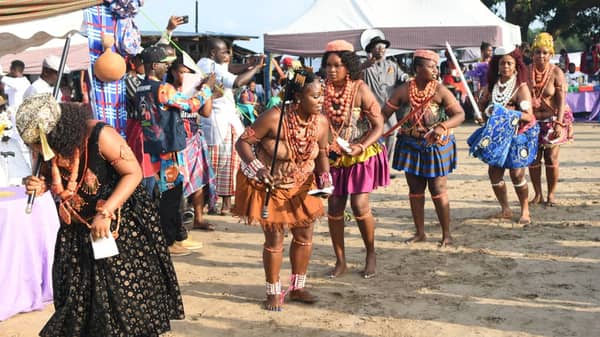
The Kalabaris, comprising three ancient riverine councils, the Akuku -Toru, Asari -Toru and Degema, of Rivers State ijaw extraction, marked their traditional New Year festival recently .
The celebration, according to the people, marks the reenactment of history and a revitalisation of the spiritual essence of the Kalabari people.
It was learned that in the Kalabari traditional belief system, the festivity brings cleansing of its water and land, which they believe purges all the sea pollution.
The event, which held on November 15, marks the end of a current year and the beginning of a new one from the next day, being November 16.
Harry Awolayeofori MacMorrison, Chief administrator and chairman of Kalabari Renaissance Foundation, described the new year as a renewal of the people (of Kalabari Kingdom).
He said: “It’s the renewal of the people. Kalabari area is saline environment and at a time, the Sombrero River comes in and pollutes the river. On November 15, across Kalabari, the tide turns and takes all the fresh water that polluted the saline river back to the Sombrero River. On the 15th is the end of the year. Normally when there is an end, there is a new beginning. On the 16th (November) is the beginning of the Kalabari calendar.”
Tracing history, Mac Morrison said the new year festival had been an annual celebration for centuries, dating back to pre-slave trade times when the Kalabaris were living in their first place of abode known as Elem Kalabari or Torusaramapiri, now referred in their local parlance as ‘Old Shipping.’
That unified new year celebration stopped when Kalabari communities began to migrate from Elem Kalabari about 150 years ago to their present abodes in Bakana, Abonnema (Nyemoni) and Buguma in Degema, Akuku-Toru and Asari-Toru councils respectfully.
However, the migration and dispersal of the Kalabari communities did not stop them from observing and celebrating their traditional new year. All the communities continued to celebrate the festival in their own way until the Renaissance Foundation, an organisation committed to reviving, restructuring and promoting the traditional and cultural heritage of the Kalabari ethnic nationality, decided to harmonise the celebration last year.
“It’s been happening for centuries. This community we’re in (the venue of this year’s festival) is Elem Kalabari. Elem Kalabari is old Kalabari. This was where all the Kalabari communities were but they left to the other communities and those celebrations ended. All the other communities commemorate it individually but last year was the beginning of unified commemoration. Unified commemoration means that all the communities come together to commemorate it instead of Independently.commemorating it.
“Last year, it was commemorated at Abalama. This year, it is in Elem Kalabari. Next year, we will all vote again for the next community that will host it,” the chairman of Kalabari Renaissance Foundation, MacMorrison, said.
He added that the new year festival signifies socio-cultural unity, peace and economic development of the Kalabari Ethnic Nation, noting that his Foundation is also planning to launch a development master plan that will chart a course for Kalabari’s economic growth leveraging their rich trado-cultural heritage.
“It (the new year festival) unifies, brings about peace and it also brings about development. Today, we’re unveiling and launching the Kalabari master blueprint for development. It’s a 25-year plan for Kalabari,” he said.
For the Elem Kalabari community, an ancient city-state once ruled by King Amachree I, hosting the 2025 Kalabari new year festival, which has as its theme, CElebrating Our Heritage, Honouring Our Waters And Renewing Our Spirit, was not just a nostalgic reenactment of history but also a revitalization of the spiritual essence of the Kalabari man. It was also like a home-coming that reconnected the Kalabaris to their aboriginal source – their cradle.
The Amanyanabo (King) and Paramount Ruler of Elem Kalabari, Asari Dokubo, reflected on the traditional, cultural and spiritual significance of the festival.
Dokubo likened the Kalabari traditional renaissance new year festival to a resurrection from death under the auspices of the Kalabari Renaissance Foundation, organizers of the historic event.
“It’s not just about celebration. It’s about recreating ourselves, bringing us back from death. The organization that has come to take over this celebration – Renaissance – really fits the description of what ought to happen us as a people. It’s not just Kalabari; it’s about all of us and our values. We have to look at ourselves and our values,” he said.
Asari, who said Elem Kalabari was the first place an African was addressed as king in the 19th century, tasked the academics and mystics of Kalabari origin to come together and calculate their real calendar time based on their traditional new year, adding that while some countries and races calculate their calendar based on the lunar and solar cycles, that of the Kalabari nation should be based on their marine cycle.
“This place (Elem Kalabari/ was the first place Europeans decided to call an African king…Let us take our own very important. Russians will not have the same calendar with us. Russian new year, even though they’re all Christians, is different from Nigerian new year.
Ethiopian new year is different from Nigerian new year. Chinese new year is coming. They’re going to go on vacation for up to two months. India too.
“When we want to do our own, people say it’s demonic. So, what of the Ethiopian people who are doing new year, it’s demonic too? The Russian people who are doing their own year; Russian Christmas is different, Russian new year is different, their own too is demonic too? You see, when we don’t have an argument to support our point, we bring something that somebody cannot explain. When you go into the realm of the spirit, a lot of people cannot explain, we can only guess.
“And for the intellectuals, for the geographers, astronomers, I think we should sit down and draw a proper calendar, following the course of how our fathers calculated their own. Other people have lunar calendar, solar calendar; our own is by the water. So we should be able to calculate our own by the movement of the water and have a proper calendar,” Dokubo said.
Ibiba Don Pedro, a member of the Kalabari new year festival planning committee, said there was need to reawaken the consciousness of their people on the need to embrace their traditional values without reservations, noting that there was nothing fetish about the festival.
She said the new year festival was the most significant celebration of the Kalabari people, given its cultural, spiritual and ecological impact on their lives, adding that she is proud to be part of it.
“The Kalabari new year is not just a new year by name or just another event in the calendar of the Kalabari people. It’s the most significant in the sense that this is the beginning of life for our people and it has ecological, cultural, spiritual meanings and indications.
“The Kalabari new year represents that period when the almighty Atlantic ocean – the Abaji -pushes back the flood water from the fresh water and comes back on its own, cleaning up the whole environment. Because we’re a salt water people, all the fishes, all the sea life comes alive from today November 16. The Kalabari new year is an event of great significance, at the very centre of our lives as Kalabari people, a riverine people. From today, we’re back to our lives. It’s a rhythmic thing, it’s something that happens in a cycle,” Ibiba, a journalist and environmentalist, said.
Also speaking,Chairperson of the Torusarama Piri Women Council and President of Ijaw Women Connect, Dr. Vivian Dabota Elenwo, said, “God will teach his people how to count their times and their age. So if we count our times and our age by our own calendar, I think it would be better for us than copying from other people’s calendar.”
She expressed optimism for the New Year, stating that, “the new year brings in good things, better plans, and we’re looking forward to a better people, performance, and a better prosperity.”
The New Year festival which attracted guests from across Kalabari communities, Nigeria and the globe, featured cultural performances, a boat regatta, and the unveiling of development blueprints that the organisers say will shape the kingdom’s future for decades.