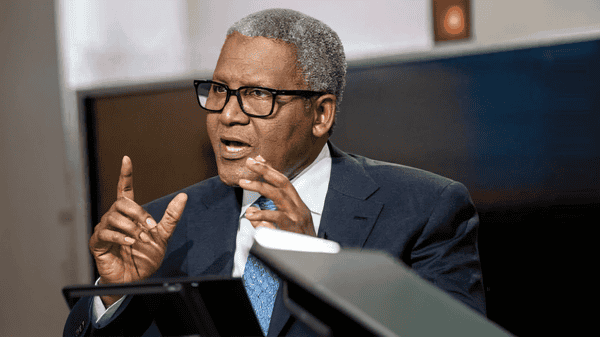
President and Chief Executive of Dangote Industries Limited, Aliko Dangote, has called for an investigation of the operations of the Nigerian Midstream and Downstream Petroleum Regulatory Authority (NMDPRA), citing economic sabotage that is undermining domestic refining in Nigeria.
Speaking at a press conference at the Dangote Petroleum Refinery yesterday, Dangote accused the leadership of the NMDPRA of colluding with international traders and oil importers to frustrate local refining through the continued issuance of import licences for petroleum products.
The Dangote Group chairman assured Nigerians that the pump price of Premium Motor Spirit (PMS) would fall further, stating that petrol would sell at no more than N740 per litre from tomorrow, beginning in Lagos, due to his refinery’s reduction of the gantry price to N699 per litre. He said MRS filling stations would be the first to reflect the new pricing.
Expressing concern over the state of the downstream sector, Dangote said Nigeria’s continued reliance on fuel imports was harming local production and discouraging investment in domestic refining. He disclosed that import licences covering approximately 7.5 billion litres of PMS had reportedly been issued for the first quarter of 2026, despite the availability of significant domestic refining capacity.
According to him, modular refineries are already struggling under the current policy environment and on the brink of extinction, while the persistent issuance of import permits further weakens the sector.
“I am not calling for Farouk Ahmed’s removal, but for a proper investigation. He should be required to account for his actions and demonstrate that he has not compromised his position to the detriment of Nigerians. What is happening amounts to economic sabotage,” Dangote said.
“The Code of Conduct Bureau, or any other body deemed appropriate by the government, can investigate the matter. If he denies it, I will not only publish the tuition he paid at those secondary schools, but I will also take legal steps to compel the schools to disclose the payments made by Farouk. I sent my own children to secondary schools here in Nigeria. How many Nigerians can afford to pay five million dollars for secondary school tuition, not university education? In his home state of Sokoto, many parents are struggling to pay as little as N10,000 in school fees,” Dangote said.
He described the downstream petroleum sector as being under severe strain, alleging the presence of entrenched interests that profit from fuel imports at the expense of national development.
“There are powerful interests in the oil sector. It is troubling that African countries continue to import refined products despite long-standing calls for value addition and domestic refining. The volume of imports being allowed into the country is unethical and does a disservice to Nigeria,” he added.
Dangote stressed the need for a clear separation between regulatory oversight and commercial interests, warning that allowing traders to influence regulation would undermine the integrity of the sector.
“The downstream sector must not be destroyed by personal interests. A trader should never be a regulator. Forty-seven licences have been issued, yet no new refineries are being built because the environment is not conducive,” he said.
He maintained that Nigerians would ultimately benefit from local refining, even as fuel importers incur losses. Dangote said he would not relent in ensuring that Nigerians enjoy the benefits of domestic refining, noting that the company was working around the clock to ensure that recent reductions in the gantry price were fully reflected at the retail level.
From tomorrow, he said, all MRS filling stations would begin selling PMS at prices not exceeding N740 per litre, starting in Lagos. He added that the refinery had reduced its minimum purchase requirement from two million litres to 500,000 litres to enable more marketers, including members of the Independent Petroleum Marketers Association of Nigeria (IPMAN), to participate.
“So if you come to the refinery today, you will get PMS at N699 per litre,” he said.
Dangote disclosed that despite frustration and sabotage, the refinery would deploy its Compressed Natural Gas (CNG) trucks in the coming days and was prepared to procure additional units beyond the initial 4,000 if required to sustain affordable pricing nationwide.
Responding to complaints from oil importers that the recent price reduction would result in losses, Dangote said the refinery was established primarily for the benefit of Nigerians.
“Anyone who chooses to continue importing despite the availability of locally refined products should be prepared to face the consequences,” he said.
He also highlighted quality differences, noting that products supplied through MRS and other offtakers from the refinery were straight-run fuels, unlike blended products imported from overseas markets.
“Nigerians have a choice to buy better quality fuel at a more affordable price or to buy blended PMS at a higher rate. Importers can continue to lose, so long as Nigerians benefit,” he added.
Dangote said the refinery was driven more by legacy than profit, noting that he could have invested the 20 billion dollars elsewhere if financial gain were his sole objective. He revealed plans to list the refinery on the Nigerian Exchange to allow Nigerians to own shares in the facility.
“We want every living Nigerian to have the opportunity to benefit, no matter how small their holding. If the market takes 55 per cent and I retain 45 per cent, I am satisfied,” he said.
He disclosed that discussions were ongoing with the Securities and Exchange Commission (SEC) to enable Nigerians to purchase shares in naira while receiving dividends in dollars.
Dangote accused the NMDPRA of misrepresenting the refinery’s capacity by publishing offtake figures rather than actual production levels.
“We have the capacity to meet local demand, and we have sufficient refined products in stock. But to keep prices high, imports are deliberately encouraged,” he said, adding that attempts were being made to push the refinery into exporting products only for them to be re-imported into Nigeria at higher prices.
“This refinery is for Nigerians first, and I am not giving up,” he said.
Dangote also disclosed that the refinery imports an average of 100 million barrels of crude oil annually from the United States, a figure expected to rise to 200 million barrels following expansion, due to insufficient domestic crude supply. He added that the refinery also sources crude from Ghana and other countries, while exporting jet fuel and gasoline to the United States.
He further alleged that domestic refiners are forced to buy Nigerian crude at premiums of up to four dollars per barrel from the trading arms of international oil companies, placing them at a competitive disadvantage.
He called on the government to ensure crude oil taxes are assessed based on actual transaction values, warning that the current system allows under-declaration and revenue losses.