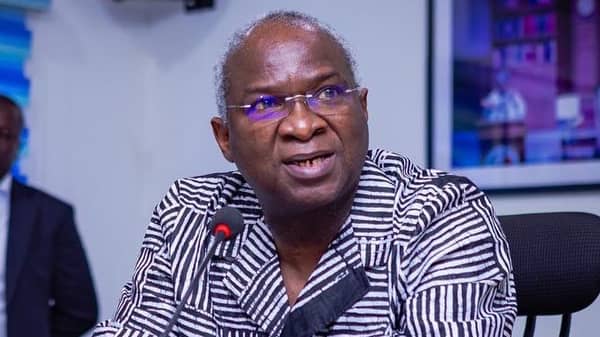
Former Governor of Lagos State, Babatunde Raji Fashola (SAN), has described a renewable energy law and policy book authored by a legal practitioner and policy analyst, Dr Bitrus Joseph Bulama, as a timely and seminal contribution to the study of Nigeria’s renewable energy legal and policy framework.
Fashola, who authored the Foreword to the new book titled ‘Renewable Energy: Law and Policy in Nigeria – A Crosscutting Perspective’, said it has addressed the role of law in promoting investment in renewable energy as well as examined the relationship between law, development and access to electricity in the country.
He noted that while international efforts at promoting renewable energy dated back to the Montreal Protocol of 1987, the sector only began to gain traction in Nigeria about a decade later.
He further traced the evolution of Nigeria’s power sector, referencing the coming into force of the 1999 Constitution and the enactment of the Electric Power Sector Reform Act of 2005, which ended the government’s monopoly and initiated deregulation.
Reflecting on his assumption of office in November 2015 under President Muhammadu Buhari, Fashola explained that the Ministry of Power was in transition following the privatisation of electricity generation and distribution networks in 2013 by former President Goodluck Jonathan’s administration.
According to him, the Ministry relinquished generation and distribution assets to private owners along with over 5,000 staff, leaving it with fewer than 1,000 personnel and a mandate focused largely on policy formulation.
“From that point, the Ministry and its leadership shifted from being power providers to policy enablers”, he said. Fashola recalled that policies and programmes became the primary instruments available to improve energy supply. He cites the presentation of what he described as Nigeria’s first published Energy Mix Document, committing the country to 30 per cent renewable energy within a projected 30-gigawatt capacity by 2030.
This was followed by the Renewable Energy and Energy Efficiency Policy in 2015, the Mini-Grid Regulations in 2016 and the Building Energy Efficiency Code in 2017. He explained that the background informed his decision to accept Dr Bulama’s invitation to write the foreword to the book.
According to Fashola, the book offers a comprehensive account of Nigeria’s renewable energy sector, beginning with a historical overview dating back to 1896, when the first power station was built in Lagos with an installed capacity of 60 kilowatts.
He highlighted chapter four of the book for its detailed examination of the legal, policy and institutional frameworks governing the renewable energy sector in Nigeria.
Fashola also identified the fifth chapter as the core of the book, noting its discussion of challenges confronting renewable energy development in the country. Drawing from his experience supervising the sector, he stated that he shared many of the author’s views on the challenges, some of which were addressed through the Power Sector Recovery Programme developed during his tenure.
The Foreword also referenced the establishment of public institutions such as the Rural Electrification Agency, Nigerian Bulk Electricity Trading Plc, the Transmission Company of Nigeria, the Energy Commission of Nigeria and the National Council on Climate Change, as evidence of government political will. Fashola further mentioned a contemporaneous budgetary appropriation for solar panel installation at the Presidency in 2025 as another demonstration of the government’s commitment to renewable energy leadership.
In his assessment, he suggested that extensive but undocumented investments in renewable energy by households and businesses may mean that renewables already contribute more than 30 per cent of Nigeria’s national energy consumption.
While commending Dr Bulama’s scholarly approach and successful presentation of complex industry concepts in clear and accessible language, Fashola described the book as a practical resource for policymakers, legal professionals, energy practitioners, researchers, opinion leaders and environmental advocates interested in the interaction between law, policy and energy in Nigeria.
The over 900-page book was published by Bar and Bench Publishers, Abuja, and positioned as a comprehensive reference for all those seeking to navigate Nigeria’s renewable energy regulatory landscape, as well as those who wish to understand the emerging field of renewable energy law in Nigeria.