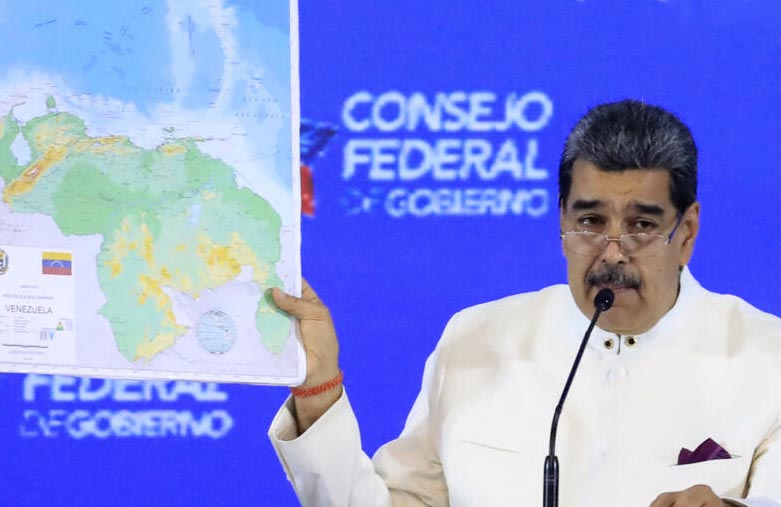
World leaders called for calm Thursday as Venezuela decried joint US-Guyana military exercises as a “provocation” and vowed to push ahead with the “recovery” of an oil-rich region both neighbors claim as their own.
The UN Security Council called an urgent meeting for Friday on the fast-escalating row that Guyana said “threatens international peace and security.”
Fears of the conflict blowing up have deepened after Venezuelan President Nicolas Maduro’s government held a controversial referendum Sunday on the fate of the Essequibo region.
Maduro’s 2018 reelection was rejected by the United States and dozens of other nations as fraudulent. He is widely expected to seek a third consecutive term next year.
Addressing the recent flare-up, Guyanese Vice-President Bharrat Jagdeo said Venezuela “is not going to succeed, now or ever” at taking the Essequibo region.
“Every single movement that Venezuelans make, particularly in the proximity of our borders, is tracked, every single one of them.”
The United States, through National Security Council spokesman John Kirby, urged the sides to find a diplomatic solution to the territorial dispute, saying “we don’t want to see this come to blows.”
But Washington provoked an angry response from Caracas by announcing via the embassy in Georgetown it would hold joint “flight operations within Guyana” as part of “routine engagement and operations to enhance security partnership” with its ally.
“This unfortunate provocation by the United States in favor… of ExxonMobil in Guyana is another step in the wrong direction,” Venezuelan Defense Minister Vladimir Padrino Lopez said on X, formerly Twitter.
He added: “We will not be diverted from our future actions for the recovery of the Essequibo,” where the US oil giant has discovered crude.
Essequibo has been administered by Guyana for more than a century and is the subject of border litigation before the International Court of Justice (ICJ) in The Hague.
It makes up about two-thirds of Guyanese territory and is home to 125,000 of the country’s 800,000 citizens, but is also claimed by Venezuela, which does not recognize the ICJ’s jurisdiction and is seeking to bring the area under its rule.