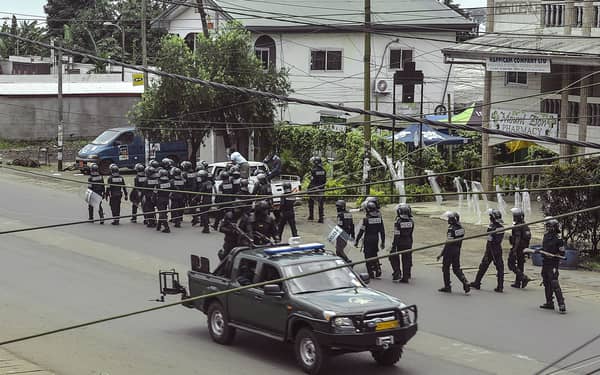
Cameroon’s main opposition party on Thursday accused the government of having “militarised” two regions shaken by unrest among the country’s anglophone minority.
“The Northwest and Southwest regions are heavily militarised,” the head of the Social Democratic Front (SDF), Jean Tsomelou, said in an interview with AFP, describing the situation as “worrying.”
“We have observed troop movements in both regions. The government has spoken of thousands (of troops) who are in the Southwest and Northwest,” he said.
“Abuse has been committed” against local people, he said.
In September and October, “live fire was targeted against people who were simply carrying a message of peace,” he charged.
English-speakers account for some 20 percent of the nation’s population of 23 million. The minority dates to the emergence of Cameroon in 1960-61 as France and Britain wound down their colonies in west Africa.
Anglophones have long protested against what they perceive to be a bias in favour the French-speaking majority.
Since November 2016, resentment has fed demands for autonomy or a separate state to which the government has responded with a crackdown, including curfews, raids and restrictions on travel.
International monitors say at least 20 and possibly 40 people have been killed since late September.
In turn, separatists have begun an armed campaign, targeting police and soldiers. Ten were killed last month alone, the authorities say.
“We condemn loss of human life on both sides,” said Tsomelou, a francophone senator, adding that his party would send a delegations of MPs and senators to the two anglophone regions to urge people to be “calm and wait for a peaceful solution.”
He singled out Cameroon’s 84-year-old president, Paul Biya, for sharp criticism, saying he “let the situation degenerate” in the two regions in order to justify his crackdown.
“It’s a problem that could have been resolved by dialogue,” he said.
On December 1, Biya lashed the secessionists as “a band of terrorists” and vowed to carry out every measure “to incapacitate these criminals.”
[ad unit=2]