
BANGUI (Reuters) – CENTRAL Africans cast their ballots yesterday in an election meant to restore democratic rule, determined to turn the page on years of bloodshed that has killed thousands and split the impoverished nation along religious and ethnic lines.
One of the world’s most chronically unstable countries, Central African Republic (CAR) was pitched into the worst crisis in its history in early 2013 when mainly Muslim Seleka fighters toppled President Francois Bozize.
Christian militias responded to Seleka abuses by attacking the Muslim minority community. One in five Central Africans has fled, either internally or abroad, to escape the violence.
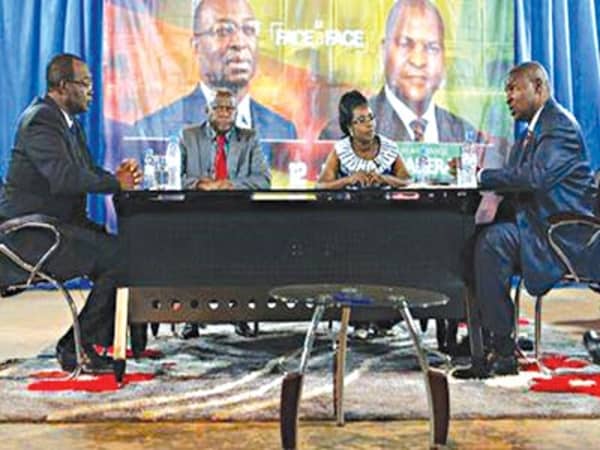
Two ex-prime ministers, Faustin-Archange Touadera and Anicet-Georges Dologuele, were contesting a presidential run-off that will determine who will be charged with the enormous challenge of restoring peace and reuniting the nation.
Touadera has portrayed himself as an anti-corruption stalwart, while Dologuele pledges to revive the economy and draw in investors hesitant until now to exploit significant gold, diamond and uranium deposits.
Authorities were also trying to re-run a first round of legislative polls which were canceled over irregularities.
In Bangui’s PK5 neighborhood, the capital’s principal Muslim enclave following a campaign of ethnic cleansing, some voters arrived before dawn to queue at the main polling center.
Alima Zeinabou Shaibou, 32, who like most Muslims in the southwest has been forced to leave her home, crossed the road from the mosque where she now lives with her five children to be among the first voters. “I want there to be a change. I want Christians and Muslims to live together as before,” she said.
The voting center in PK5 witnessed violent attacks by local militia during a December constitutional referendum. And though the situation has remained largely calm during the election period, Sunday’s vote was held under heavy security.

