The Resource Centre for Human Rights and Civic Education (CHRICED) has faulted President Bola Tinubu’s claim of economic growth, saying the realities faced by ordinary Nigerians contradict the administration’s narrative of progress.
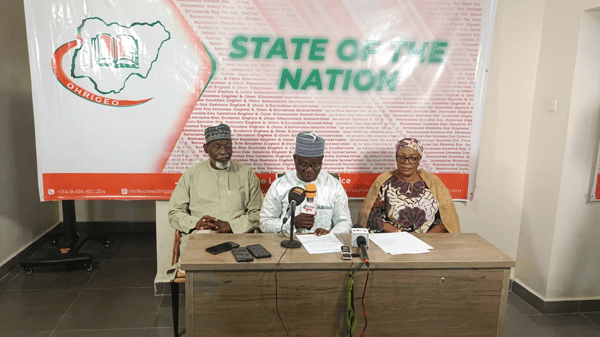
Speaking on Saturday at a media briefing on the state of the nation in Abuja, the Executive Director of CHRICED, Comrade Ibrahim Zikirullahi, said the Federal Government’s much-publicised economic growth had not translated into improved living conditions for citizens.
Zikirullahi was reacting to Tinubu’s New Year address, in which the President highlighted signs of economic recovery and growth. He questioned who was benefiting from such growth amid rising poverty, insecurity and hardship.
“When they say there is economic growth, growth for whom? Has the price of food dropped? Has the price of fuel dropped? Has cooking gas become cheaper? Have bank charges reduced? If there is growth, Nigerians should be able to afford basic necessities of life,” he said.
He described the President’s address as predictable, arguing that political leaders often use polished language to present their performance in favourable terms while ignoring the lived experiences of citizens.
According to him, genuine economic growth should be reflected in improved incomes, job creation and reduced cost of living, rather than macroeconomic indicators that have little impact on households.
“There is no way a president will take himself to account because, in the eyes of the public, he will be regarded as a failure. So speeches are crafted to suit their own taste.
“If there was real growth, we would be hearing verifiable figures, millions of young Nigerians fully employed, families able to feed themselves, children staying in school. Instead, children are being withdrawn from schools, farmers are afraid to go to their farms, and people are scared to travel because of insecurity,” he said.
Zikirullahi criticised the removal of fuel subsidy, rising electricity tariffs and other fiscal policies, saying they had compounded hardship for citizens who were repeatedly told there was no money, even as government officials lived in comfort.
“You keep taxing the people to death — fuel subsidy removal, electricity tariffs, bank charges. Every sector is squeezed. Yet those in power are celebrating Christmas and New Year in luxury,” he said.
He accused the political elite of benefiting disproportionately from economic reforms and painted a grim picture of Nigeria’s outlook in 2025, citing rising inflation, a weakening naira, worsening insecurity, shrinking civic space and what he described as an accelerated drift toward a de facto one-party state.
Zikirullahi warned that unless urgent corrective measures were taken in 2026, public trust in governance and democracy would continue to erode.
He urged Nigerians to reject what he described as half-truths from political leaders and to speak out against policies that deepen hardship.
“Despite massive allocations to defence and security, Nigerians remain trapped in fear. Kidnappings, banditry, insurgency, and violent crime continued to ravage communities across the country.
“From highways to farmlands, from schools to marketplaces, from Churches to Mosques, insecurity tightened its grip, leaving citizens traumatized and exhausted.
“Farmers abandoned their fields. Students were abducted or forced out of school. Businesses relocated or shut down. Entire communities were displaced. The human and economic toll is staggering and unacceptable.
“A nation that cannot guarantee safety cannot guarantee development. Nigeria cannot rise while its citizens live under siege,” he added.