Washington lobbyist urges U.S. to treat Nigeria like Venezuela
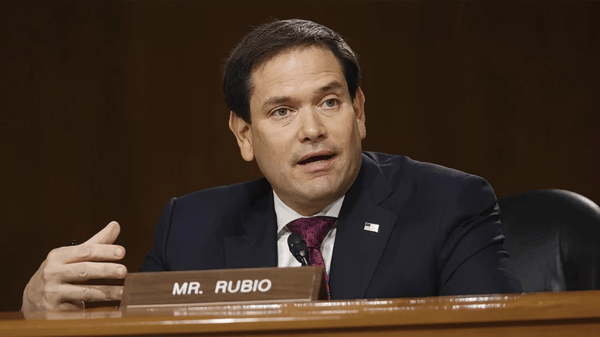
The United States yesterday escalated pressure on Nigeria as Secretary of State Marco Rubio announced looming visa restrictions for officials involved in religious freedom violations.
This came as a Washington lobbyist also called for Nigeria to be treated like Venezuela, stripping it of sovereign respect.
Rubio said that the United States is taking decisive action in response to what he described as atrocities and violence against Christians in Nigeria and other parts of the world.
In a statement posted on the social media platform X, Rubio said the U.S. Department of State would restrict visas for individuals who “knowingly direct, authorise, fund, support, or carry out violations of religious freedom”.
He added that the policy would apply to Nigeria as well as other governments or individuals involved in the persecution of people based on their religious beliefs.
For his part, Elias Gerasoulis — a Washington, D.C.-based lobbyist and government relations professional who works with clients on matters involving the U.S. Congress, the State Department, and other government agencies — posted on X, saying, “Nigeria doesn’t warrant the respect of a sovereign nation. The U.S. should approach Nigeria in the same way it approaches Venezuela.”
President Donald Trump had announced in November via his Truth Social platform that his directive to the Pentagon to prepare for a possible military invasion of Nigeria was aimed at halting what he described as the persecution and massacre of Christians in the country.
In a statement laced with fiery rhetoric, Trump warned that “if the Nigerian Government continues to allow the killing of Christians, the USA will immediately stop all aid and assistance and may very well go into that now disgraced country, ‘guns-a-blazing,’ to completely wipe out the Islamic Terrorists who are committing these horrible atrocities.
“I am hereby instructing our Department of War to prepare for possible action. If we attack, it will be fast, vicious, and sweet, just like the terrorist thugs attack our cherished Christians!”
The U.S. leader’s position, coming shortly after Nigeria was designated a “country of particular concern,” was reportedly based on claims that the Nigerian government had failed to curb attacks and tyranny against citizens, especially Christians.
This was followed in November by U.S. lawmakers issuing stark warnings over Nigeria’s worsening violence, questioning Abuja’s capacity and political will to protect Christian communities and other victims of extremist attacks.
In his reaction, former presidential aide, Bashir Ahmad, said, “This is a welcome development. All individuals, whether in Nigeria or abroad, who are causing trouble, fueling destruction or contributing to the killings in our country should be banned. Ban them all.
“They are also killing my fellow Muslims, not only your Christian brothers and sisters. If they undermine our peace and stability, they should be deprived of the privilege of ever setting foot in the United States again.”
He, however, criticised calls from the United States for Nigeria to abolish Sharia law and disband Hisbah commissions, describing the move as an attempt to interfere in the country’s internal matters.
He issued the reaction yesterday after a report emerged that U.S. lawmakers were urged on Tuesday to pressure the Nigerian government to end the implementation of Sharia law in northern states and to dissolve Hisbah bodies.
The appeal was made during a joint House briefing held in response to United States President Donald Trump’s October directive and the subsequent designation of Nigeria as a Country of Particular Concern.
At the briefing, Council on Foreign Relations Senior Fellow, Dr Ebenezer Obadare, said violent groups such as Boko Haram, the Islamic State West Africa Province (ISWAP), and radicalised Fulani militants were exploiting Sharia structures and Hisbah officials to push extremist ideology, enforce forced conversions, and operate with minimal resistance.
Reacting to the development in a post on X, Ahmad said he did not wish to continue engaging the topic but considered the development a clear intrusion into Nigeria’s internal affairs.
He stressed that the United States had no authority to determine how Nigerians should live, govern themselves, or practise their faith, noting that Nigeria is a sovereign country with its own constitutional and institutional frameworks.
He tweeted, “In as much as I don’t want to continue talking about this, but I must say this what a blatant intrusion into our internal affairs! The United States has absolutely no right to dictate to us how we should live, govern ourselves or practice our faith, as Nigeria is a sovereign nation with our own Constitution, democratic institutions, cultural values and legal frameworks.”
At a heated congressional hearing, legislators pressed for accountability, deeper U.S. engagement and urgent action to prevent further mass atrocities.
The House reviewed Nigeria’s redesignation as a country of particular concern (CPC).
In an emotional contribution, Congressman Bill Huizenga accused President Bola Tinubu’s government of “sitting back” amid worsening insecurity in Nigeria.
He directly criticised the Nigerian delegation for downplaying the crisis in Washington.
“It ought to be outrageous that Christians, moderate Muslims, and anyone being terrorised by radicalised Islamists in Nigeria are suffering while the Tinubu government sits back and does not do enough.
“I was recently interviewed by Nigerian television, and the question was whether the Tinubu government is doing enough. My answer: no, they are not. I do not understand how a delegation can come here and downplay the crisis or offer excuses for why this is allowed to happen. It should be rejected and called out for what it is,” Huizenga said.
Huizenga also criticised the media and some members of Congress for “denying” or “de-emphasising” the scale of the killings.
Recalling a Christmas Eve 2023 attack that killed 200 people, he said the incident highlighted that security conditions have not improved.
“Do we see Christians killing Muslims the way radicalised Islamists kill Christians in Muslim areas?” he questioned, highlighting the pattern of religious attacks in the country.
Representative Andy Olszewski called for a deeper and more urgent examination of Nigeria’s ability to protect Christian communities amid what he and other lawmakers described as escalating extremist violence.
Speaking at a U.S. congressional hearing on alleged Christian genocide in Nigeria, he argued that the Nigerian government lacks the means to safeguard citizens from groups that “kill indiscriminately”, while stressing that inadequate capacity does not absolve leaders of responsibility.
According to Olszewski, a government’s duty is to protect its people, and failures—whether due to neglect, corruption, or governance challenges—must be met with accountability.
He urged the United States to reassess its approach to Nigeria, questioning whether Washington is offering genuine partnership or relying on threats of sanctions and airstrikes instead of technical assistance, training and long-term institutional support.
Olszewski pressed U.S. officials on whether the State Department believes Nigeria has the capacity to defend Christians and other religious minorities from extremist violence.
In response, Ambassador Jonathan Pratt described Nigeria as a wealthy and populous nation facing a “very serious” security problem that the United States is attempting to help address.
Pratt said the core issue is not only capability but focus, noting that while the United States has provided various tools and assistance programmes, it wants to see greater Nigerian commitment to confronting religiously targeted attacks within the broader security crisis.
The congressman also raised concerns about disrupted youth-focused peacebuilding initiatives. Citing the U.S. Commission on International Religious Freedom’s 2025 report, he pointed to a State Department-funded programme in northeast Nigeria, Nigerian Youth Care, which had worked to bring Christian and Muslim youth leaders together but was halted for months due to administrative delays. The programme ultimately received no extension at the close of the fiscal year.
Olszewski asked Ambassador Pratt and senior State Department official Jacob McGee why the project had not been granted a no-cost extension and whether they would recommend reinstating it.
McGee responded that the United States remains the world’s most generous foreign aid donor and continues to support early-warning and interfaith dialogue programmes, while reviewing all assistance to ensure it is effective and aligned with the complex, multi-layered drivers of violence in Nigeria. He stressed the importance of acknowledging that religious persecution and extremist ideology play a central role in the crisis.