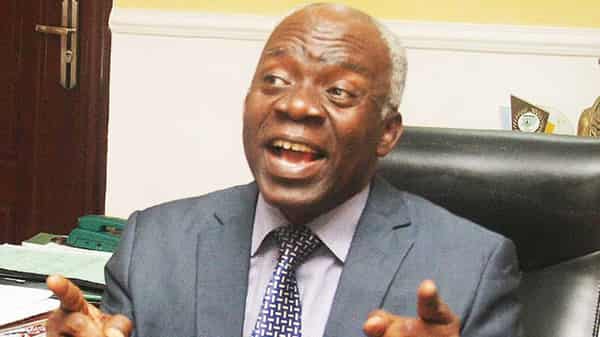
Human rights lawyer, Femi Falana (SAN), has called on the Federal Government, state governors and first ladies across the 36 states of the federation to “immediately end digital repression” and uphold constitutional guarantees on freedom of expression, media freedom and the rights of citizens in the digital space.
He warned that digital tools and cybercrime legislation were increasingly being used to target journalists, activists, students, whistleblowers and critics, despite constitutional and judicial protections.
Falana gave the charge while delivering a paper titled, “Press Freedom and Cybercrime Law in Nigeria: Bridging the Justice Gaps,” at the plenary session of the Nigerian Bar Association Section on Public Interest and Development Law (NBA-SPIDEL).
According to him, “Across Nigeria, serving and former public officers, and increasingly their spouses, have systematically weaponised law enforcement agencies to silence journalists, students, activists, whistleblowers, and political opponents.”
Falana noted that these practices persist despite constitutional safeguards under Sections 35, 36 and 39, as well as binding decisions of Nigerian courts and the ECOWAS Court of Justice, adding that the trend reflects “a residue of military culture” that still shapes law enforcement behaviour more than two decades after the return to democracy.
He said that although Section 24 of the Cybercrime Act was amended in February 2024 to remove vague terms, such as “annoyance,” “insult” and “ill-will,” security agencies continue to arrest citizens under the repealed provisions. He described this as “a profound justice gap” that undermines the rule of law.
“Press freedom remains a constitutional and democratic imperative in Nigeria. Yet, cyber-security legislation, particularly the former Section 24 of the Cybercrime Act, has been systematically weaponised by public officials and their spouses to silence dissent,” he said.
The human rights lawyer drew a historical parallel between current practices and colonial-era sedition laws, recalling how British administrators and later military regimes deployed criminal libel, sedition and “false news” offences to suppress dissent.
He, however, cited the 1984 Decree 4 and the imprisonment of journalists, such as Tunde Thompson and Nduka Irabor, as well as the detention of pro-democracy journalists under Decree 2.
“These incidents illustrate how sedition and ‘false news’ offences were weaponised to shield the powerful and silence dissent,” he said, adding that the framers of the 1999 Constitution intentionally strengthened protections for media freedom to prevent a return to authoritarianism.
Falana also referenced key judicial precedents, including Arthur Nwankwo v State, Tony Momoh v Senate of the National Assembly, and ECOWAS Court rulings in SERAP v Nigeria and Laws and Rights Awareness Initiative v FRN, which prohibit criminalising criticism of public officials.
He, however, condemned the continued arrest of journalists and activists, including those detained during the #EndBadGovernance protests of August 2025, describing it as evidence of a persistent culture of repression.
Falana, therefore, stressed that Nigeria cannot continue to criminalise expression “unknown to law,” citing the principle in Aoko v Fagbemi, and called for full alignment of law enforcement practices with constitutional and judicial standards.