 Get Guardian on Google
At least five people were injured in a grenade blast at a bus stop in Burundi’s capital, police said Tuesday after the latest attack in a country gripped by political turmoil.
The incident occurred around 8:00 pm (1800 GMT) Monday when “an unknown person threw a grenade into the crowd waiting at the bus stop” in the centre of Bujumbura, police commissioner Bonfort Ndoreraho told AFP.
“Five were wounded, one critically.”
[ad]
Ndoreraho said a suspect had been taken into custody and was being interrogated.
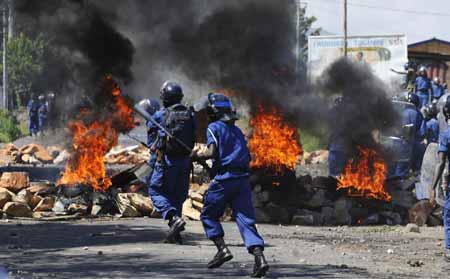
Burundi has regularly been hit by grenade attacks, but they have increased in recent years due to the political crisis that started in 2015 when President Pierre Nkurunziza ran for a controversial third term that he won in July that year.
Since then, between 500 and 2,000 people have been killed, according to various sources, while over 400,000 have fled the small central African country.
The International Criminal Court (ICC), which has opened an inquiry, estimates that at least 1,200 people have died, while thousands of others have been illegally detained and torture is widespread.
Last week, two grenades exploded in deserted parts of Bujumbura, the commissioner said.
A new round of talks aimed at ending the crisis opened last month in Tanzania, without the main opposition alliance based in exile.
The talks bring together Nkurunziza’s government and the remaining opposition to hammer out an agreement by the end of this week, with the aim of ending “all forms of violence” and the proposed creation of a “government of national unity”.
[ad unit=2]