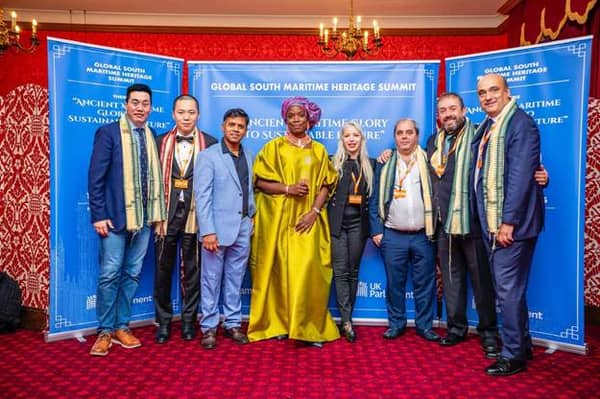
Time for Africa (TFA) Foundation has pledged to expand its programmes to additional African countries, with a strong focus on scaling successful initiatives in AI, blockchain, financial inclusion, climate resilience initiatives, education and renewable energy while deepening partnerships with academic institutions and private sector organisations to enhance technological capacity.
The pledge follows the Foundation’s receipt of the Global South Sustainability Award at the recently concluded Global South Maritime Heritage Summit, held in the United Kingdom.
The award was presented at a ceremonial event at the historic House of Lords, UK Parliament, by the Honourable Louie French, Member of Parliament, and Lord Roger Evans, in recognition of TFA’s transformative impact across African communities.
The summit brought together 115 distinguished guests from across the Global South, including Artificial Intelligence (AI) expert, Lord Rami Ranger; sustainability and economics specialist from the University of Oxford, Prof. Ajit Jaokar; University of Cambridge economist, Prof. Kamiar Mohaddes; representatives linked to the Heads of State of Sri Lanka and Malaysia; members of the All-Party Parliamentary Group on Indonesia; and leaders from business, academia, and government.
The awards ceremony underscored the growing importance of Global South cooperation in addressing shared global challenges, while highlighting how technology-driven, community-led development can deliver sustainable and scalable impact across Africa.
According to the organisers, the award celebrates a partnership that has successfully integrated advanced technology with community-driven sustainability initiatives, delivering solutions to critical challenges faced by African communities.
Members of TFA’s core leadership team, Dr. Abiodun Olushola, Dr. Kanhu Pattnayak, Anna Mwasha. Rebeca Díaz Romanenko, Ethan Wang, Leo Wang, Dan Chapman, and Pravena Mohan were honoured for their role in implementing multi-sector programmes that address community development through sustainable financing.
Among TFA’s flagship initiatives is its Clean Cookstove Programme, which targets health and environmental challenges linked to traditional cooking methods. The programme distributes high-efficiency cookstoves that reduce fuel consumption by up to 60 per cent and harmful emissions by 70 per cent. It has reached more than 50,000 households in rural Nigeria, while creating local manufacturing jobs and supporting women through micro-enterprise opportunities in stove distribution and maintenance.
The Foundation is also advancing a waste-to-energy initiative that uses biomass gasification systems to convert agricultural residues and municipal waste into clean energy. Each installation processes about five tonnes of waste daily, generating electricity for approximately 500 households and thermal energy for community kitchens.
The model addresses waste management challenges while providing affordable energy to off-grid communities.
To support vulnerable coastal populations, TFA rolled out climate resilience programmes under its Blue Economy initiative, including mangrove restoration projects that have replanted over 100,000 mangrove saplings to combat coastal erosion and enhance marine biodiversity. Complementary sustainable aquaculture projects train local fishermen in environmentally responsible practices to improve yields while protecting ecosystems.
In food security, TFA’s interventions promote drought-resistant crops, water harvesting techniques, and sustainable farming practices. The Foundation reports that these measures have increased crop yields by up to 40 per cent in participating communities, supported by community seed banks and farmer cooperatives that strengthen food sovereignty and agricultural value chains.
TFA’s healthcare programme combines mobile clinics, telemedicine services, and the training of community health workers to improve access to care in underserved regions.
The initiative has reached over 200,000 people in remote areas of Nigeria, with a focus on maternal and child health that has contributed to a reported 30 per cent reduction in infant mortality rates in target communities.
The Foundation is also deploying blockchain-based digital payment systems to enhance transparency and efficiency in development financing and global trade.
“The award validates our approach of combining technological innovation with deep community engagement that is not only technologically advanced but also culturally appropriate and sustainable in the long term,” the founder of TFA Foundation Dr. Abiodin Olushola said.