[dailymotion code=”k73BjCeSfI8mxDwUbdr” autoplay=”yes”]
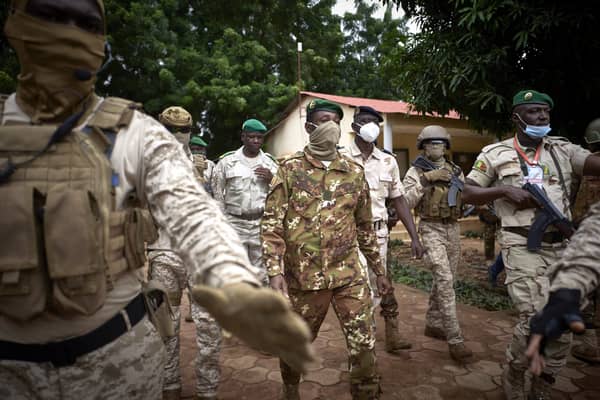
Colonel Assimi Goita, who led a coup in Mali last year, has once more taken the reins of power in the war-torn Sahel state.
This week, soldiers detained the president and prime minister of an interim government installed in the wake of a coup in August, provoking diplomatic uproar.
The military released the pair on Thursday but stripped them of their powers. According to diplomats and army officials, Goita has taken command.
But the young military officer, a former special forces commander who has shunned the limelight since arriving on Mali’s political scene, remains an enigma.
Few are confident about what his motivations are, or his ultimate goals.
Once a relative unknown, Goita burst onto the political stage on August 18 when he launched a coup against elected president Ibrahim Boubacar Keita, after weeks of mass protests over perceived corruption and his failure to end Mali’s jihadist insurgency.
Then 37, Goita said in a public address following the coup: “We no longer have the right to make mistakes.”
Cutting a martial figure in fatigues with a khaki shemagh scarf around his neck, Goita has been seen in public since then but has rarely spoken.
– Man of action –
The son of a former director of Mali’s military police, Goita studied at the country’s main military school.
In 2002, he went to Mali’s desert north for training and was subsequently based in the northern cities of Gao, Kidal, Timbuktu, Menaka and Tessalit.
Goita also saw action during the 2012 Tuareg independence rebellion, which was quickly commandeered by jihadists.
Mali has since struggled to quell the brutal Islamist insurgency, which has killed thousands of people and displaced hundreds of thousands more.
A colonel who requested anonymity said that Goita isn’t concerned about how people see him.
“He’s a man of action, we saw him in the north,” he said.
– ‘Son of the nation‘ –
Threatened by international sanctions after launching the August coup, Goita’s military junta handed power to the caretaker government headed by President Bah Ndaw and Prime Minister Moctar Ouane.
The nominally civilian government was meant to reform the constitution and stage elections within 18 months.
But Goita himself became the interim vice president, and the military retain significant clout.
Ornella Moderan, the head of the Sahel programme at the Institute for Security Studies, said the government was part of a “much larger system designed to ensure the ex-junta’s control of the state apparatus”.
Goita, though mostly out of the public eye, quickly became the point of contact for foreign governments. He would insist on Mali’s commitment to the fight against jihadists, and on returning civilian rule.
On Monday, the army deposed Ndaw and Ouane after a government reshuffle that would have replaced two colonels who took part in the August coup, who were serving as the defence and security ministers.
Brema Ely Dicko, a Bamako-based sociologist, said that removing the two putschists from the caretaker government was seen as “an affront”.
Baba Cisse, an advisor to Goita, said on Wednesday that the military officer had acted as a soldier, and was a “son of the nation who guaranteed stability”.