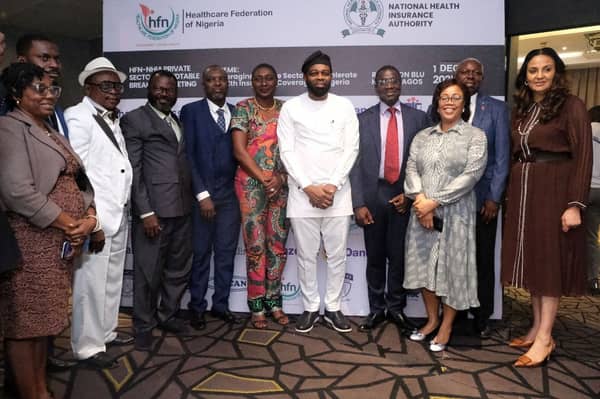
The Federal Government’s drive for wider health insurance coverage received a new push on Wednesday as the National Health Insurance Authority (NHIA) and the Healthcare Federation of Nigeria (HFN) fixed 2026 as a target year to bring more people in the informal sector into the national scheme.
This came at a private sector roundtable in Lagos where participants said the current system cannot survive without strict enforcement, strong digital tools and renewed public confidence.
They also said mandatory insurance will struggle to succeed if the country fails to build a functioning national data system that can reach informal workers.
Nigeria’s population, now estimated at 220 million, is increasing by more than six million people every year, a trend that speakers said makes rapid expansion of health insurance unavoidable.
NHIA Director General, Dr Kelechi Ohiri, said the Authority has entered a turning point and must move from plans to real protection for households.
“Mandatory health insurance will not succeed on legislation alone. Enforcement, awareness and, most importantly, restoring trust are essential,” Ohiri said.
“Government cannot do this alone. To reach the informal sector at scale, we must unlock the innovation and operational agility the private sector brings.”
HFN President, Mrs Njide Ndili, said the Lagos meeting was the first in a planned series to align the priorities of government and the private sector in health financing. She said both sides share responsibility for building a stronger system.
“Our collaborations in quality improvement, manufacturing, emergency care and data systems are designed to strengthen both demand and supply sides of healthcare,” she said.
Ndili restated HFN’s support for ongoing NHIA reforms, saying the push for universal health coverage must remain inclusive and driven by innovation.
Former chairman of the Health and Managed Care Association of Nigeria, Dr Leke Oshunniyi, warned that progress will stall without an integrated digital platform.
“Any law without enforcement is just good advice. The real elephant we must eat in little bits is technology. We need a platform that aggregates data from telcos, NIMC, FRSC, tax authorities and providers. Without that digital backbone, every other effort is floating in the air.”
He added that fintech companies already serve millions of people in Nigeria, showing that large-scale digital operations are achievable.
He urged the NHIA to work with global cloud providers and local innovators to build systems that can support as many as 300 million people over the next decade.
Several speakers also noted that Nigeria must enrol at least six million people every year just to keep pace with population growth.
“From small acorns, mighty oaks grow. But we must act now. The private sector is ready. What we need is clarity, enforcement and the right technology.”
Other recommendations included firm enforcement of the NHIA Act, a unified national data system, micro-insurance products for informal workers, growth of telemedicine for remote communities, market-led enrolment channels, improved quality in primary healthcare centres, and fintech tools that make payment easier.
Rebuilding trust in the insurance system was another major focus, with emphasis on transparent claims processes, better service quality and strong quality checks across both public and private providers.
The roundtable ended with an agreement to set up a joint NHIA–HFN working group on technology and data integration, map private-sector innovations that can scale nationwide and support the upcoming Informal Sector Coverage Fund.
The next implementation meeting with the NHIA Director General will hold in January 2026.
In a separate presentation, Prof Bode Falase of LASUTH shared findings from the Nigeria Open-Heart Surgery Registry, described as the only active online registry of its type in sub-Saharan Africa.
He reported that 1,916 surgeries have been carried out across 28 centres between 2004 and 2025, with 58 percent now performed by Nigerian teams. He said annual surgeries may hit 300 cases this year, marking the highest activity since the registry began.
Falase said sustainability is still a concern because the registry depends on a small grant and voluntary reporting.
“We urgently need funding to sustain the registry. Voluntary reporting is improving, but data validation and long-term support remain weak,” he said.
He also noted that the rising cost of advanced procedures such as mechanical mitral valve replacement, which costs about ₦8.5 million at LASUTH, shows why Nigeria’s insurance system must evolve to fund high-cost care, as is done in other regions.