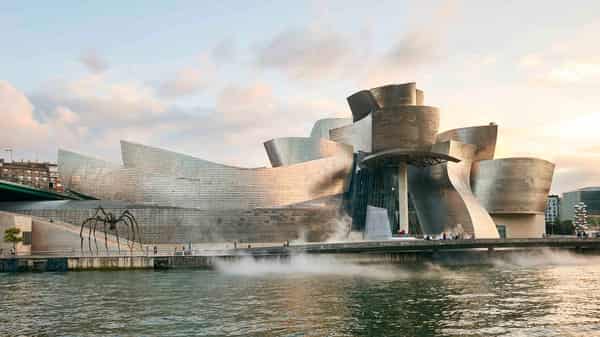
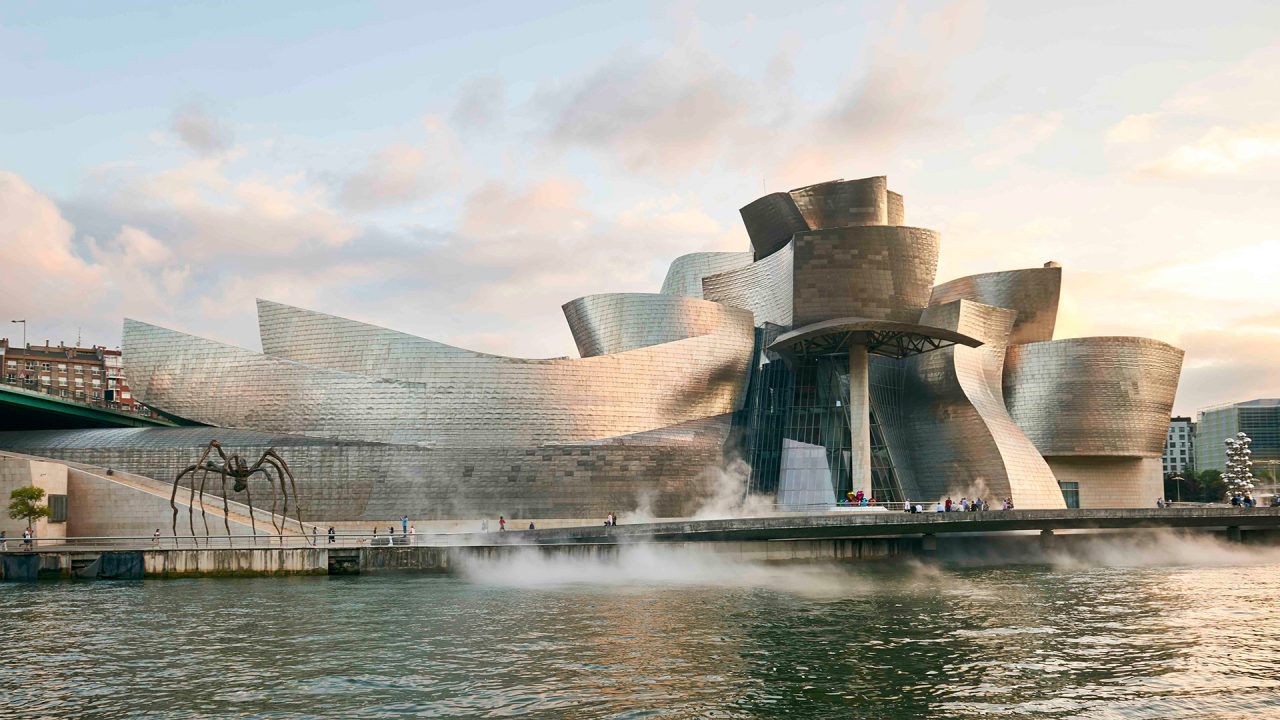
The Guggenheim Museum in Bilbao is celebrating its 25th birthday as one of Spain’s most renowned art museums.
The striking building was lauded as one of the best works of contemporary architecture. It has been a symbol of Bilbao’s regeneration into a modern city.
Designed by Frank Gehry, a popular and influential Canadian-American architect, the museum opened its doors on 18th October 1997. At the time, no one realised how much of a mark it would make. It was predicted to draw around 500,000 visitors per year. This quickly shot up to a million.
The Guggenheim is now Bilbao’s most recognisable landmark and one of the main reasons many people visit the city. It is worth noting that from 2023, international travellers will need an ETIAS for entry to Spain if they are exempt from needing a visa. However, with a simple online registration process, this is not expected to affect Bilbao’s popularity.
The largest city in the Basque Country in northern Spain, the Bilbao of today is a thriving metropolis where the old meets the new.
Like many Spanish cities, it has a casco viejo — an old quarter dating back to medieval times. There are also many grand buildings from the 19th and 20th centuries throughout the city, while some areas pay tribute to its industrial heritage.
These sit alongside shiny modern buildings, like the Iberdrola Tower and the Guggenheim itself, landscaped gardens by the River Nervión, and beautiful park spaces.
However, it was not always this way.
Bilbao was once an important industrial city and seaport, but by the 1990s, it had fallen into neglect and disrepair. The factories had closed, the docks had been moved closer to the sea, and unemployment was rife.
The building of the Guggenheim is credited with revitalising the city. The rusting factories and derelict dockyards made way for green spaces and promenades. More modern structures began to spring up and businesses moved in as the world realised that Bilbao was far from a relic of the past.
Thanks to the impact of the museum, Bilbao has become one of the most important cities in Spain in the new millennium. Even 25 years on, its economy is still strong and it is still a popular destination for many visitors. The centrepiece is still the Guggenheim.
The building itself is something to behold. Its undulating walls and roofs are clad in silver titanium, reflecting the sun and making the museum literally shine. Like many of Gehry’s works, there are few straight lines. The Guggenheim is made of shimmering waves, with no clear beginning or end.
US architect Philip Johnson lauded it as “the greatest building of our time”, going on to say: “When a building is as good as that one, f**k the art.”
Of course, this is the reason the building has its critics among the art community. According to some, the structure overshadows the works it exhibits. The unconventional shape of the rooms can also be challenging for artists who desire more control over the space of their exhibitions.
That said, this seems to be a minority opinion. The general reception to the Guggenheim has been overwhelmingly positive. This is likely why, even 25 years later, the museum is as popular as ever.
Given the impact on the city, it is strange to think that there was opposition when construction began on the Guggenheim.
Many locals actually protested. There was a sense of frustration in the decision to invest millions in a museum instead of modernising the city’s crumbling industry and in creating jobs.
There were also fears that local artists would be overlooked in favour of internationally famous ones — particularly from the US, given that the project was coming from the American Guggenheim Foundation.
However, when the work was complete, public opinion had firmly shifted. Already, the city was changing. The riverside, where the Guggenheim had emerged, had been transformed and looked better than it had for decades.
Bilbao had become the focus of something spectacular. Not only was its image changed into a centre of art and culture, it was seen as the place to be. In came the investment and business, and with them came jobs and prosperity. Other architects were hired to continue the rejuvenation of the city, with new bridges, an airport terminal, a new subway line, and more.
Cities around the world began to make their own attempts to emulate “the Bilbao effect”.
The artists who protested at first need not have complained. The Guggenheim may host exhibitions of world-class contemporary art — the works of Andy Warhol, Gerhard Richter and Jeff Koons have all been on display here — but it also makes sure to showcase local Basque and Spanish artists.
The silver, shimmering museum quickly became a source of civic pride; an icon of the city.
Architectural critic Paul Goldberger summed it up as “one of those rare moments when critics, academics, and the general public were all completely united about something”.
One of the best-loved features of the Guggenheim is that most of its permanent works are actually located outside the museum building and can be enjoyed by all.
Examples include Puppy, the beloved 40-foot tall topiary sculpture of a West Highland Terrier, which sits outside the entrance, blooming in colourful flowers.
For its 25th anniversary, the Guggenheim has a special exhibition called Sections/Intersections. This 3-part experience celebrates the museum’s story so far, with a collection of “works that have historically defined both the interior and the exterior of the Museum”.
The exhibition will run until 22nd January, 2023.