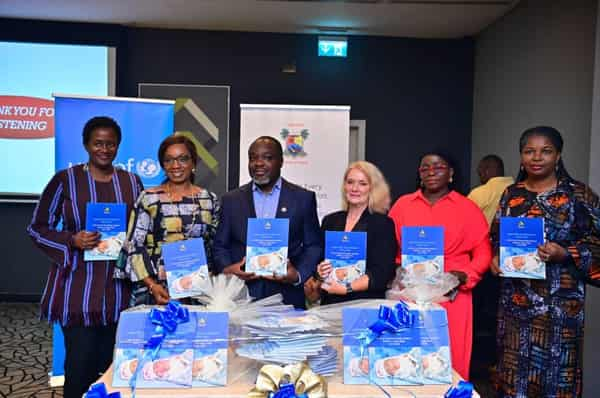
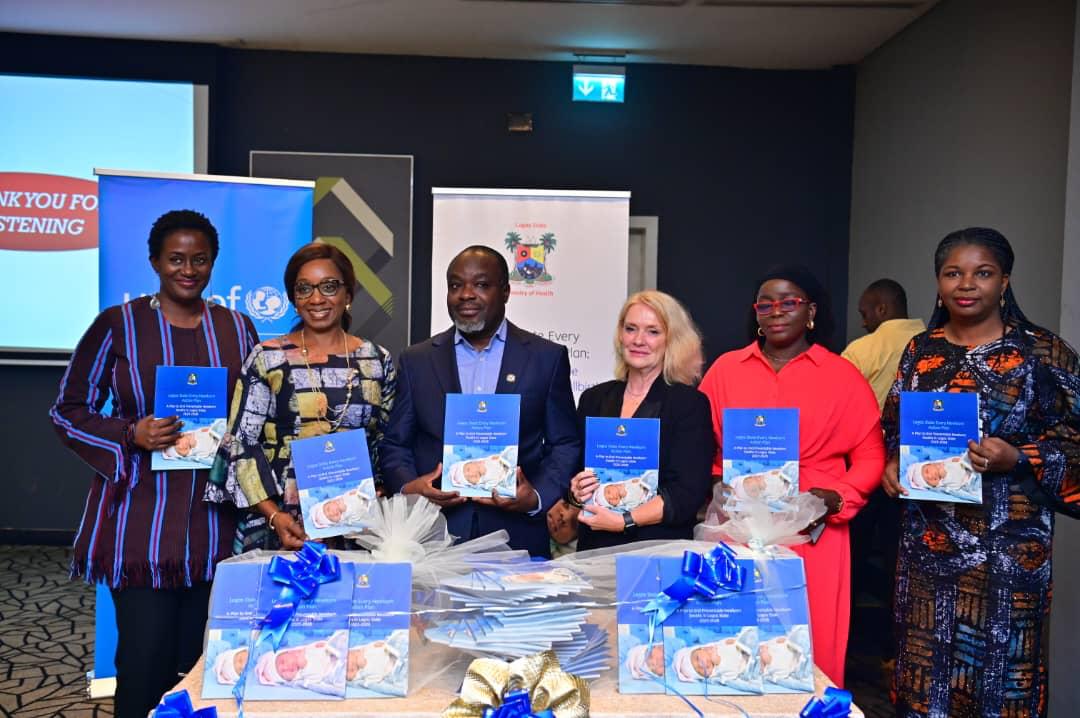
To curtail the neonatal mortality rate in Lagos, the United Nations International Children’s Fund (UNICEF) has partnered with the Lagos State Ministry of Health to put up a Lagos State Early Newborn Action Plan (LASENAP).
The five-year documented strategy is aimed at improving the coverage of state-wide interventions by taking actionable steps toward ensuring that children in Lagos survive, thrive, and attain their full potential.
Speaking at the event held at Radisson Blu, Ikeja, Chief of Field Office, UNICEF Lagos, Mrs. Celine Lafoucriere, said the Lagos State Early Newborn Action Plan was a huge step towards addressing the major issues in Lagos’s neonatal healthcare system and working towards aligning with international standards.
“Today is a very important day for UNICEF as a partner of the Lagos State Government and the State Health Ministry. We are launching the Every Newborn Action Plan, with a view to address the SDG 3.2. The Action Plan is a very important stepIt that deploys the answers that will be given to the issue of neo-natal deaths in the South-Western Region.”
The Director of Family Health and Nutrition, Lagos State Ministry of Health, Mrs. Folashade Oludara, commended the Lagos State Government for taking giant strides in tending to the well-being of older age groups, said it’s now time to give more of its attention to neo-natal and peri-natal healthcare.
“Lagos State has achieved remarkable milestones in caring for older children through our targeted strategies, including routine immunization, integrated management of childhood illnesses, home-based care, diarrhea control, infant and young child feeding, to name a few”
“The Lagos State Every Newborn Action Plan we launch today embodies the collective wisdom and expertise of our technical teams, civil society organizations and community leaders. We believe this document will garner commitments from concerned stakeholders to curtail under-five mortality rates in the State” she said.
In a keynote address delivered by Consultant Neonatologist at the University College Hospital, Ibadan, Dr. Olukemi Tongo, said majority of the causes linked to neo-natal and peri-natal casualties are completely avoidable with the right precautions.
She anticipated that the plan would draw awareness from many concerned parties towards achieving a collective goal.
“The issues associated with neo-natal mortality are preventable, and treatable, so we wonder why our babies are still dying in the hundreds of thousands from these problems.
“The Early Newborn Plan is simply a programme that will harness all available resources. It will get many communities to buy in, train stakeholders to help babies survive, and also call attention. We want more babies to be born in health facilities, to avoid delay in identifying problems and finding solutions for these babies,” she said.
While Programme Coordinator, from the Lagos State Ministry of Health, Dr. Taiwo Johnson, revealed that a lot of work had gone into developing this highly insightful roadmap, for which she had high hopes. She added that the plan was direct in its approach to tackle the issues affecting neo-natal wellbeing.
“The journey to developing this document has come a long way. This document was brought about by the work of many concerned stakeholders. It is aimed at fast tracking progress, because we are implementing a high impact, cost effective intervention which gives priority to new born health, and employs specific actions to significantly reduce still births, and new born mortality” she stated.
[ad unit=2]