Photo: AFP
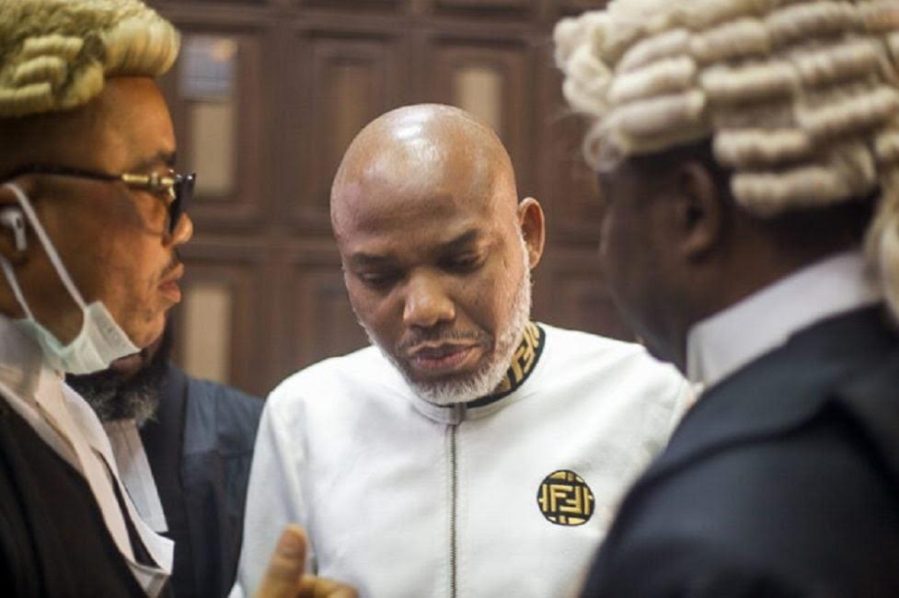
Aloy Ejimakor, the Special Counsel for the detained leader of the Indigenous People of Biafra (IPOB), Nnamdi Kanu, has said Kanu’s decision to request that Justice Binta Murtala-Nyako recuse herself from presiding over his case at the Federal High Court in Abuja was propelled by a simmering loss of confidence in the judge, stemming from key events.
Ejimakor, in a statement, said that if one wants a partial judge to try their case, they should go ahead, but Kanu will not.
He explained that his statement was for the benefit of those who asked him why, adding that the truth was that “Kanu properly exercised his constitutional right back in September last year when he requested Justice Binta Murtala-Nyako to recuse herself from presiding over his case.”
He said, “By any definition, it was an informed decision that is bereft of any personal animosity or any intransigence to the judicial order, even when it rankled some as brazen and gutsy.”
Ejimakor listed six key events he stated propelled the simmering loss of confidence in the judge.
“First, back in June 2021, the judge conducted a hearing by which Mazi Kanu (an awaiting trial) was ordered remanded without notice to, and the presence of his former counsel (of record) at the hearing. That was a grave constitutional error that turned highly prejudicial against Mazi Kanu.
“Second, Mazi Kanu was ordered detained in DSS cells instead of a prison as the law requires, albeit with some exceptions. The excuse then (which, by the way, fell outside the exceptions) was that every penitentiary in Nigeria is porous or pathetically low-security. This excuse suggested a judicial state of mind that imputed a proclivity for jailbreak to Mazi Kanu. That’s wrong and presumptuous.
“Third, when the DSS detention posed grave risks to Mazi Kanu’s constitutional right to fair hearing and to counsel, the judge summarily refused his application for transfer to prison or other less restrictive facilities. That’s manifest injustice.
“Fourth, when the Supreme Court ruled against Mazi Kanu’s bail revocation, the same judge who had revoked his bail refused to reinstate the bail. That’s an egregious violation of the Constitution and the doctrine of stare decisis.
“The fifth and sixth events he listed were:
“The Supreme Court had held that, by revoking Mazi Kanu’s bail, the judge’s impartiality had become suspect. If you would like a partial judge to try your case, go ahead and take the chance, but keep in mind that it will amount to deadly hubris to ignore such a weighty censure from the apex court.
“And that despite the enormous risks to Mazi Kanu’s right to fair hearing posed by the strict conditions of his detention at the DSS, the judge ordered an accelerated trial. That’s the last straw that broke the camel’s back.”
To those he guessed might wonder about the next steps, the Special Counsel for Kanu posited, “Given that the judge had affirmed the recusal in good faith and enrolled an order in that regard, the case will remain in limbo until another judge is assigned to handle it by the Chief Judge of the Federal High Court.”
He added, “That a new or another judge has not been assigned to the case and such has lingered for an unreasonable period of time, a vigorous case can be made that the continued incarceration of Mazi Kanu has become unconstitutional by effluxion of time.
“In plain terms, the Constitution forbids the authorities from detaining anybody without trial beyond a limited period of time. In this very case, that period has come and passed.
“This judicial gridlock is not the fault of Mazi Kanu. It’s instead the fault of the authorities that have proved unable or unwilling to conduct Mazi Kanu’s case in accordance with the dictates of the Constitution and the statutes pertinent to the case. And to make matters worse, the extraordinary rendition brought its own unique complications that have not settled to this day.”