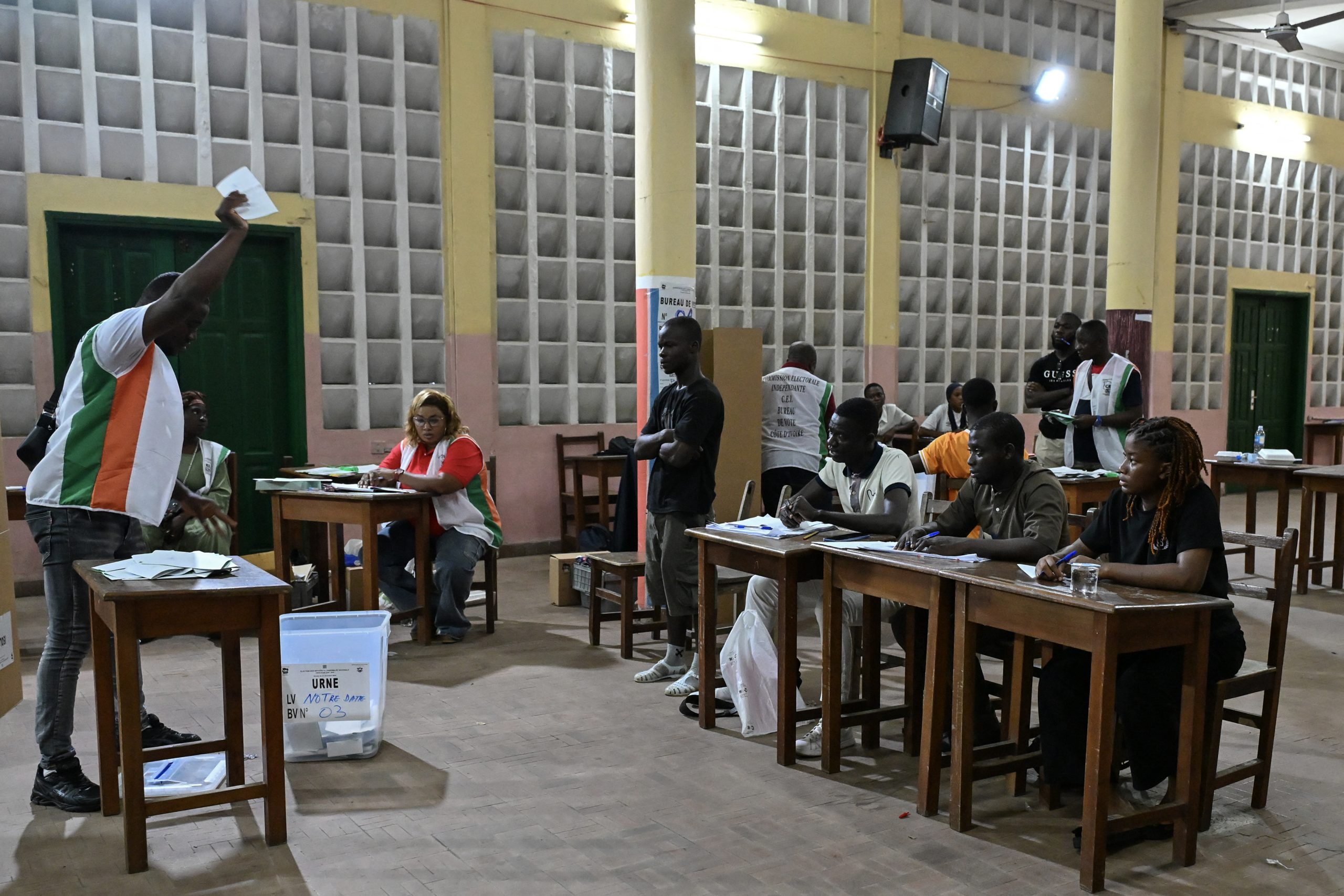
Five people are lined up before Chantal Dagah’s newsstand in Benin Republic‘s economic capital, Cotonou, a sure sign of trouble.
Traffic at her kiosk, just steps away from several government ministries, guarded by tanks Monday afternoon usually comes in dribs and drabs, but after a failed coup over the weekend, Beninese across the seaside city are eager for more information.
A group of soldiers on Sunday took over the national television station and announced that President Patrice Talon had been deposed, but the attempted putsch was ultimately defeated by loyalist army forces with the help of the Nigerian air force.
“I don’t usually buy newspapers, but today I grabbed two, because something exceptional happened yesterday,” said customer Stephane Nelson, spending several minutes browsing the newsstand.
Despite yesterday’s air strikes and troop deployments, calm has returned across the coastal city of Cotonou as the economic engine of the small west African nation kicks back to life.
“Talon reassures the country after foiled coup” blares a headline in Le Parakois newspaper. L’Independant joins in: “President Talon’s statement reassures and re-enchants the Nation.”
Beyond the front pages, the main of yesterday’s upheaval are the tanks in the streets, including those moving along the Boulevard de la Marina, which connects the presidential palace, airport, sea port and several ministries.
Some roads to the palace remained blocked to traffic.
– Coup plotters on the run –
“It was important to know more,” Nelson told AFP. “There’s still a lot in flux, but we know that the stakes are important, especially since a sovereign country had to intervene to support our democracy.”
The property developer was referring to strikes by the Nigerian air force, after Beninese authorities called on their neighbour for help pushing back the would-be junta leaders, who dubbed themselves the “Military Committee for Refoundation” (CMR).
Nigerian troops have also arrived in Benin, with west African regional bloc ECOWAS promising more soldiers from Ghana, Ivory Coast and Sierra Leone on their way.
Though the CMR had declared that Talon had been “removed from office”, a source close to Talon told AFP the president was always safe, and had quickly mobilised loyal army forces against the “small group of people who only control the television”.
As of Monday, the hunt continued for some of the soldiers behind the putsch attempt, though all their hostages — including high-ranking officers, had been freed.
Talon, who is set to step down after the end of his second term in April, took to national television himself Sunday evening to declare “the situation is completely under control”.
– ‘Almost a normal Monday’ –
Across Cotonou, a bustling city on the Atlantic Ocean, it was a remarkably normal Monday: vendors hawked their wares, moto-taxis scoured for clients and schoolchildren crossed the wide boulevards in groups.
“It’s almost a normal Monday,” said an agriculture ministry employee who, like many government workers, declined to give his name to journalists.
“I hope there won’t be anything else like this. I’m happy everything seems to have gone back to normal,” he said while enjoying a break under a tree, lemon tea in hand.
For some, Sunday’s upheaval put their bottom line at risk.
“I had to close the shop yesterday,” a 19-year-old tailor named Thor told AFP.
“Today, I’m here as if it’s a normal day. I hope that doesn’t happen again, because otherwise I’ll lose money.”
His atelier is just down the street from a National Guard base that was bombed by the Nigerian air force on Sunday.
Down the road, in a noodle restaurant where steam and scents waft into the air, some patrons debate the reason behind the lack of customers.
It could be the coup attempt, or, just as likely, the heavy rains currently lashing the city.