I have particularly agonised about the vacuum in the Nigerian foreign policy space, our distressing non-committal disposition towards the foreign environment. There have been several events that require the flexing of our diplomatic muscles. These include French intervention in Cote D’Ivoire, the U.S.-led destruction of Libya, the perpetual crisis in Congo DRC, the ethnic cleansing in Sudan and South Sudan, and the spread of jihadist forces in the Sahel. Juxtapose the prevailing inertia with the 1970s and the mid-1980s, which may be regarded as the golden moments of Nigerian foreign policy outputs.
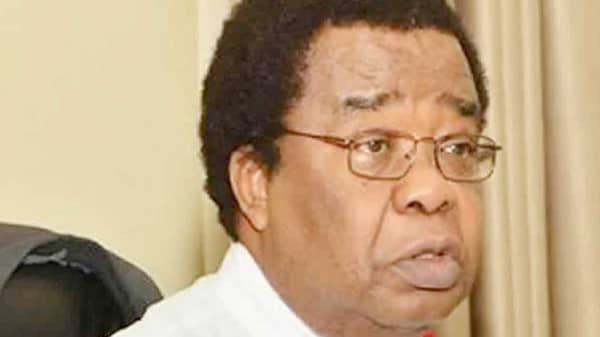
The mid-1980s shone because of the role played by Professor Bolaji Akinwande Akinyemi. He was a bridge between the two decades as DG of NIIA and as Foreign Minister. As a young man bubbling with radical nationalist passion during that period, I remember well the “concept of medium powers” which Professor Akinyemi articulated.
It was an informal consultative body of 16 countries, drawn from Africa, Asia, Latin America and Europe, with the goal of mediating the bipolar environment through a multilateral approach to global issues. The idea died with his exit as foreign minister. In hindsight, it was perhaps a vision of a multipolar future, with the winding down of bipolarity that had shaped the context of much of the twentieth-century foreign policy environment.
Given the foregoing background, his call for intellectual engagement with the Middle East crisis, given currency by the Israeli war on Gaza, is only understandable. With information and communication technology, we saw real-time images of the brazen destruction of the lives of non-combatants, children and women, in Gaza by the Israeli military’s scorched-earth policy.
Unlike Auschwitz, which calls for a phenomenological approach, a re-imagining of the ordeal of the survivors, the horrors of Gaza were being televised daily.
The horrors have not ended. While academic institutions struggle to understand and re-assess the contradictory dynamics of the event. This is the first major national agency, to my knowledge, to interrogate this contemporary horror that has not only riled the conscience of mankind but inclined it towards a tipping point of global conflagration. Thanks again to our Octogenarian professor, whom I have eulogised among others in my article, “Octogenarian at Rutam House”, for his foresight.
Where to begin
From an embankment overlooking Gaza City, there’s no hiding what this war has done…The Gaza of maps and memories is gone, replaced by a monochrome landscape of rubble stretching flat and still for 180 degrees, from Beit Hanoun on one side to Gaza City on the other…Beyond the distant shapes of buildings still standing inside Gaza City, there’s almost nothing left to orient you here, or identify the neighbourhoods that once held tens of thousands of people (Williamson, 2025).
On October 7, 2023, Hamas, the Palestinian hegemonic political organisation in Gaza, attacked Israel and killed about 1219 Israelis and took 251 others as hostages (www.diplomatie.gouv.fr).
It would appear that Israeli security was caught napping, and the event shocked the Israeli public. Not a few have called into question the easy breach of Israeli security and have opined that Israel may have deliberately allowed it to justify a takeover of Gaza that Netanyahu’s patron, President Donald Trump, has proposed for a Riviera.
For example, Charlie Kirk, recently assassinated in the United States (U.S.), called into question the easy breach of Israeli security on the Gaza border. Hear him:
But I’ve got to be very honest with you here, I want to make sure we ask the right questions. Israel is by far the most alert country in the world… It is a country built as a fortress. Maybe the Israeli government was double-crossed, maybe they had intelligence about this. We don’t know.
Usually there’s helicopters flying all over the place … But you’re trying to tell me that the CIA, Mossad, Israeli intelligence, everybody missed this? Israel cares about its border deeply. They work hard to secure it. They have billions of dollars of technology built completely and totally on border security. How did this happen? (Quoted in King, 2025).
Although the recent dismissal of three Israeli generals, namely,Aharon Haliva, former military intelligence chief; Yaron Finkelman, former southern command chief and Oded Basyuk, former operations chief, over the October 7, incident, further complicates the above assumption of complicity.
Nevertheless, Israel opened the ‘gate of hell’ in Gaza with massive bombardment followed by ground operations in the Gaza Strip and full-scale invasion on October 13 and 27, respectively. At the last count, 67,160 Palestinians have been killed and 169, 679 injured by Israeli forces in Gaza Strip since October 2023 (Kekatos, 2025). The carnage is not over but ongoing.
The Middle East situation raises a number of questions anew. What are the points at issue in the crisis? What are the social forces at play? Why has peaceful settlement been elusive? Are there new dynamics in the conflict? How may we find lasting solution? In what follows I shall attempt to illuminate the subject and make suggestions on the way forward.
Perspectives on the Middle East crisis
In contemporary discourse of the Middle East crisis, focus has shifted more on the Israeli-Palestinian crisis, thereby obscuring the second component of the crisis—the Arab-Israeli crisis.
The word ‘crisis’ is employed here interchangeably with ‘conflict.’ While the former implies a climactic stage of crisis dynamics, the latter implies a struggle. While acknowledging the line of distinction, I use both terms interchangeably. Firstly, I focus on the Arab-Israeli Conflict.
Arab-Israeli Conflict
The insertion of Israel in Palestine by the European powers was seen as an assault on Arab nationalism, and was overwhelmingly opposed. While the European powers have sought to stabilise the embattled Ottoman rule in Palestine metaphorised as the Eastern Question as a form balance of power, they also positioned themselves as receivers of the assets and liabilities of a collapsed Ottoman suzerainty over Palestine. Marks (1970, p. 39) has rightly noted that:
The Palestine problem, which today involves achieving peace between Israelis and Arabs, was created and is basically sustained by the western world. The roots of the problem lie in the Middle Ages when large numbers of persecuted Jews left Christian states for the milder regimes of the East, and in the 17th century when European powers began seeking first to penetrate and later to control Near Eastern territories, in order to share in the luxury trade further east.
These two roots with their more recent tentacles underlie and support the present world dilemma in Palestine.The British wanted an overland route to India through Syria and Mesopotamia, which were under Ottoman control. The Russians sought control of the Black Sea, and the French seized Alexandria in Egypt, in a manner that brought Palestine into the vortex of great powers’ politics in the Near East. However, the sick man of Europe, as Turkey was called, collapsed in the aftermath of World War I, and Palestine became a booty of the European powers.
The League of Nations made Palestine a Mandate territory with Syria and Lebanon under French control and Palestine and Iraq under the British. It was within this complex geopolitics that Israel was born by the Balfour Declaration of 1917.
To be continued tomorrow.
Akhaine is a professor in the department of Political Science, Lagos State University (LASU). He delivered this Lecture (excerpts) at the Nigerian Institute of International Affairs on December 2, 2025, as part of the Institute’s Foreign Policy Lecture Series.