Youth dressed in traditional Zulu attire hold posters during the 10th "Durban Sari Stroll" march on Durban's beachfront on September 15, 2019, as the annual Durban Beach Sari Stroll has evolved from celebrating the sari to becoming an advocate for women's issues. - The sari forms part of the cultural and religious attire that transcends the boundaries by its universal colourful appeal to all women. The stroll is to promote social cohesion across race and age boundaries in celebration of the sari. (Photo by RAJESH JANTILAL / AFP)
Youth dressed in traditional Zulu attire hold posters during the 10th "Durban Sari Stroll" march on Durban's beachfront on September 15, 2019, as the annual Durban Beach Sari Stroll has evolved from celebrating the sari to becoming an advocate for women's issues. - The sari forms part of the cultural and religious attire that transcends the boundaries by its universal colourful appeal to all women. The stroll is to promote social cohesion across race and age boundaries in celebration of the sari. (Photo by RAJESH JANTILAL / AFP)
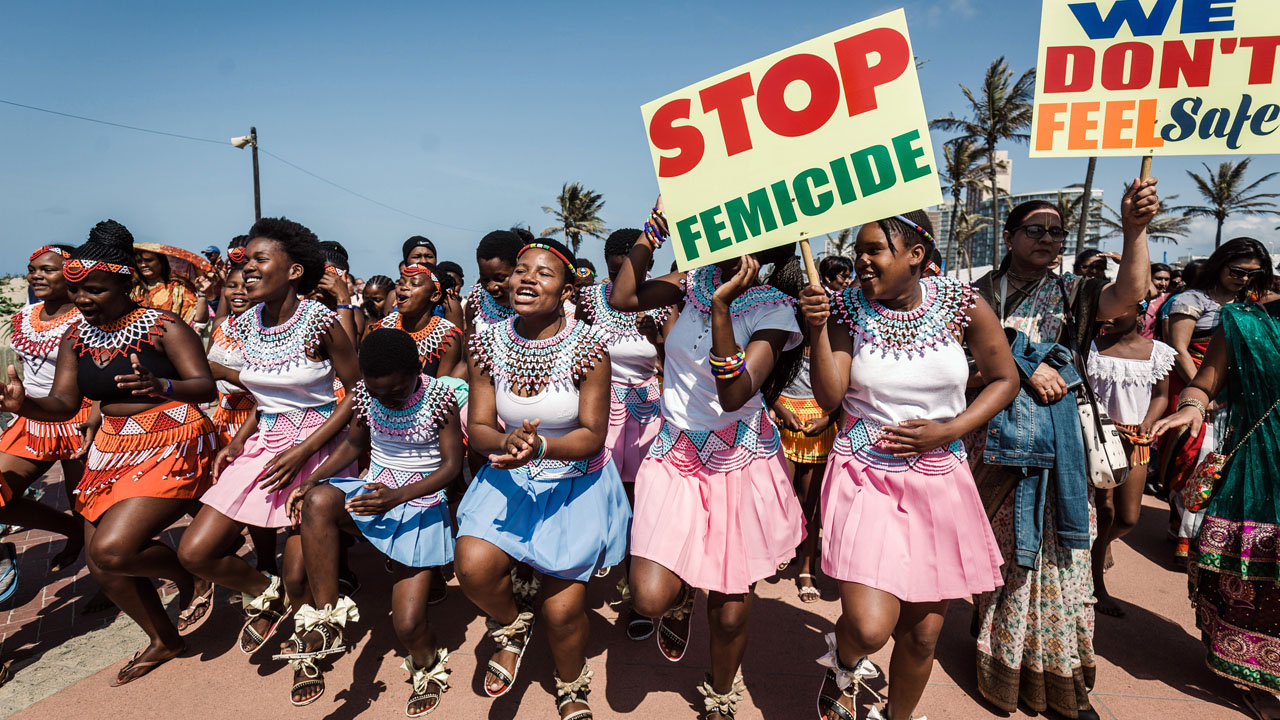
Youth dressed in traditional Zulu attire hold posters during the 10th “Durban Sari Stroll” march on Durban’s beachfront on September 15, 2019, as the annual Durban Beach Sari Stroll has evolved from celebrating the sari to becoming an advocate for women’s issues. – The sari forms part of the cultural and religious attire that transcends the boundaries by its universal colourful appeal to all women. The stroll is to promote social cohesion across race and age boundaries in celebration of the sari. (Photo by RAJESH JANTILAL / AFP)President Cyril Ramaphosa admitted Wednesday that South Africa is one of “the most unsafe places in world to be a woman” and announced an emergency plan to stop the resurgence in violence against them.
Comparing the levels of such attacks to a war zone, Ramaphosa told a special session of the two chambers of parliament that “there is a dark and heavy shadow across our land. Women and children are under siege”.
His remarks come after Women’s Minister Maite Nkoana-Mashabane reported that more than 30 women were killed by their spouses in August alone.
[ad]
Police reported a nationwide average of 110 rapes a day last year.
Promising legislation to force longer minimum sentences for crimes against women and children, Ramaphosa said a series of reforms would curb “male-perpetrated violence”.
Advertisement
“Those who are found guilty for those charges should not be eligible for parole,” he said.
“If sentenced to a life sentence, this must mean what it is, life in prison.”
Ramaphosa said his government would release an extraordinary 1.1 billion rand ($75 million) budget over six months to fund the plan.
He also announced the creation of a fund for private companies to finance prevention and education programmes to stop violence against women.
Advertisement
We will “ensure that justice is served, perpetrators are held to account,” Ramaphosa said.
 Follow Us on Google News


 Follow Us on Google Discover