 Follow Us on Google News
 Follow Us on Google Discover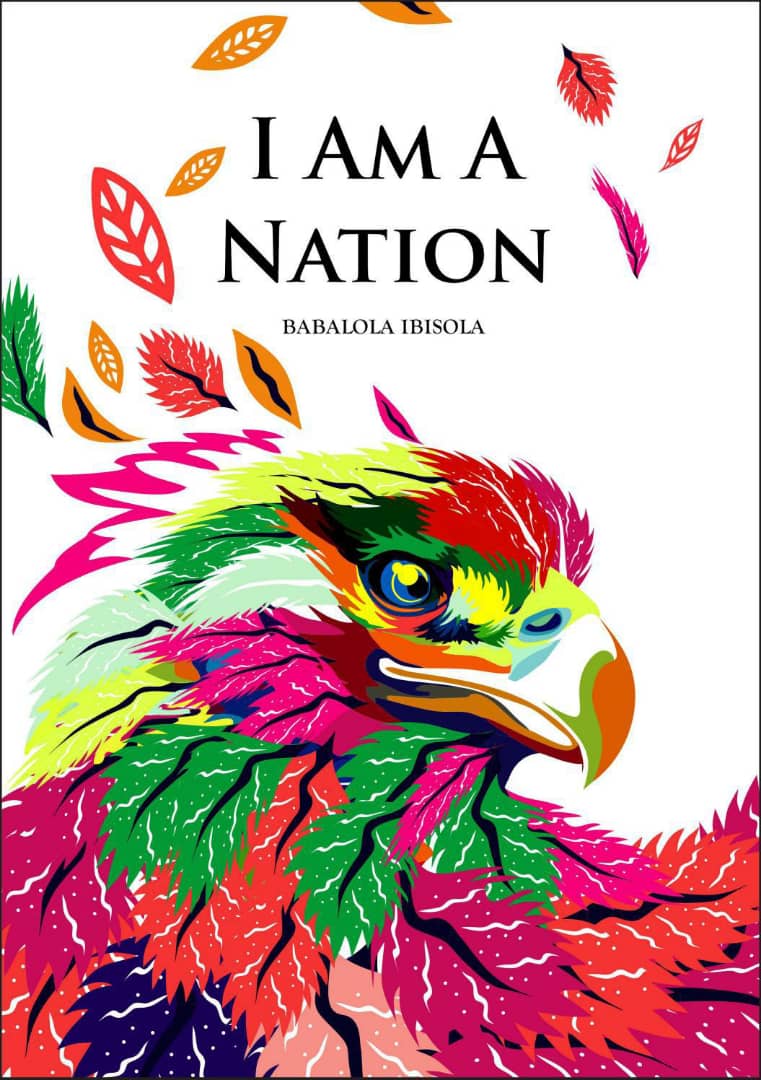
 It is often a difficult task putting together poems of vast themes. There is always a possibility of alienating central focus of the collection, as every poem struggles for domination.
Babalola Adeniyi Ibisola’s I Am a Nation, is not an exception. However, the poet has not forgotten to collocate his most intimate poems, which celebrate the moment, while longing for a better future. The collection also explores the effects that human decisions can have on others.
Deploying concrete imageries, the poet conveys his message in long verses to remind readers of the beautiful nature and environment. It touches on emotions.
The book is a collection of bold, impressive and moving poetry, in which verses collide with nature, ideas and living objects. The poet does not only interrogate emotional virtuosity, he awakens reader’s consciousness to life’s realities: that is, man’s struggle to make ends meet and eventualities.
[ad]
On the pages of this compact and engaging work, readers are exposed to the essence of God, his true greatness, which He has deposited in humanity to project and possess. Each one of the pieces opens a new vista of thoughts for the readers to contemplate.
With verses such as, African Child, Destiny Tour, Folashademi, Hands of Death, Headless Giant, Hustler’s Pain, In My Heart, I Am a Nation, Life is Not Long, Make a Wish, Shun the Witch, My Lesson from Death, No Vacuum, Ocean Deep, The In-between, Time is timeless, Uniformed Tout, Why Today Is Here, The Hunter, Grace for the Race Coffin, Schizoid (Bi-polarity) and Mindful Devotion, among others, the poet decouples life from private ownership, opening it up to more generous, alternative worldviews.
In African Child, the poet’s mood is contemplative, but not sullen. He deploys a structured verse with both regular and irregular rhyme scheme.

The dense, serious verse also says:
It is not how the story is told,
It is how well it would hold,
Both in the heat and the cold,
When the lies glitter like gold.
How once we were told to care,
And believe all they said we were,
Black on sight, black in heart,
Short of height, so of sight.
The poem inspires its readers to develop strength in character to forgive when wronged, to stand up and be strong in the face of challenges and to see that the world is a beautiful place.
In Destiny Tour, the poet, like Jean-Paul Satre and Albert Camus, looks at meaninglessness of life. He says life is too short to be taken seriously. He queries its absurdities, but not in the manner of Samuel Beckett, Eugene Ionesco or Arthur Adamov. He says life is too transient to be taken too seriously.
While in I Am A Nation, the poet looks at the country’s colonial heritage, which has forced on the people, a skewed federalism. He, however, believes that justice must be internalised to become poetic currency:
I may not have been well structured,
By the acclaimed sculptors,
Yet for a century I have stood,
At first attached wings of an old lion,
And now a sculpture in the round,
A wild eagle with independent extensions.
The framing of this landscape is driven by tensions between present-day experience and cultural memory. The poet, however, concludes: “We are citizens of the earth; the world is ours. We embody nationhood; we must not allow hate or hurt, bitterness or bigotry and dent or death diminishes our divine nationality.”
He writes:
[ad]
The same message is drawn in Headless Giant’s landscape. This verse looks at alienation, that sense of powerlessness. Innocence is loss to a headless being.
In his foreword, President, Commonwealth Medical Association, Dr. Osahon Enabulele, describes the collection as a “scintillating poetry book.”
While commending the author for a well-packaged book, he notes, I Am a Nation, is “quite apropos and reflective of the very challenging time in the socio- economic and political life of our country, Nigeria.”
Enabulele says: “The book is an archetypal testament to our very existence as a people, country, and global community. It poetically captures in very real terms our past, present, and future challenges and relationships as a people.”
In his author’s note, Ibisola says: “The earth or world is an ordered existence of the Supreme Being, God Almighty. As humans, we are inherently conditioned to act beyond the boundaries of this natural order. In so doing, we often undermine the nationhood that we individually are capable of birthing.
“Love, in its boundless expression, is capable of helping us to sail safely through the tumultuous gale of the unnatural world that man has through centric agenda created for himself.”
[ad]

