 Follow Us on Google News
 Follow Us on Google Discover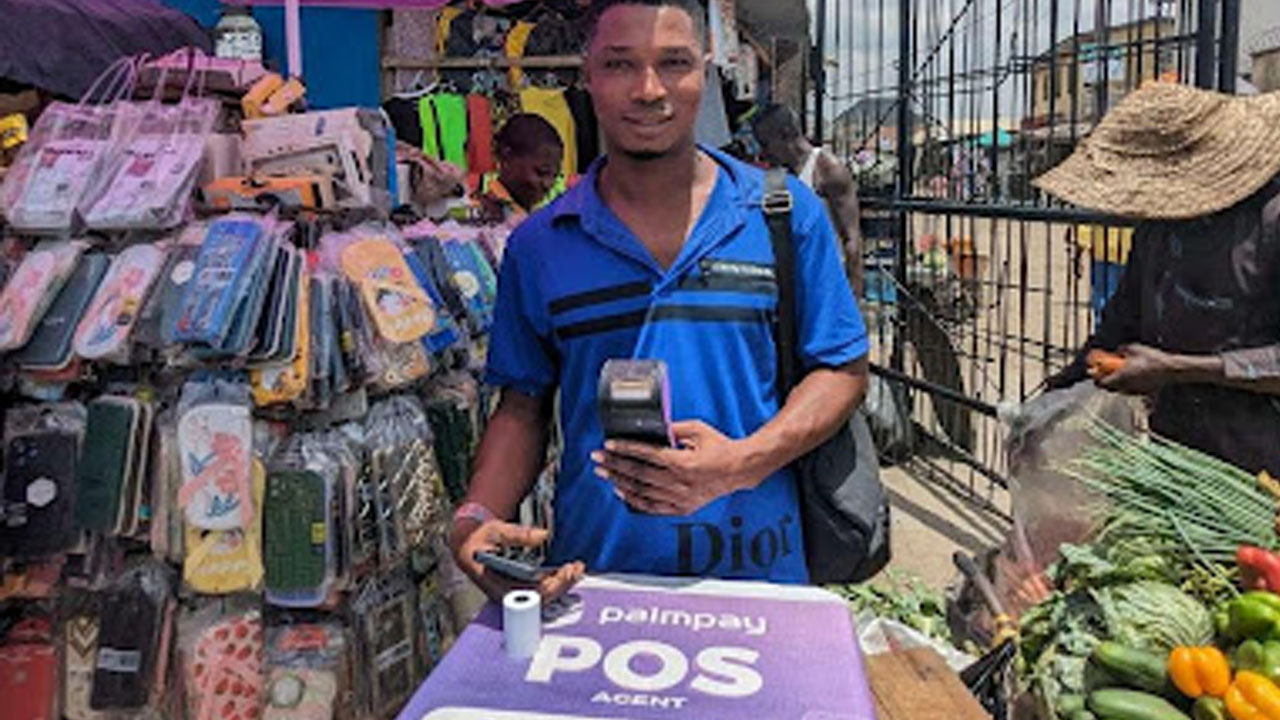

This article chronicles PalmPay’s achievements and delves into its innovative use of technology to make banking more efficient and secure for millions of its users.
A PalmPay Agent
[ad]
Prior to finding out about PalmPay, Samuel, a farmer in the Ikorodu area of Lagos, Nigeria’s commercial capital, said, “I never thought I’d have access to banking services.”
At first, one may find Samuel’s admission hard to believe. However, his position is not unique. Nigeria has a financial inclusion challenge, one that is to a greater degree noticeable in rural areas. Situated in Nigeria’s cosmopolitan city of Lagos, Ikorodu, with its kilometres, however, remains a high-density and relatively low-cost area.
Speaking to this media, Samuel said that using the PalmPay app has presented him with the ability to “save money, get loans, and insure my crops. It’s like a bank in my pocket!” He is not the only one that is full of commendation for the most downloaded finance app in Nigeria.
A small business owner, Maria says “PalmPay has been a lifesaver for my business. I can easily receive payments from customers and pay my suppliers, all from my smartphone. It’s simple and hassle-free.”
A Payment App That Keeps Giving
Over the last four years, PalmPay’s rich and engaging bouquet of features has indeed earned it the most downloaded financial app in Nigeria and the fastest-growing financial app in Africa. The app boasts of some of the best features among its peers.
Adekoya Raheem, a secondary school teacher, says the app’s interface looks “more like my Android phone, easy to navigate, and transactions are faster than I thought.”
[ad]
PalmPay’s ecosystem extends beyond its basic payment features to offer millions of its users a wide range of financial services that includes savings and other products that help PalmPay users and registered businesses transform how they manage their finances.
There is the savings feature, a wealth management service that offers a diverse portfolio of saving plans, including Fixed Savings and Flexible Savings (Cashbox), to maximize your money.
For Fixed Savings, users have the opportunity to lock away their funds for a specified duration of 7 to 540 days, during which time they enjoy an enhanced interest rate of up to 20% per annum.
CashBox is a product that allows users manage and grow their money in a more flexible way compared with Fixed Savings. Here, users get interest payout everyday, while the funds that they deposit will not be locked and the principal and interest can be withdrawn at anytime with no penalty.
Another feature is the Pay Shop, or ‘Pay With Transfer,’ which allows users to pay and earn cashback easily and securely at over 600,000 local shops, restaurants and street vendors. With this feature, businesses of all sizes can display or paste PalmPay’s brand mark poster with their merchant account to accept payment.
Nigeria’s Fintech Takeover
The emergence of PalmPay and other Fintech companies like Opay and Moniepoint are shaping the future of banking in Nigeria, having shown a higher technological edge than traditional banks.
With over 30 million users, PalmPay is one of the most used payment apps in Nigeria, leveraging its advanced security features, friendly user interface, and seamless process for payments.
PalmPay has an impressive year-on-year growth of 117% up, with over 15 million monthly active users that carry out monthly transactions valued at over $6 billion.
Its close competitor, Opay, says it has 500,000 agents, 300,000 merchants and over 35 million users, while Moniepoint, which only recently expanded into retail banking, wants a share of the market.
Compared to figures from traditional banks and the short amount of time it took PalmPay to build such huge numbers, 30 million users for a single payment platform remains a great feat.
Let’s put this into perspective. Recent data from the Nigeria Inter-Bank Settlement System (NIBSS) puts active bank accounts in Nigeria at 133.5 million as at December 2021.
For a country of over 200 million population, the number shrinks down to 57 million when we link the over 133.5 million active bank accounts to a Bank Verification Number (BVN).
Marking four years of PalmPay’s existence recently, Managing Director, Chika Nwosu, pegged the bank’s users at “30 million,” and its transaction success rate at 99.5% within 10 seconds.
[ad]
PalmPay’s Digital Banking Feats
Trusted by over 30 million Nigerians, PalmPay’s rise to prominence can be attributed to its ability to provide financial inclusion to the country’s unbanked and underbanked market.
Financial inclusion has long been a challenge in Nigeria, with more than 42 million adult Nigerians living in rural areas lacking in basic banking services, according to a 2021 report by EFInA.
PalmPay is changing this narrative by providing a convenient and secure way for individuals to access financial services, including the unbanked in remote corners of Nigeria.
A cornerstone of PalmPay’s strategy is its expansive network of 1.1 million businesses, including 500,000 agents and 600,000 merchants, who embrace the company’s POS or Pay With Transfer services.
These dedicated agents have further extended PalmPay’s reach across the entire breadth of Nigeria, serving millions of additional consumers with essential financial services.
In total, 40 million consumers, or 1 in 5 Nigerians, are now using the PalmPay platform via its smartphone apps, merchants and agents for money transfers, bill payments and savings.
PalmPay has helped transform Nigerian consumers’ behavior and sensitized them to making cashless transactions. On average, every user of the PalmPay app is said to make up to 50 transactions per month, a figure that has quadrupled since the app’s launch four years ago.
Speaking at the company’s four-year anniversary, Mr Nwosu said, “This remarkable achievement firmly establishes PalmPay as a trusted and reliable platform for conducting a wide range of financial transactions.
“With our achievements, we fully embody our tagline – Finance That Fits Your Life,” Mr Nwosu said, adding that, “As we move forward, we are excited about the opportunities that lie ahead and are committed to fostering a future where financial services are accessible to all.”
The Future of Banking by PalmPay
Sofia Zab, Global Chief Marketing Officer, PalmPay, told reporters at the company’s 4th anniversary celebration that PalmPay was built “to drive financial inclusion.”
Four years and counting, with over 30 million Nigerians that trusts the brand, Ms Zab says PalmPay’s unprecedented success rate in its transaction system, is something to be “very proud of.”
For players in the financial services sector, the future of banking undoubtedly lies in embracing technological advancements like PalmPay has done since its inception in 2019.
As smartphones become more prevalent and internet access expands across Nigeria’s rural areas, the potential for digital banking solutions will be limitless. PalmPay is at the forefront of this transformation, with plans to expand its services across Africa and beyond.
Presently in Nigeria, Ghana, and Tanzania, with plans for Kenya, PalmPay is certainly poised for further expansion, and has the potential to reach even more underserved markets beyond Africa.
[ad]

