 Follow Us on Google News
 Follow Us on Google Discover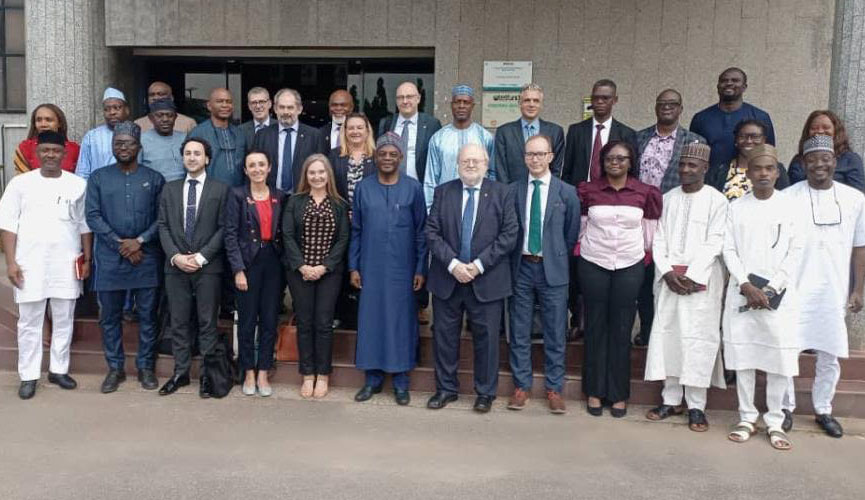

They were not the everyday guests. They were dons from across several higher institutions in faraway United Kingdom. Call them ‘big masquerades’ and you won’t be out of place. The reason for their visit to Africa’s most populous nation is simple – to rub minds and work out modalities on how UK universities could work more closely in future with Nigeria as mutual partners.
[ad]
The delegation of British Universities’ Vice-Chancellors led by UK Government International Education Champion and Head of the UK Government’s High-Level Education Delegation to Nigeria, Sir Steve Smith, was received by the Tertiary Education Trust Fund (TETFund).
Welcoming the August gathering, TETFund’s Executive Secretary, Sonny Echono, confirmed that the visit served as an avenue for stakeholders to explore opportunities for a mutually beneficial higher education partnership between the UK and Nigerian universities, in the best interest of the collaborating parties. He disclosed that the Fund currently provides intervention in 253 public tertiary institutions in Nigeria.
The ever resilience Executive Secretary also disclosed plans to increase the number to 270 in 2024 with the addition of seven newly established higher institutions.
He also informed that plans have reached advanced stage to set up four multi-disciplinary laboratories across the country, stressing that they would be equipped with state-of-the-art facilities and function 24 hours a day, seven days a week. He said the centres would not only be used for medical diagnoses that were hitherto taken abroad but will also fill the void of infrastructural deficit in public tertiary institutions.
Echono described as embarrassing, situations where researches are prolonged in the country due to lack of equipment.
“We also feel that we need to put a governance structure in place that will make them self-sustaining in longer term. Because we have the embarrassing situation where sometimes, researches are prolonged because specific equipment is not available. It is still at final planning stage; the designs have been approved. Locations will be approved in the next couple of weeks; the budget is already in place for that. And we are already discussing with some companies in the UK, particularly in terms of the equipment for those laboratories”, he further revealed.
Echono expressed concern at the rising issue of brain drain in Nigeria, explaining that the Federal Government has sought partnership with British universities to ensure that sponsored scholars return home after completing their studies abroad.
He noted that the brain drain phenomenon had not only affected the development of the country but also posed a significant loss of investment in the scholars’ education.
“The government has invested heavily in the education of these scholars and it is disheartening to see many of them choosing to stay abroad after their studies. Our goal is to foster collaboration with British universities to create a mechanism that encourages the return of these scholars to Nigeria”, said Echono
According to him, there could be a possibility, based on partnership, for scholars to return to complete their programmes in Nigerian universities after doing the major training overseas.
The Executive Secretary also highlighted the need for capacity building and strengthening of the higher education sector within Nigeria, saying that the government aimed to create an enabling environment that will attract scholars to return and contribute their expertise by improving the quality of education and research facilities.
Earlier, the leader of the delegation, Sir Steve Smith, described the UK-Nigerian relationship as strong and deep, especially in education, which he said, is producing incredible results. The UK Government International Education Champion, who said this was his third visit to Nigeria in two years, pointed out that this was part of the Nigerian-UK Steering Committee on Transnational Higher Education (NIG-UK-HE-TNE).
The former Vice Chancellor, University of Exeter, acknowledged the importance of retaining highly skilled individuals in their home countries, noting that the brain drain issue affects both Nigeria and the international community.
“We understand the concerns of the Nigerian government and we share the vision of providing quality education to talented individuals. By working together, we can create opportunities for these scholars to contribute to the progress of Nigeria, while furthering their academic careers,” Smith said.
Steve was accompanied by heads of institutions from Robert Gordon University, Arden University, King’s College London, Lancaster University, University of Exeter as well as officials from UK Department for Education, UK Department for Trade, British Council, British High Commission, Association of Commonwealth University and a host of others.
[ad]

