 Follow Us on Google News


 Follow Us on Google Discover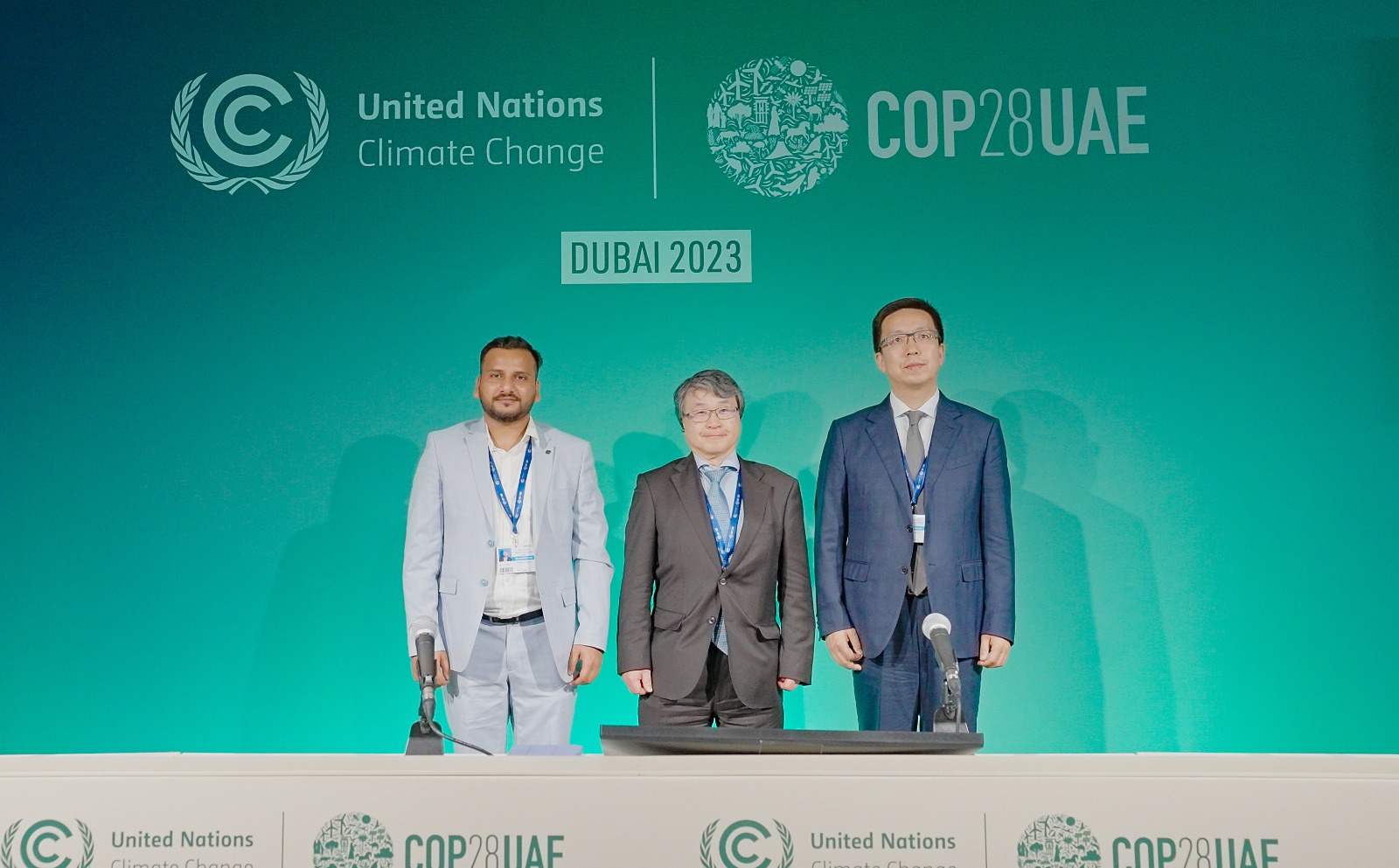
 Huawei has teamed up with multiple United Nations (UN) agencies to help unlock the potential of Artificial Intelligence (AI) in bolstering collective response to climate change at the ongoing United Nations Climate Change Conference (COP28), hosted by the United Arab Emirates (UAE).
The President of Huawei’s Global Technical Services, Research and Development, Jerry Guo, joined top officials from the International Telecommunication Union (ITU), International Atomic Energy Agency (IAEA), Food and Agriculture Organisation (FAO) and UNESCO in encouraging green digital solutions for climate change at high-profile event at COP28 that saw the announcement of winning teams from the AI/Machine Learning in 5G Challenge, which kicked off in July.
[ad]
More than 700 teams from 83 countries took part in the 5G energy consumption modelling challenge, a problem statement Huawei introduced as part of the series of competitions curated by the UN organisations, and led by the International Telecommunication Union (ITU) and International Atomic Energy Agency (IAEA).
Data scientists Krishna Priya and Rajat Ranjan, from India, emerged as the winning team that developed machine learning models to reduce energy consumption of base stations from any manufacturer.
Guo noted that more than 90 per cent of a telecom operator’s carbon footprint for operations comes from the electricity used to power networks.
“This means we need to act fast to reconcile between fast-growing demand for data with expectations for green networks,” Guo said.
Guo said one case in point is the AI-powered Simulated Reality of Communication Networks (SRCON), which saves more than 20 percent of energy while ensuring leading network performance.

He said tbe technology has been implemented in more than 40 countries, helping reduce carbon dioxide emissions by 700,000 tons per year.
According to him, increasing the efficiency and quality as well as reducing energy consumption and cost of communications networks is the responsibility of tech companies like Huawei, and a major part of how the firm can contribute to human development.
The Secretary-General, ITU Doreen Bogdan-Martin, said AI has the potential to help mitigate between five to 10 per cent of global greenhouse gas emissions by 2030.
She added that increasingly, people are discovering how technologies can unlock solutions and put the world on a greener and more sustainable path.
[ad]

