 Follow Us on Google News


 Follow Us on Google Discover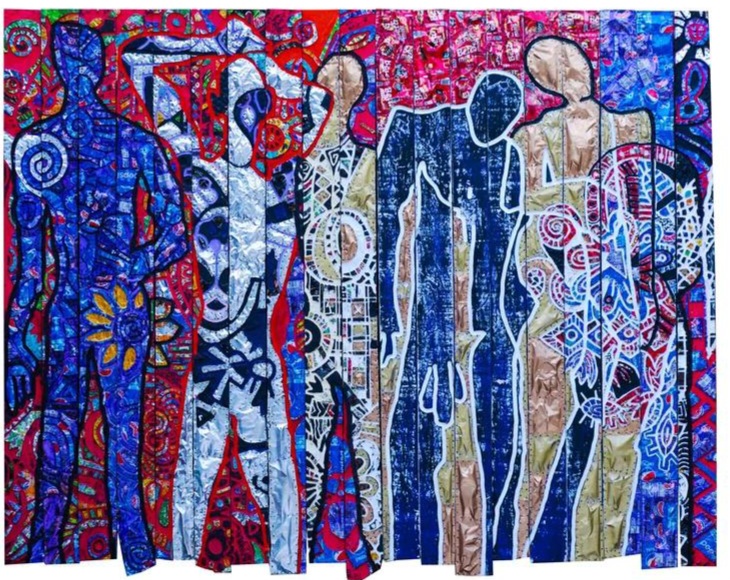

A rich color palette, tones of blue, red and purple in shade – dark and light. Marked with white and black, motifs fused with indigenous writing styles. Male human forms with heads in different directions almost suggesting they are headed to different destinations. Unclothed for the same cause, something momentary and soon passing away. That another may begin. They all wait in joy that soon and every soon that which they have waited long enough for is being handed to them.
[ad]
This wood panel mixed media by Gerald Chukwuma, features five naked young men all standing, but moving in different directions. The red and blue colors in the background blended into motifs recalls the beauty of traditional African woven fabrics like the Akwete. These men are in a procession as their movement suggests while others are dancing, there is one of note whose head is on his head, a very uncomfortable sign in African cultures. He seems not to be part of the procession, like he should have been but he isn’t.
Iwa Akwa from which this artwork gets its name is a popular rites of passage ceremony among the Igbo people of Nigeria. As a word it is loosely translated as “wearing of cloth” and it is the rite of passage for young boys into manhood. It is believed that manhood is a form of clothing worn only on those deserving of it, therefore boys who were once “naked” have now taken upon themselves the responsibility that comes with clothing having satisfied all conditions thereof. The ceremony is a status signal within their community and it is made public with a procession along the length and breadth of such a community, young men in the company of their friends, loved ones, drums, songs and dancing proceed to the village square with cloth around their neck. It is at the village square all those observing the rites gather, exchange greetings and are received officially into manhood.
Across traditional African societies, rites of passage existed as a statutory practice. Structurally, African communities were communal and progress – both biological and otherwise had certain metrics, some of which could be family, nobility, impact, identity and demonstrated potential to mention but a few. While a person might qualify for the rite of passage into a certain grouping by biological advance, if such an individual is found wanting on account of other metrics, they will be denied the rites of passage. Groupings were a form of network, people binded first by common origin and then by age, trade and other factors.
This piece rendered in enchanting colours is a delight to see, a stylistics genius of creation that could be rated in the parlance of contemporary Nigerian colloquial lingo an 8/10 not for reasons of technical inadequacies, aesthetics nor thematic. As such, Iwa Akwa is not merely a visual representation but a dynamic dialogue between the artist, his audience and culture, prompting a deeper appreciation and broader artistic value. This critical examination reaffirms the importance of Chukuma’s work in the art community and highlights how art can serve as both a mirror and a lens through which our world can be understand.
By creating and exhibiting this piece, Chukwuma recalls his childhood experience as a young man growing up in Eastern Nigeria. He calls his viewers into the same experience while showing the beauty and prestige of a long standing tradition even though it is sparsely practiced today.
[ad]


