 Follow Us on Google News


 Follow Us on Google Discover
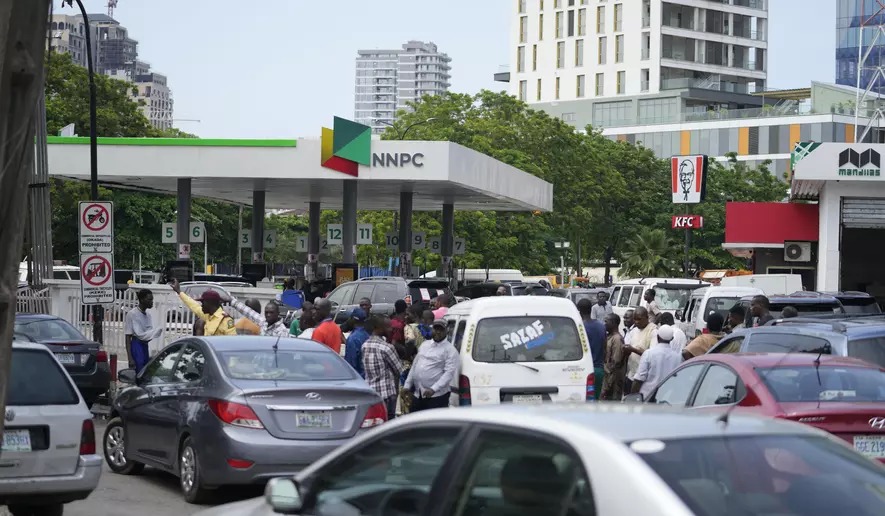
Amidst the confusion and anger currently trailing the unofficial increase in the price of petrol, it remains sad and unacceptable that Nigerians are subjected to agonising experiences at filling stations, spending hours, even days, in fuel queues, and sometimes returning home without getting the product to buy. That this has become a regular feature of a country that is supposedly one of the major oil-producing countries in the world is nothing but deplorable.
Notwithstanding that this abnormality has been endemic across several past regimes even in the military eras, the present Federal Government led by President Bola Tinubu must take responsibility for failing, like its predecessors, to address in concrete terms, the patent underlying causes of the situation. This perennial scarcity is despite the substantial increase in the price of petrol since May 29, 2023, when President Tinubu proclaimed that subsidy was gone. Since then, the price has gone from N545.83 per litre to N700, N900 and far above N1,000, depending on location and availability.
[ad]
Accompanying the high retail price of petrol is the inevitable hike in the cost of transportation, with a ripple impact on the prices of goods and services. Indeed, these are excruciating times for Nigerians, in a country regarded as a leading producer and exporter of crude oil in Africa, a member of the Oil Exporting Countries (OPEC), with a proven reserve of 37.50 billion barrels, but with a near zero refining capacity.
This culture of endemic failure should cease. The Federal Government should show capacity and responsibility, especially for a sector that is the major revenue earner and contributor to the country’s Gross Domestic Product (GDP). This is the time to get it right by frontally tackling the factors responsible for the failure of the refineries to work; and the tumbling value of the local currency that has sustained high fuel prices, not just of petrol but also diesel, kerosene and aviation fuel.
Nigeria has four major refineries, two in Port Harcourt, and one each in Warri and Kaduna, with a combined capacity to refine 450,000 barrels per day. Over the years, the refineries have been moribund despite huge sums invested in paying staff and in endless Turn Around Maintenance (TAM). As of May 2023, the outgoing National Assembly reported that more than N11.35 trillion ($25 billion) had been spent in 10 years to get the refineries working. While not producing a drop of refined product, the refineries spent N127 billion on salaries, wages and employment benefits between 2020 and 2021, as reported in the audited financial statements of the Nigerian National Petroleum Company Limited (NNPCL). That era of waste is unacceptable and must stop.
We recall that President Tinubu promised to fix the refineries when he met with the leadership of the Nigeria Labour Congress (NLC) in August 2023, when workers went on one-day protest against hardship fueled by the sudden removal of subsidy. Tinubu assured workers that the Port Harcourt refinery will start production in December 2023. On the strength of the President’s assurance, Labour called off the protest. But the president’s promise has not been kept despite repeated echoing by other officials of government. It was the same empty promise the Buhari administration made in all of eight years. The Tinubu administration should demonstrate that it is different from the business-as-usual past, walk the talk and get the refineries working.

It beats the imagination of the ordinary Nigerians why the government and the NNPCL appear unwilling to take advantage of the Dangote Refinery to flood the market with products, a development that will save the country this global embarrassment. It is projected that with the capacity to deliver 650,000bpd of refined products, sufficient for the domestic market and export, the Dangote Refinery could save the country up to $10 billion in foreign exchange (FX) and generate another $10 billion in exports. What else is the Federal Government waiting for?
[ad]
While the controversy generated by the Nigerian Midstream Petroleum Regulatory Authority (NMDPRA) concerning the status of the Dangote Refinery is notable, that dispute is needless, coming after an investment of around $20 billion and long after the refinery has commenced production and supply of AGO, also known as diesel.
It is equally unfortunate that the supply of crude to domestic refiners is delayed due to regulatory bottlenecks. That should not be. The order by the Federal Government for the Nigerian Upstream Petroleum Regulatory Commission (NUPRC) to sell crude to local refiners should not be flouted. We equally hope the order to sell the crude in Naira will materialise. There should be no shifting of the deadline of October 1, 2024, as a date to begin the supply.
President Bola Tinubu, who allocated to himself the portfolio of Petroleum Minister, should instill sanity in the oil sector. The anomalies in that sector have dragged on for too long. This is the time to allow the Petroleum Industry Act (PIA), despite its shortcomings, to sanitise the industry. For far too long, the absence of corporate governance has robbed the sector of appropriately defined roles for regulators and operators. There is too much opacity and politics in the running of NNPCL. It is high time Mr President dismantled the principalities that hold the organisation hostage; let heads roll and let there be a new dawn in the sector.
[ad]
With local refining, a lot of wastage and duplication will stop. It is a known fact that there is a lot to benefit from local refining. Apart from jobs and enhanced revenue, local refining would guarantee energy security amid recurrent price volatility in the international market, trouble in the Middle East and the Russian/Ukraine war.
This is the time to encourage indigenous companies and put a stop to acts that willfully or unknowingly sabotage local efforts. The government must put an end to the activities of cabals in the sector, which are bent on frustrating local capacities.
It is a good thing that the NNPCL has finally acknowledged that it is hugely indebted and unable to import fuel. The company has confessed to facing financial strain confronting its capacity to sustain supplies. It is reported to owe debts of over $6 billion. It’s a shame this is where NNPCL has landed the country. The implication is that the scarcity could get worse.
The quickest route out of the logjam is immediate local refining. Dangote Refinery should be given maximum encouragement, while government refineries should also be made to function. There’s no more time to waste.
[ad]

