 Follow Us on Google News
 Follow Us on Google Discover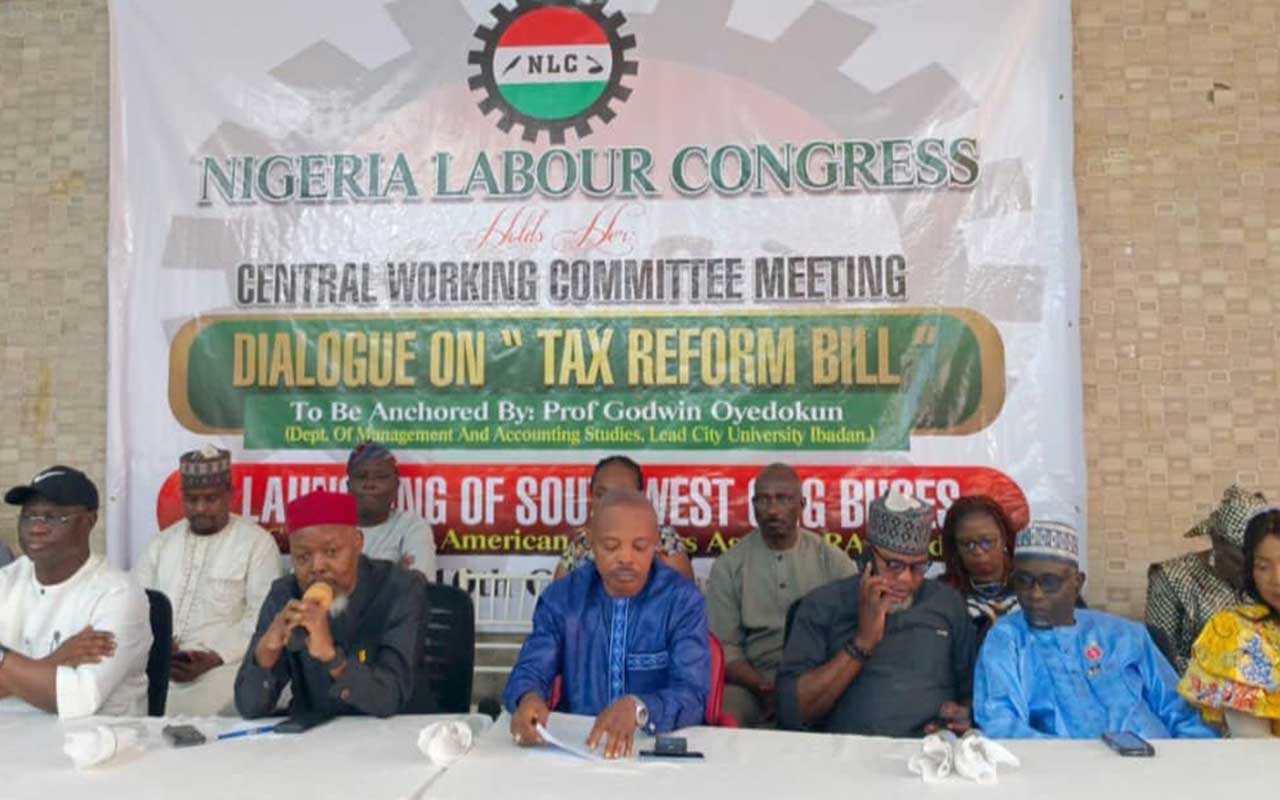
Over the weekend, the leadership of the Nigeria Labour Congress (NLC) and other critical stakeholders, including tax experts, gathered in Ibadan, Oyo state, to assess their positions on the ongoing tax reform bills, saying a wider and deeper engagement is required.
The forum, which was organised by the NLC, would come up with a stand that would reflect the appeals of most Nigerians, the business community as well as employers of labour.
[ad]
NLC President, Joe Ajaero, submitted that the dialogue became imperative to address some of the noticeable grey areas in the Bill, with an observation that some aspects of the tax reform bill needed clarifications from the government for better understanding.
However, he faulted the response of the Chairman of the Presidential Committee on Fiscal Policy and Tax Reforms, Taiwo Oyedele on how the tax reform bills would benefit workers.
Describing his statement as insensitive, Ajaero said: “When his committee was settled, we wrote to the federal government and said that you cannot shave our heads in our absence. So, he (Oyedele) cannot tell us how we will benefit. If he is sure we will benefit from it, why is he avoiding us? We have some little knowledge about this tax policy that we will bring to the table. That is all we have asked for. So, this policy will make workers poorer.
“As practitioners, we are calling for dialogue to make our contributions. We are the people on the ground, and we know where it is pinching us. Unless you talk with people who are in the background, who daily go out there on the streets, you may be talking above them.”
Oyedele on his X handle reacted to the NLC New Year message, where the congress called on President Bola Tinubu to halt the tax reform bills before the National Assembly until such a time when all the views of critical stakeholders are taken on board.
[ad]
Oyedele dismissed the claims that the proposed bills would have negative impacts on the welfare of Nigerian workers, even as he listed how the tax reform bills would lead to improvement of the welfare of Nigerian workers.

According to him, the implementation of the tax reform bill will lead to lower taxes that will enhance the disposable income of workers as they provide for full exemption of low-income earners up to N1 million per annum (about N83,000 per month) representing about one-third of all workers in the private and public sectors from PAYE tax while PAYE tax for workers earning up to N20 million per annum (about N1.7 million per month) will also be reduced.
He said that the bills also contained tax waivers to promote affordable housing like VAT exemption on rent and acquisition of real property and exemption of stamp duties on rent below N10 million.
Oyedele added that there are incentives to stimulate employment opportunities for workers in the bills, including tax incentives for employers to hire more workers, friendly tax rules to attract remote work opportunities for Nigerians, and tax exemption for 97 per cent of SMEs, harmonisation, and reduction of corporate tax rates for large businesses to stimulate growth and create more employment opportunities for workers.
“We believe that the NLC will not intentionally work against the interest of its members. We therefore look forward to the opportunity to discuss specific areas for improvement in the bills to better serve the interest of all Nigerians, including workers,” he said.
[ad]
Countering Oyedele, Ajaero, at the dialogue in Ibadan, said: “There is a need for collaboration with the government to straighten out some issues as spelt out in the Bill because there is a section of the Bill that stated zero taxation for workers earning below N800,000 per annum, but you and I know that in the public service, people have gone beyond maybe level 2 and 3.
“It then means that all workers in Nigeria will be affected because if we take a baseline of N70,000 per month which somebody is supposed to pay, but there is nobody on level 1 step 1 that is N70,000, which means that no worker is exempted in the payment of taxes. So, by the time you get to Level 9, everybody has been cut off from the N800,000 or N1 million per annum salary.
“This, for me, brings up the issue of indirect taxation, especially in an era when the Central Bank of Nigeria (CBN) is deliberately withdrawing withholding tax and people have to even pay some money to access cash. Who are the people suffering from this? That is the area that people are seeking clarification. What we are saying is that we need to talk so that we tell you where it is hurting us.”
He said that the dialogue was more enlightening, especially with the NLC’s knowledge on tax and tax justices, which would give room for Congress to articulate a more uniform position to the interests of Nigerian workers, especially as it affects avoiding double taxation and indirect taxation.
He further urged that the government should dialogue with Congress on the tax reform bill, to enable its members to make their inputs, even as he implored members of the public to endeavour to go through the tax reform bill to prevent misinterpretation which could trigger misinformation.
[ad]
Giving an overview of the proposed tax bill, a professor of accounting and financial development at Lead City University, Godwin Oyedokun, said what was needed at this time was for the government to widen the tax net rather than increase taxes, considering the country’s socio-economic challenges.
Citing some grey areas under the Personal Income Tax (PIT) and Value Added Tax (VAT), he urged that rather than allowing the Bill to scale through, labour should negotiate on the PIT, because once the Bill is enacted, nothing could be done about it.
However, he said repealing the Bill was not in the best interest of workers, even as he urged them to stay abreast of the dangers ahead of the Bill.
Oyedokun said the proposed tax bill aims to create a favourable environment for job creation and economic growth through various incentives for businesses.
He said the provisions are expected to have a positive impact on employment levels and wage growth in both the formal and informal sectors.
However, the don said the success of the provisions would depend on their effective implementation and the ability to formalise the informal economy.
[ad]
On implementation challenges, Oyedokun highlighted challenges of infrastructure gap and administrative capacity, stating that the success of digital tax collection systems relies on robust infrastructure, including reliable internet access, electronic payment systems, and data security protocols.
According to him, in rural or underserved areas, the infrastructure gaps may hinder the effective implementation of digital systems that track transactions and monitor compliance.
He said while the creation of a centralised tax authority (the Nigerian Revenue Service) aims to streamline tax administration, there might be initial resistance from regional tax agencies.
He mentioned that coordination between federal, state, and local governments could be challenging, especially with the diverse nature of businesses and industries across different regions.
Oyedokun clarified that the new tax is aimed at those with luxurious lifestyles, ensuring they contribute to the system.
He also highlighted the significance of tax reform in capturing revenue from informal sectors and digital businesses.
He, therefore, urged the NLC to engage in positive negotiations with the government, rather than opposing the reforms outright, suggesting that those resisting reforms may be motivated by self-interest.
[ad]

