 Follow Us on Google News


 Follow Us on Google Discover
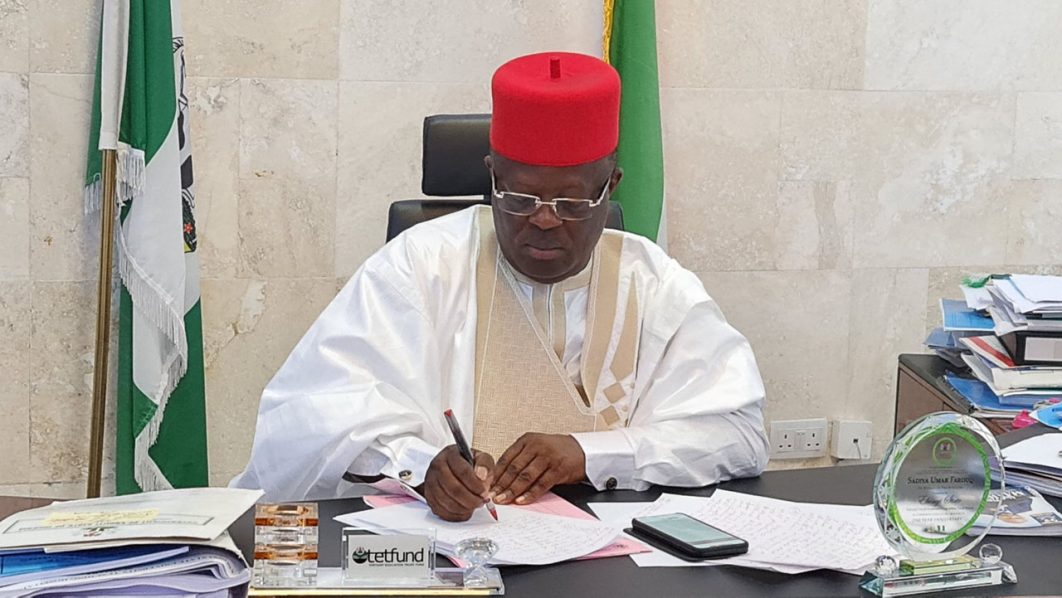
The advocacy by the Minister of Works, Dave Umahi, for government to borrow money in order to provide roads infrastructure has once again brought to the front burner the nagging challenge of how to fund roads development and maintenance in the country. That most Nigerian roads constitute an eyesore and patent danger to motorists is perhaps an understatement. And while government has often attributed the parlous state of roads to inadequate budgetary allocations, there has been no consensus on how to resolve the impasse, considering that the available funds are chasing many developmental projects other than roads.
[ad]
What is certain is that the country is already neck-deep in debts, and needs to avoid more debt traps, for the sake of the coming generations, which would invariably be saddled with servicing the debts. One sure bet for the authorities is to sever the multiple avenues for waste in government expenditure, cut unnecessary cost and be more prudent in its financial management. Another option that should be practiced alongside others is the deliberate confrontation of corruption that over the years has become endemic and highly destructive of government’s infrastructural ambitions.
Getting about 36,000 kilometres of federal roads across the country motorable and safe all year round has been a daunting challenge for decades. Over the years, different management models have been canvassed for the sector, including public private partnership (PPP), tolling, road tax, among others to ensure robust funding and execution of road contracts and for maintenance. Despite the loftiness of the policies, government’s lack of fiscal discipline and systemic corruption have stagnated road infrastructure in the country. There is therefore need for government and stakeholders to be sincere and committed if the country is to have good roads across the country.
There is no doubt that more funding is needed for the sector, just like for every other sector that is grappling with inadequate and inconsistent funding. More troubling is the failure of government and stakeholders to apply accountability and transparency codes contained in extant procurement regulations, making it difficult to rely on whichever funding model that is adopted.
Government should ensure that resources budgeted for roads are released and utilised within recommended and reasonable timeframe, given the volatility of prices, among other variables. That should be the first step before any official contemplation of borrowing to fund roads. Government officials must first learn to cut waste and live within realistic means.
At the 2025 budget defence, Minister of Works, Umahi, advocated borrowing money to fund roads projects. He said the country needed N18 trillion to fix the roads while lamenting that annual budgetary provisions are insufficient to address the challenge.
His words: “Remember the President inherited 24,064 projects, totaling N13 trillion in 2023. If you review that in line with the market realities now, it should be close to N18 trillion….that’s why I have been telling the National Assembly, we have to borrow money to fix roads. The roads, when fixed would be catalyst to economic growth. It will also eliminate hunger. This is because road infrastructure creates a lot of economic activities.”
While it is true that road infrastructure creates economic activities, Nigerians in general are yet to see the connection between previous borrowings and the accompanying upsurge in economic activities. Instead, Nigerians have witnessed massive dilapidation of roads, rendering them into an appalling state over the years, leading to high haulage and transportation costs as well as mass death in automobile crashes involving fuel-bearing trucks and passenger vehicles
The works minister needs be reminded that Nigeria’s debt stock is estimated to hit N187.8 trillion in 2025, due to continuous borrowings, repayment costs and the depreciation of the naira. Without fixing the fundamentals of the economy, more borrowings in the name of fixing roads without the discipline to put the funds where they are needed most will only lead to more indebtedness. For instance, it cost N6.0 trillion to service debts in the first half of 2024. Nigeria can no longer afford to expend so much to service debts that are not productive.
[ad]
In the last 20 months, revenues accruing to the Federal Government have multiplied, especially after removal of fuel subsidy. As of November 2023, the Federal Government claimed that it had saved N1.45 trillion from removing fuel subsidy. Economists have canvassed that with fuel subsidy removal government doesn’t need to borrow any more. Finance minister and coordinating minister of the economy, Wale Edun, announced in November 2024 that Nigeria had saved $20 billion from removing fuel subsidy and floating the naira. Yet, government has kept borrowing.
It is important for government to prioritise spending on relevant and growth-enhancing projects. For instance, in May 2024, government claimed it had commenced disbursement of N75,000 to 50 million Nigerians. There is hardly any trace, or impact of that disbursement in the economy and in the lifestyles of the people. It thus seems to be a waste of hard-earned resources as far as most Nigerians are concerned. Trillions have been spent on palliatives supposedly to alleviate pains of fuel subsidy removal, but there is little to show for it. The Federal Government is set to share another N75,000 to perhaps another set of 70 million Nigerians. These are monies that could deliver tangible gains in roads infrastructure if well applied. Government should be disciplined in the application of resources, rather than toeing the lazy option of borrowing.
Nigerians challenge government to prioritise public expenditures and put resources where they are most needed and verifiable. Roads are no doubt very important for economic growth. Nigerians also demand accountability and transparency in costing road projects. There are concerns that road projects in Nigeria are more expensive than in other countries with similar terrain and weather conditions. This is directly traceable to corruption within the procurement template, inflation, poor planning and delayed release of funds after budget approvals. Nigerians demand strict observance of procurement procedures, otherwise known as due process.
It remains an anomaly for the central government to be in charge of highways running through states in a supposedly federal system. It is even more confounding that the federal government that lays claim to these roads has no lasting capacity to make them motorable. Just as the need for state police is daunting, states must be empowered to work on their roads. This is devolution of responsibility that should be fully embraced and nurtured in a federal system of government that Nigeria professes.
[ad]

