 Follow Us on Google News
 Follow Us on Google Discover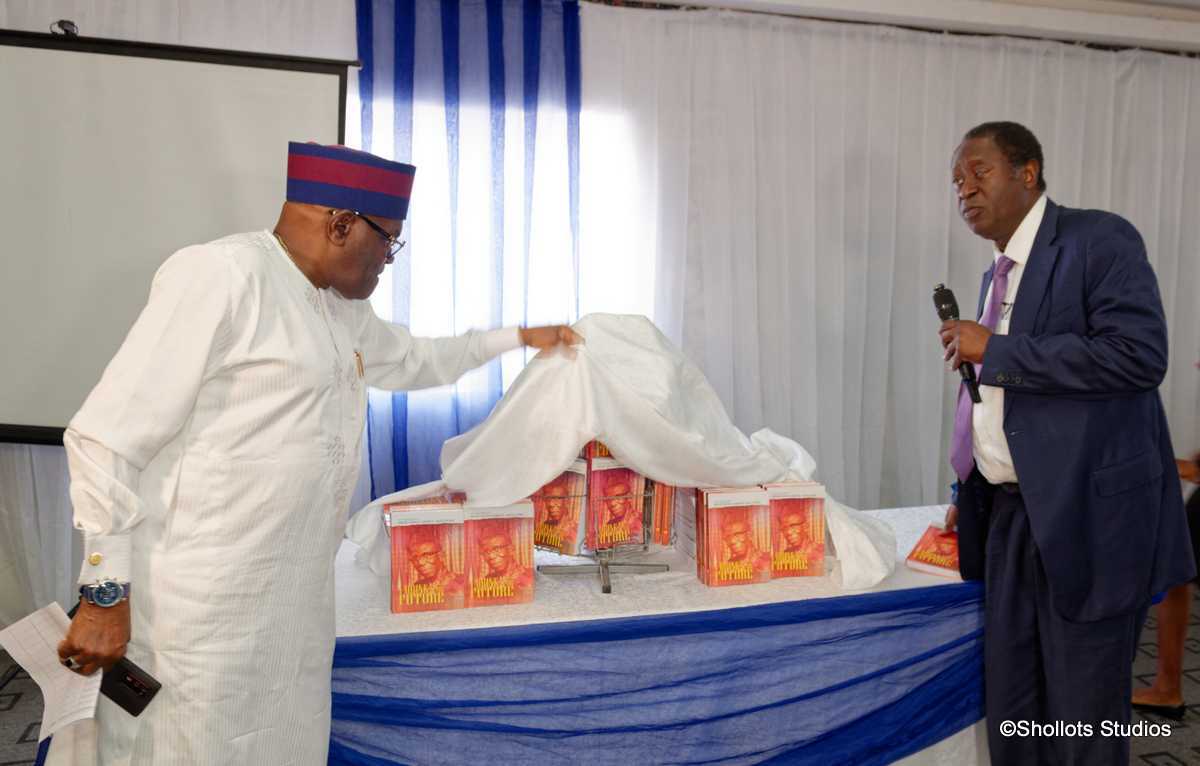
Prominent figures from various sectors gathered to celebrate the life and legacy of High Chief Gabriel Akin-Deko at the launch of his autobiography, ‘I Drink to the Future’. The event was marked by speeches reflecting on his impact in agriculture, politics, education, and governance.
In his welcome speech, Chief Wale Babalakin (SAN) described the occasion as a tribute to an icon whose dedication to service was unparalleled. “We have come to celebrate an icon, we’ve come to celebrate the past that we badly desire. We’ve come to celebrate the epitome of service, which is now the end of the day. We have come to celebrate commitment to a cause.”
Babalakin recounted Akin-Deko’s journey from Government College Ibadan, where he was admitted in 1930, to his extensive contributions in governance and agriculture.
He said, “As a student in Grier House in 1971, I remember Chief Akindeko was a teacher at GCI. He had been the Minister of Agriculture and also the FAO, he had been everywhere.”
He reminisced about the agricultural boom of the 1950s and 60s in Western Nigeria, adding, “Growing up in Ibadan, every morning, the Ministry of Agriculture and Natural Resources would deliver a pint of milk at our door at 7 a.m., and this they did to almost every household at minimum cost.”
READ ALSO: Inflation hits urban areas harder as Nigeria rebases index
Representing the Akin-Deko family, Adegboyega Akin-Deko provided insight into the personal life of the late Chief.
“From the family perspective, he raised all his 10 children by bringing the housemaster skills he had acquired from GCI Ibadan, with humour and compassion. He was philosophical in his teaching and also deeply religious in his conduct, yet remained a strict disciplinarian,” he added.
He recalled how Chief Akin-Deko’s deep connection with Government College Ibadan led him to build his first house opposite the school and later another near St. Teresa’s College during the Second World War.
He said, “You will not believe it, GAD moved with them to St. Teresa’s College and built his second house in front of STC and called it Motupe Lodge.”
Chief Pius Akinyelure, Chairman of the Board of Directors at NNPCL, described Akin-Deko as “more than a leader, he was an institution in himself.”
He highlighted his innovative contributions to agriculture, stating, “As a minister, High Chief Akin-Deko introduced innovative technologies in the cultivation of high economic produce such as cocoa, rubber, and timber.”
He also credited him with bringing pipe-borne water and electricity to Idanre, as well as establishing an education scholarship scheme for indigenes.
Dr. Christopher Kolade, in a video interlude, recalled his time at Government College Ibadan and Akin-Deko’s impact as a teacher.
He added, “High Chief Akin-Deko taught my class religious knowledge, how to develop a relationship with the Bible. He skillfully mixed biblical principles with everyday life, making it engaging.”
Senator Dr. Okurounmu provided a detailed review of the book, shedding light on Akin-Deko’s illustrious career.
He said, “Between 1937 and 1947, he worked as a schoolmaster at GCI, grooming top academicians and administrators. He later founded one of the leading construction companies in the country, Akin-Deko Kontrakts.”
He also underscored Akin-Deko’s achievements as the first African Chairman of the International Cocoa Organization and his leadership in the National Sports Commission, where he supervised the construction of Liberty Stadium and initiated the National Stadium in Lagos.
Akinwumi Adesina, President of the African Development Bank, paid glowing tribute to Akin-Deko’s visionary leadership in agriculture.
The AfDB president said, “Even though he was not trained in the field of agriculture, he was the mastermind behind the revolutionary farm settlements in Nigeria in the 1960s.”
READ ALSO: You’re leaders of today, not tomorrow, Obasanjo to Nigerian youths
Adesina revealed that Akin-Deko’s legacy continued to inspire agricultural development, stating, “At the African Investment Forum last year, we mobilized an additional $2.2 billion towards the development of special agro-industrial processing zones in an additional 28 states in Nigeria.”
Former President Olusegun Obasanjo recounted his personal encounters with Akin-Deko, stressing his intellect and commitment to agriculture, noting: “Papa was a smart guy, smart in the sense of a good brain. Whenever I talked to him, I used to be amazed about what he recollected and how simple he was.”
Obasanjo recalled how their conversations frequently revolved around agricultural policies despite Akin-Deko’s role as a contractor in the construction industry.
Governor Lucky Aiyedatiwa, represented by Dr. Anthony A. Omolola, praised the autobiography as an essential read.
“If you go through the pages of this book, you will see the kind of quality. It is a book that I highly recommend for younger generations,” he said.
He assured that Akin-Deko’s name would be immortalised in Ondo State for his contributions to agriculture and education.
Modupe, Akin-Deko’s daughter, expressed her joy at finally bringing her father’s work to light.
He said, “My father actually has been dead 38 years, but the children have been trying to finally put it together.”
She emphasized the book’s significance in reviving lost values, adding that “it gives insight into things we have lost, values that were instilled in us but have unfortunately faded.”
The launch of ‘I Drink to the Future’ was a celebration of a visionary whose influence spanned agriculture, education, governance, and public service. The event reaffirmed Akin-Deko’s enduring legacy and the lasting impact of his remarkable life.

