 Follow Us on Google News
 Follow Us on Google Discover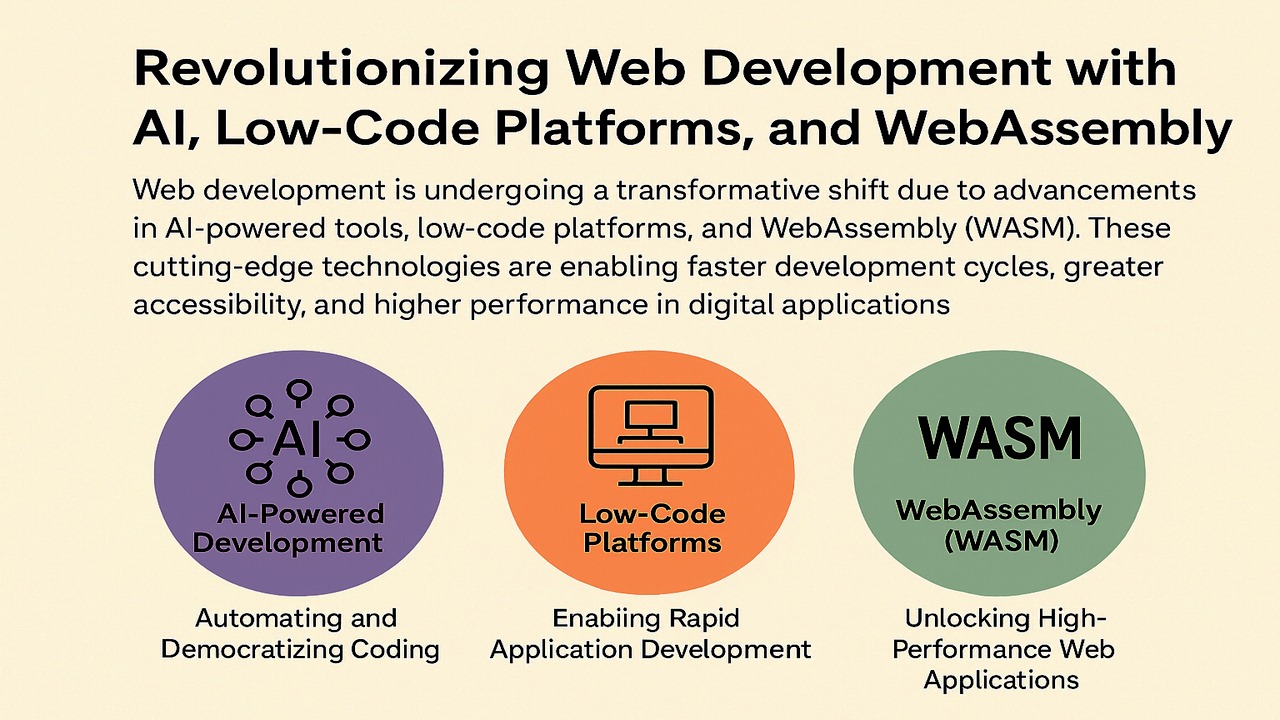
Web development is undergoing a transformative shift due to advancements in AI-powered tools, low-code platforms, and WebAssembly (WASM). These cutting-edge technologies are enabling faster development cycles, greater accessibility, and higher performance in digital applications. According to Sai Vinod Vangavolu in Research AI tools are automating repetitive tasks and improving code quality, while low-code platforms democratize the development process, allowing non-developers to contribute. Meanwhile, WebAssembly enhances browser performance, supporting compute-heavy tasks like gaming, AI, and video editing. These technologies are revolutionizing how applications are created, making web development more efficient and accessible to businesses and developers worldwide, marking the future of software engineering.
AI-Powered Development Tools: Automating and Democratizing Coding
AI-powered tools, such as GitHub Copilot and OpenAI Codex, are transforming the development process by automating repetitive coding tasks like code completion, debugging, and performance optimization. This automation allows developers to focus more on creative and complex aspects of programming. AI tools are also bridging the skills gap, enabling non-developers to contribute to the development process by allowing natural language programming. Additionally, AI-driven testing frameworks help improve code reliability and predict potential issues. Furthermore, AI personalized user experiences by dynamically adapting content and interfaces based on individual preferences, enhancing both functionality and engagement across web applications.
Low-Code Platforms: Enabling Rapid Application Development
Low-code platforms like Out Systems and Mendix are changing the way businesses develop applications by simplifying the development process. These platforms enable individuals with little or no coding experience to build applications quickly, using drag-and-drop interfaces and pre-built templates. The integration of AI tools enhances the backend by automating tasks such as database management, predictive analytics, and UI generation, enabling even more efficient development. These platforms allow businesses to quickly adapt to changing market conditions and innovate at a faster pace, reducing reliance on large IT teams. Low-code platforms also offer scalability, making them suitable for both small projects and large enterprises.
WebAssembly (WASM): Unlocking High-Performance Web Applications
WebAssembly (WASM) enables high-performance applications directly in web browsers by executing tasks at near-native speeds. It enhances the performance of applications that require significant computational power, such as gaming, video editing, and real-time AI tasks. WASM allows for the decentralization of tasks to the browser, reducing latency and improving responsiveness, which is particularly useful for real-time systems. Additionally, it offers cross-platform compatibility, making it ideal for applications that need to work seamlessly across various devices and operating systems. By providing powerful tools for creating high-performance, compute-intensive web applications, WASM is poised to change the landscape of web development.
AI-Driven Enhancements in User Experience and DevOps
AI is revolutionizing user experience through personalized content delivery, dynamic recommendations, and intelligent chatbots. AI tools dynamically adjust content based on user preferences, which increases engagement and conversion rates. Additionally, real-time A/B testing driven by AI optimizes layouts and content for maximum impact, ensuring better user experiences. In DevOps, AI accelerates testing, deployment, and monitoring, streamlining the CI/CD pipeline for faster, more reliable software delivery. AI also enhances security by detecting vulnerabilities, predicting threats, and continuously monitoring applications for risks. Finally, AI-driven cloud optimization helps businesses reduce costs while maintaining scalability and efficiency in their cloud infrastructure.
Challenges in Adopting Emerging Technologies
Despite the numerous benefits, adopting AI, low-code platforms, and WebAssembly presents significant challenges. Over-reliance on AI-powered tools may hinder the development of manual coding expertise, potentially reducing developers’ creativity and problem-solving abilities. Low-code platforms, while convenient, may lack the flexibility required for highly customized or intricate applications, limiting their utility for complex projects. Furthermore, the rise of automated development tools could create a skills gap, as traditional development skills may no longer be as essential, requiring developers to constantly upskill in new technologies. Addressing these challenges will be critical to ensuring the continued success and evolution of these emerging technologies.
Conclusion: A Transformative Future for Web Development
AI-powered tools, low-code platforms, and WebAssembly are revolutionizing web development by making it more efficient, accessible, and scalable. By 2025, these technologies will have redefined how businesses build applications, providing high-performance solutions that can adapt to rapidly changing user needs. However, addressing challenges like over-reliance on automation and ensuring flexibility in tools will be vital for sustainable growth. As these technologies mature, they will continue to unlock new possibilities in web development, transforming how software is created and deployed. This shift promises a future where innovation and creativity drive digital transformation at an unprecedented pace.

