 Follow Us on Google News


 Follow Us on Google Discover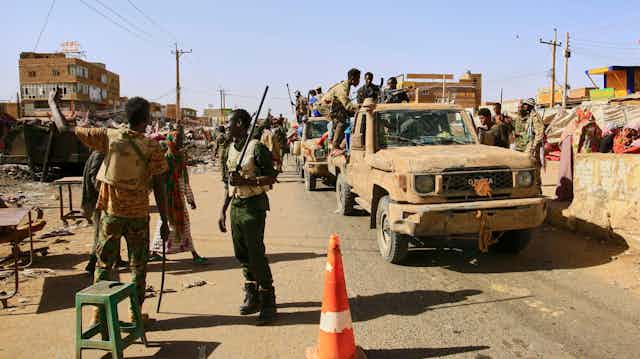
Sudan’s political and military landscape is witnessing rising tensions within the alliance between the Sudanese army, led by Abdel Fattah Al-Burhan, and factions of political Islam such as the Al-Baraa bin Malik Battalion, Al-Bunyan Al-Marsous, and the Revolutionary Brigades. These internal rifts now threaten the stability of the new government headed by Kamil Idris.
In a surprising move, reports indicate that the army has suspended the supply of weapons to these factions, limiting its support to ammunition only and freezing their recruitment efforts, citing “non-compliance with military directives” following the army’s retaking of Khartoum in March. The controversial decision has exposed deep fractures within the alliance, driven not only by military disagreements but by political and economic rivalries that could undermine military authority and further isolate Sudan internationally.
With international and domestic reports confirming serious violations committed by these factions, fears are mounting that they are evolving into a “state within a state,” posing existential threats to Sudan’s post-war stability and governance.
Military Motives: Disciplinary Action or Political Realignment?
According to a report by Ayin Network, factions such as the Al-Baraa bin Malik Battalion, led by Musbah Abu Zayd Talha, played prominent roles in operations around Khartoum but raised alarm within the army due to their attempts to establish parallel security forces in “liberated” areas, a move explicitly rejected by military intelligence.
However, Sudanese analysts questioned the credibility of the army’s justification, suggesting that Al-Burhan may be restructuring the alliance in favour of political Islam loyalists, whose influence has grown significantly within the military. A report by Eurasia Review noted that “Al-Burhan’s rise to power was backed by Islamists, especially the shadow brigades of the Islamic Movement,” indicating these factions are not mere battlefield allies but strategic partners seeking to expand their political and economic dominance. This perspective casts doubt on whether the army’s decision aims to weaken these factions or simply recalibrate internal power dynamics.
Accusations of Violations: Deepening International Isolation
The factions allied with the military face serious accusations of systematic abuses, further complicating the new government’s legitimacy. The Sudanese group Emergency Lawyers documented ethnically motivated crimes in Al Jazira State, where these factions – including the al-Baraa bin Malik Battalion – targeted civilians of Darfuri origin, resulting in 17 deaths in what were described as revenge killings over alleged support for the Rapid Support Forces (RSF).

Footage circulating on social media shows fighters from these factions throwing a civilian off a bridge in Wad Madani, a scene human rights organisations have labelled a “war crime.” International condemnation followed. U.S. Special Envoy Tom Perriello denounced the violations, noting they deepen the isolation of the army and its allies.
Meanwhile, a report by Amnesty International confirmed that “the Sudanese army and its allied Islamic brigades carried out indiscriminate attacks on civilians, including shelling civilian infrastructure.” These abuses led the U.S. to impose sanctions in January on Al-Burhan himself for “violating international humanitarian law.”
These sanctions, compounded by allegations that the army used cluster munitions, have intensified global pressure on the nascent government, casting doubt on its legitimacy before it can even function.
Political Power Struggles: A Battle Over Ministries
These developments unfold amid escalating disputes over political representation within the new government. Movements from the Juba Peace Agreement, including the Justice and Equality Movement (led by Gibril Ibrahim) and the Sudan Liberation Movement (led by Minni Arko Minnawi), are demanding retention of their 25% share in ministerial positions, based on the 2020 Juba Peace Agreement.
According to Sudan Tribune, “intensive consultations led by Kamil Idris have focused on reshuffling the Ministries of Foreign Affairs and Defense, with fierce competition over economic portfolios—especially Finance and Minerals.”
These demands have angered other groups, such as the Sudan Shield Forces, who opposed Idris’ appointment, claiming the new government fails to reflect the agreed political balance.
At the same time, Islamist factions led by figures like Ali Karti are seeking to expand their influence by securing control of key ministries, particularly Finance and Minerals, which together generate 95% of government revenue.
A report by the Arab Reform Initiative noted that “armed militia leaders have taken over critical ministries like Finance, Energy, and Minerals, effectively becoming financial empires.” This resource-driven power struggle reflects the ambitions of these factions to entrench themselves in state structures, raising fears of ideological fragmentation reminiscent of Iraq, Syria, or Afghanistan, where jihadist factions splintered into warring entities.
Security Challenges: A Vacuum Breeding Chaos
Sudan faces a serious security vacuum. Police forces in liberated areas are operating at just 15% capacity, allowing extremist factions like Al-Baraa bin Malik to fill the void. They have set up unauthorised checkpoints and detention centres, with rights groups documenting cases of torture and arbitrary arrests.
This vacuum is exacerbated by the faction’s jihadist rhetoric. Its leader, Musbah Abu Zayd Talha, justified executions as punishment for “collaboration with the RSF.” In contrast, army deputy commander Shams Al-Din Kabbashi condemned these acts, warning of the “dangers of uncontrolled weapons”, exposing a rift within the military leadership itself.
These tensions have led to field-level divisions. In North Kordofan last week, poor coordination between the army and its allies caused catastrophic losses, with allegations of betrayal targeting Zaghawa fighters from Juba-aligned movements.
A report from the International Crisis Group stated that “the army faces serious coordination issues with its allies, including intelligence gaps and a lack of air support”, raising the risk of intra-alliance conflict.
Scenarios for the Future: Collapse, Repositioning, or Confrontation
Kamil Idris’ government faces a complex matrix of threats stemming from the army’s fragile alliance with Islamist factions. Three plausible scenarios emerge:
● Collapse of the Alliance: Continued violations, coupled with mounting international isolation and sanctions – including recent U.S. measures against Al-Burhan and military industry director Mirghani Idris Suleiman – could lead to the alliance’s breakdown.
● Repositioning of the Factions: Burhan may attempt to redirect the factions back to the front lines in exchange for political promises, such as a share in government. However, this carries the risk of further entrenching their security and economic influence.
● Direct Confrontation: If violations persist, tensions may escalate into open clashes between the army and its allied factions, particularly if the latter continue to build parallel power structures.
An Arab Observer report warned that “the relationship between the army and the Islamic Movement is fragile and may collapse entirely if the power struggle continues.”
The Greatest Challenge: Rebuilding the State
The most critical test facing Idris’ government is closing the security gap and rebuilding state institutions. The Sovereign Council’s recent decision to strip its members of supervisory authority over ministries signals an attempt to curtail factional influence, but success depends on the government’s ability to impose state authority.
Idris has pledged to “build the institutions of law,” but this goal faces immense hurdles amid ongoing war and the factions’ grip on economic power. A report by the Centre for Strategic and International Studies (CSIS) stated that “the army’s refusal to cooperate with civilian forces, like the Democratic Civil Forces Coalition led by Abdalla Hamdok, has strengthened Islamist factions and risks reproducing a military-Islamist regime.”
A Treacherous Road Ahead
Sudan’s new government faces a web of challenges rooted in a fragile alliance between the military and Islamist factions. The decision to halt weapons supplies reveals deep internal fractures, intensified by systematic abuses and a struggle over resources. As international isolation worsens and field-level tensions grow, the government’s success hinges on its ability to rein in factions, restore security, and rebuild state institutions. Yet continued internal discord and external pressure may drive Sudan deeper into chaos, where ideological and ethnic factions threaten to turn the country into a battlefield of competing agendas, undermining any hope for post-war stability.

