 Follow Us on Google News
 Follow Us on Google Discover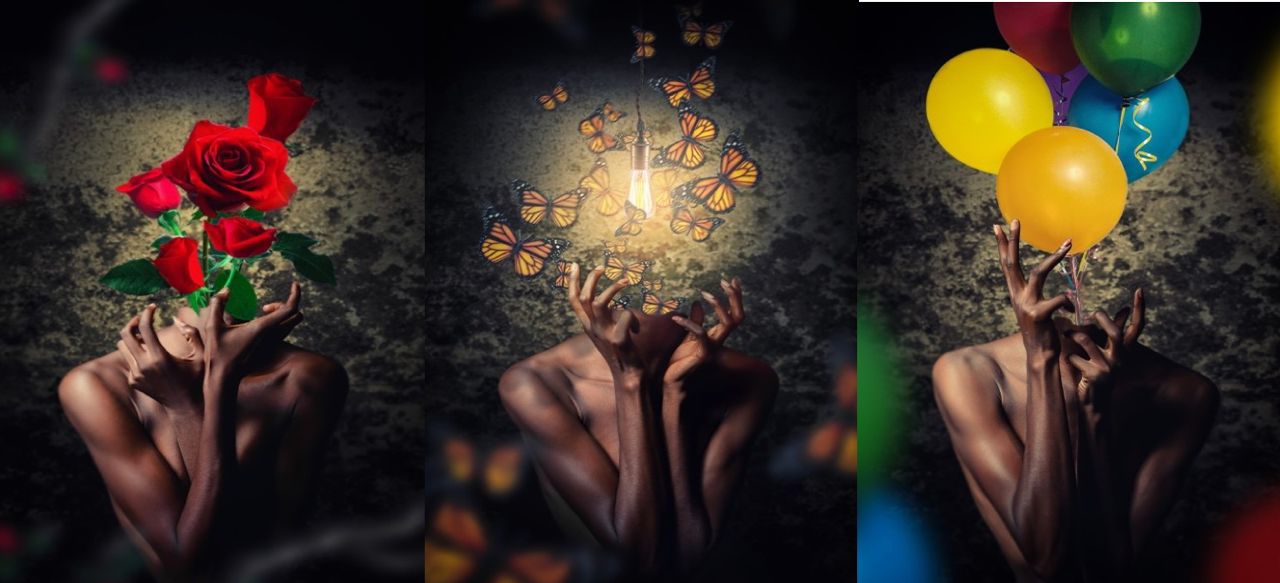
In Faceless, Adah Clarence Ugbede known professionally as Gottay offers more than a visual experiment. He offers an emotional dissection. A poetic protest against superficial intimacy. A quiet rebellion against the tyranny of the seen. In this series, he strips the human face from the frame and replaces it with metaphors of roses, butterflies and balloons. In doing so, Gottay invites us to see beyond features and expressions, to question what we truly love in others, and to confront what remains when appearance disappears. This is a conceptual performance anchored in raw emotion and symbolic force as each piece feels staged like a silent theatre of the soul where gesture, tension, and metaphor perform the role the face usually plays. Faceless is not about anonymity. It is about essence. What love sees when the world’s gaze is gone.
Act I: “The Thorns That Keep Us” The Rosehead Bloom
A black body, bare and gripping itself with haunting intimacyblooms into a bouquet of roses. Not arranged, not placed or grown. These roses are not held in the hands but they are the face. It’s a stunning inversion. Beauty is no longer worn like makeup, but rooted like truth. The arms rise as if in self-defence or worship and while it’s not conclusive if this person is holding the roses in place or holding on because of them, the ambiguity is deliberate. For Gottay, love is not just perfume and poetry. It’s scent and sting. Thorn and thrill. And yet, what emerges is not warning but reverence. It tells us when love hurts, it is not broken. It is honest.
Act II: “When the Light Came On” The Flutter of Becoming
The second act floats with butterflies, those clichés of innocence and rebirth become electric in the subject’s hands. The orange wings flicker like sparks around a suspended lightbulb, which hangs above the faceless figure like an idea or a prayer. It’s surreal, but not fantastical. It feels possible, like something that once happened in a dream you forgot to forget. The subject’s pose is similar to the first act but now it carries less weight. There is still tension in the hands, but now it’s wonder. The butterflies don’t land. They move. Constantly and that’s what makes them dangerous. Gottay’s visual art is clever. He knows the butterflies are not just beautiful but fleeting and so he gives them a stage and then reminds us they never stay. This is what infatuation looks like; lit up, lifted and gone before you can name it.
Act III: “The Weight of Air” The After laugh of Joy
The Balloons take the place of butterflies but Larger, louder, more deliberate. This is joy with sound, this is the kind of happiness that gets photographed at weddings and birthdays. But once again, the figure beneath is unmoved as the arms still rise, the body still clutches itself as if something is off. And that’s the point. The balloons are so bright they almost feel artificial. The strings look too thin to hold anything real and so you realize, this isn’t joy but a memory of joy. The performance of celebration. The kind of happiness you rehearse when people are watching, even when your hands tremble. Gottay doesn’t deflate the balloons. He doesn’t need to. We know how it ends in this final act which is the tragedy of optimism: how it floats, how it shines, and how it leaves you empty when it’s gone.
Faceless is more than a series, it is a philosophy rendered in flesh and metaphor. In removing the face which is our most expressive and performative feature, Gottay has done something radical: he has asked us to feel without being told how. He has asked us to see without the comfort of eyes and it works because what remains is truth which is Undistracted, unfiltered, and unforgeable. This body of work is a masterstroke of fine art photography which proves that vulnerability can be louder than speech, symbolism can be more precise than realism and sometimes the most honest thing you can show is what you choose to leave out. Gottay has not just created images. He has composed emotional landscapes and turned metaphor into skin, and silence into scripture.
Faceless is not just brilliant. It is necessary. It is a reminder that love, loss, wonder, and grief all live beneath the surface and the soul does not need a face to speak.

